



Learn how customer service operations help B2B teams manage workflows, SLAs, and customer communication at scale without losing visibility or control.
B2B customer service operations are fundamentally a coordination problem. According to Front’s Coordination Tax report, B2B companies spend nearly three hours coordinating for every one hour spent solving customer problems.
As customer work moves across teams, systems, and channels, the question isn’t whether you have the right people; it’s whether the system around them is built to keep contacts and ownership intact.
This article covers what effective customer service operations look like in B2B, where complexity tends to break them, and how high-performing teams build the processes that hold up at scale.
What are support operations in B2B customer service?
B2B customer service operations are the workflows, systems, and accountability structures that help teams handle complex customer work — consistently, at volume, across multiple stakeholders.
Luke Atkins, who runs internal enablement for Front’s support team, describes the function this way:
“Support operations means building the infrastructure around your support team so that they can actually do the support. As soon as you have that infrastructure in place, the job shifts, and it goes from being on the front lines reacting to tickets coming in, to actually thinking about other things.”
That infrastructure usually breaks down into four areas:
Workflow and queue management
Effective operations start with how incoming work gets handled. As customer requests arrive across email, live chat, and Slack, teams need clear processes for prioritization, routing, and load balancing. That means defining escalation paths and handoff workflows so that requests move to the right person without losing momentum or context.
Cross-functional coordination
In B2B customer service, most customer work doesn’t stay in one team. A billing and grief hold in finance. A compliance question routes to legal. A product issue involves engineering. Good customer operations management defines ownership at every stage and tracks issues through to resolution, so handoffs don’t become black holes. As Luke says, “Ownership ambiguity means nobody owns a decision, so every ticket becomes a scavenger hunt."
SLA and performance management
Service-level agreements (SLAs) hold teams accountable and make performance measurable. Common SLA targets include: first response time, first contact resolution, overall resolution times, and escalation paths and timelines.
Meeting them consistently requires organized workflows, balanced workloads, and clear accountability.
Hitting them isn’t the same as helping, though:
Luke says, "Your SLA dashboard may be green, but customers don’t care that you replied in three minutes if that reply doesn’t move them forward."
His alternative is to measure the first moment a customer can act rather than the first moment they hear back: "Relief isn’t the same as resolution. It’s the moment the customer stops feeling stuck."
Reporting and operational visibility
Operations teams use customer service analytics to diagnose problems and improve processes. Beyond ticket volume, metrics that matter are workflow bottlenecks, coordination failures, recurring escalation patterns, workload spikes, and inefficient handoffs.
With that visibility, you can fix systemic issues before they compound and gain the insights needed for more efficient customer support processes.
Why do customer service operations become complex in B2B environments?
Complexity in B2B isn’t a sign that something’s broken; it’s the baseline. Here’s what drives customer service challenges for B2B support staff.
1. Customer requests move across multiple teams
Unlike B2C, where interactions are typically self-contained, B2B support requires coordination among multiple internal stakeholders. When requests cross people and channels without a shared system, context fragments. That’s when delays and inconsistency start.
2. Conversations happen across disconnected systems
Without a unified customer service platform, information lives in silos: a Slack thread here, an email chain there, a CRM note somewhere else. Teams end up communicating with customers using incomplete information, which breaks consistency and erodes trust.
3. Ownership changes throughout the lifecycle of a request
B2B queries often pass through multiple stages and multiple owners. Each handoff creates a risk of delays, missed follow-ups, and unclear accountability. As teams grow without updating their workflows, those risks multiply.
4. High-volume environments increase coordination pressure
AI and automation help teams manage volume, but only when the underlying processes are sound. Front’s Coordination Tax report found that 93% of companies surveyed use AI in customer operations — yet 71% experienced significant AI-related issues in just the past three months. AI tools and automated workflows help teams manage high-ticket volumes, but only if they have the right operational foundation in place.
How strong customer service operations improve business performance
Well-run operations create better outcomes on both sides of the relationship:
Faster resolution without context loss: Organized handoffs mean customers don’t repeat themselves, and support requests move through the system faster — without dropping critical details along the way.
More predictable service performance: Strong operational workflows help teams meet SLA targets, balance workloads, and handle escalations consistently. Customers know what to expect.
Reduced operational drag across teams: Clear ownership, defined escalation paths, and routing make inter-team handoffs cleaner. Less time gets spent on coordination and overhead, more on actual customer work.
Stronger retention in high-touch B2B relationships: Reliable operations build the kind of trust that holds long-term accounts together. And with AI and customer data to identify problems early and offer proactive support to fix them before they affect customer satisfaction.
The role of AI in customer service operations today
AI has become a core component of how B2B teams manage operational load, but how you deploy it matters.
Automate routine customer work
AI agents can handle repetitive requests and automate key workflows like routing and escalation, freeing teams to focus on the interactions that actually require judgment.
Front Autopilot handles this by learning from historical context and your own playbooks. It’s built for the cross-team complexity of B2B customer support, with clear controls over what gets automated and what stays with your team.
Assist teams with complex issues
AI assistants help agents find relevant information, summarize long threads, and draft responses, without removing human judgment from the equation.
Front Copilot pulls customer context instantly and suggests appropriate responses. Your team reviews every suggestion before it goes out, keeping high-quality customer communication and accountability intact.
Analyze service quality and operational performance
AI tools can monitor every conversation for shifts in sentiment or satisfaction.
Front Smart CSAT automatically analyzes each interaction for satisfaction signals, while Smart QA reviews team performance across every conversation and flags where improvement is needed.
How leading B2B teams run customer service at scale
Centralize conversations and customer context
Use an omnichannel platform that gives teams a shared view across all channels. When a logistics manager emails about a delayed shipment that originally came in via Slack, the support team needs instant access to the full thread — not a fragmented history across three systems.
Build workflows around ownership and accountability
Accountability has to travel with the work. Create routing rules and escalation paths that ensure every request goes to the right person, and structure each handoff so context stays attached and ownership is always clear.
Track operational signals continuously
Real-time metrics reveal where the friction is building before it reaches the customer. A spike in escalations from a specific manufacturing account might signal an integration problem. With visibility, you can act before it becomes an SLA breach.
Bring visibility and accountability to customer operations with Front
Strong customer service operations create a better experience for customers and make it easier for your team to manage high-volume, high-context B2B work.
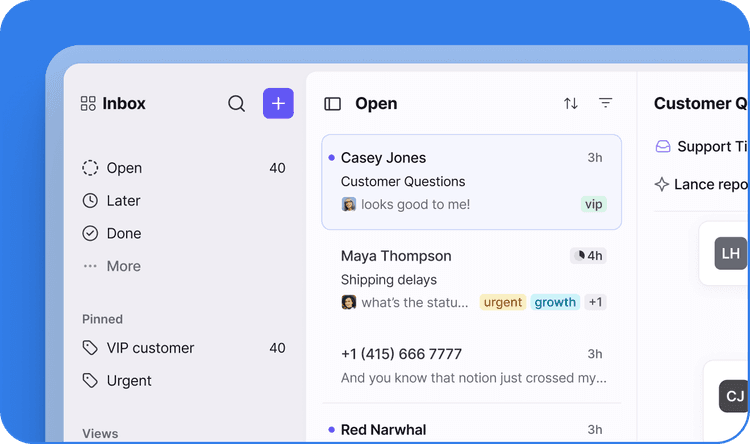
Front is the customer operations platform built for B2B teams where coordination matters. It centralizes customer communication into a shared system that keeps every team, tool, and conversation in sync. Download the 2026 Customer Operations Automation Field Guide to learn how to scale AI automation without sacrificing trust, quality, or control.
FAQ
What are some top companies for customer service operations?
Front is a strong choice for B2B customer service operations. Zendesk and Intercom are popular with B2C teams.
How do you communicate effectively with customers during delays or escalations?
The key is to be proactive. Keep customers informed and set clear expectations — so they never have to follow up asking for an update.
How does technology support customer service operations?
Customer operations platforms help teams coordinate conversations, ownership, and workflows across departments. Analytics and reporting tools drive visibility and continuous improvement. Knowledge bases give both customers and agents fast access to answers.