




Learn how B2B teams coordinate online customer service, stay in control of conversations, and scale workflows with visibility and accountability.
It’s 10 a.m. on a Tuesday, and your logistics team is already under water.
A high-value client emailed a priority change to a shipment. At the same time, the driver is messaging through your app about a roadblock, and the warehouse manager is looking for an update on a missed pickup. Right now, these conversations live in three separate systems. Miss one message, and a container sits idle — putting your service-level agreement (SLA) instantly at risk.
For support managers, this scenario isn’t a tough day at the office, but a typical Tuesday in B2B operations.
When customer service, operations, and account management teams work in silos, visibility disappears. Effective B2B service requires clear orchestration for every communication channel. Instead of juggling fragmented conversations across email, chatbots, and internal systems, teams need a way to bring those interactions into a single workflow.
That coordination is what defines online customer service at scale. Here’s how B2B teams can build repeatable, measurable processes to manage growing conversation volumes while delivering an even stronger customer experience.
Why online customer service matters for B2B operations
In B2B organizations, online customer service is what drives operational performance, not just customer satisfaction (CSAT) scores. Every incoming message — whether it arrives by email, SMS, live chat, or portal — is connected to multiple teams and workflows. When one message slips through the cracks, it slows response time and disrupts entire workflows.
Take manufacturing as an example: A missed order update, such as a part needed earlier than expected, can disrupt production schedules across the floor. Inventory sits unused on the warehouse floor, planners scramble to adjust timelines, and assembly lines stall. Meanwhile, shipments get delayed and customer relationships hang by a thread — all because a message didn’t reach the right person at the right time.
For financial organizations, a delayed compliance inquiry can trigger audit issues or fines. And in logistics, a missed dispatch message throws a whole route off schedule.
Across industries, poor visibility and uncoordinated responses lead to SLA breaches, longer handling times, and frustrated teams scrambling to catch up.
Effective online customer service brings all of this together by unifying multi-channel conversations across channels and giving every team member a clear view of what’s been requested and what’s been done. This cuts down on miscommunication and makes performance predictable for customers and the business alike.
Challenges in online customer service for complex B2B workflows
Managing online customer service in B2B operations comes with specific pain points. Every request can touch multiple teams, systems, and channels, making it easy for messages to slip through or for priorities to conflict.
If help centers and support teams don’t anticipate these challenges, the result is lower customer satisfaction and a weaker overall customer experience.
Multi-team handoffs can lead to lost context
When a customer inquiry passes through several teams, critical details often get lost along the way. For instance, a logistics team might miss an SLA because one agent assumed another had updated shipment details. In financial services, failing to track ownership of a regulatory inquiry could create compliance gaps and risk penalties.
Each handoff increases the chance that customer needs aren’t fully understood, which slows issue resolution.
Siloed tools or communication channels create inefficiencies
Too many support teams shuffle between communication platforms without a unified view of all touchpoints. If those channels are disconnected, agents may duplicate work or miss updates, leaving customers waiting for answers.
A knowledge base or self-service portal can help, but only when integrated into the workflow so teams and customers can resolve issues faster.
Limited visibility into workflow status slows issue resolution
Without real-time visibility into ongoing workflows, it’s hard to spot bottlenecks or breakdowns before they escalate. Overlapping assignments and unresolved compliance inquiries can go unnoticed, causing delays that ripple across the organization.
Even when individual departments are doing their job, the lack of coordination leaves requests unresolved and customer satisfaction suffering.
4 best practices for B2B online customer service
Strong B2B online customer service depends on clear processes that keep conversations moving smoothly, even when they span multiple teams and channels.
These four strategies help support teams improve online customer service and maintain visibility at every step.
1. Centralize conversations across channels
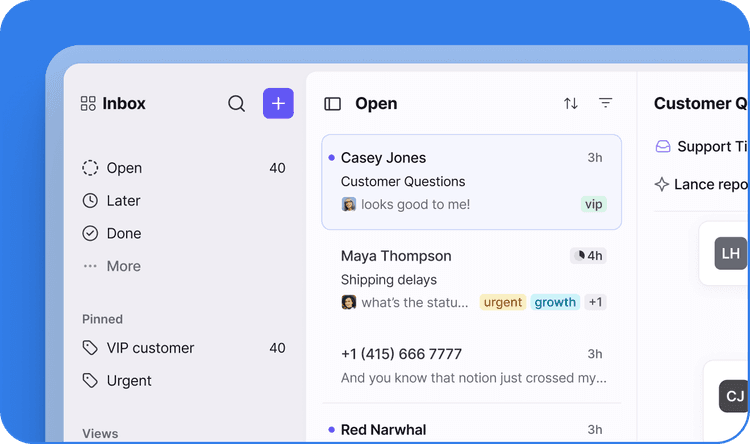
Email, live chat, and SMS inquiries often arrive on separate platforms, making it hard for teams to see the full picture. By bringing all conversations into one place, teams can see what each customer needs and respond faster.
AI can help by categorizing messages, flagging urgent requests, and suggesting responses — while human oversight keeps accuracy and accountability intact.
Example: A logistics company received hundreds of shipment inquiries every day, but emails and chatbot interactions lived on different platforms. After integrating these channels into the same workflow, agents could see inquiries in a shared workspace, allowing them to respond quicker and reduce SLA breaches by 20%.
2. Establish clear ownership and structured workflows
Assign every conversation and workflow stage to a specific team or person. In addition, define handoffs and escalation paths so everyone knows what to expect (and what’s expected of them).
Implementing structured workflows cuts down on confusion and keeps multi-team processes aligned, making it easier to track progress.
Example: At a financial services firm, compliance inquiries were scattered across channels, making it difficult to track ownership. After routing each inquiry to a clearly designated owner and implementing defined escalation rules, teams reduced response times by 35% and improved audit readiness, as every request was properly tracked and accounted for.
3. Automate routine conversations without losing oversight
Use automation to handle repetitive requests, such as tracking order status or providing standard account updates, while keeping humans in the loop for exceptions. This frees up online customer support teams to focus on higher-value work — like resolving billing disputes or onboarding new clients — while still maintaining service quality.
Example: At a manufacturing company, support agents were spending hours sending order confirmations and shipment updates manually, leaving little time for more complex customer requests. Once they automated these status updates, agents could monitor messages and step in only when exceptions occurred. This cut average handling time by 25% and kept satisfaction scores high, helping to cultivate long-term customer relationships.
4. Track KPIs to spot bottlenecks and improve performance
Monitor key performance indicators (KPIs), such as SLA compliance, backlog size, and resolution rate, to identify where teams are falling behind and where they can improve.
These insights show where workflows need adjustment and which processes can be automated or refined to deliver a better customer experience.
Example: At a B2B logistics provider, response times and SLA compliance varied widely across teams, causing delays during peak periods. By tracking these KPIs and reallocating workload based on traffic and volume data, teams were able to smooth operations, boost SLA adherence, and increase throughput — all without adding customer service staff.
How Front helps teams stay in control of every conversation
As B2B organizations grow, maintaining clarity and accountability across every customer conversation gets harder. Requests often move across multiple channels and teams before they’re resolved. Without the right structure in place, context disappears and response times suffer.
High-performing teams take a different approach to the online customer service experience. They keep interactions visible, assign clear ownership, and hold teams accountable as requests move between departments. With that level of coordination, organizations can manage higher ticket volumes without losing control or compromising CSAT.
That’s where Front really shines. Built for B2B complexity, Front keeps teams, tools, and conversations in sync so you can scale communications without losing visibility. Instead of chasing messages across disconnected systems, teams can coordinate responses and manage handoffs with confidence.
If you’re looking for practical ways to improve response quality and CSAT, sign up for Front and download the five support message templates. They provide ready-to-use responses that help teams share the right information, right when it’s needed.
FAQs
What metrics should B2B teams track to measure online customer service performance?
To scale B2B support, teams track operational metrics like: SLA compliance, response times, average handling time, total conversation volume, and CSAT scores. These metrics show where your organization is succeeding and highlight bottlenecks that may be slowing things down.
How do you prevent conversations from getting lost when multiple teams are involved?
Prevent conversations from getting lost by centralizing communication channels and assigning ownership for every task. By clearly defining workflows and handoffs, support teams know exactly who’s responsible for what and when to escalate a request.