



Learn when high-touch service makes sense vs. low-touch, and what it takes to stay personal as a B2B team scales.
It’s easy to deliver high-touch customer service in a small company with just a few clients. But as B2B companies grow, so does the complexity. Support teams have to manage more customer relationships involving multiple stakeholders and different communication channels, making personalized service difficult to maintain.
This article breaks down what high-touch customer service is, why it gets harder as you grow, and how to deliver it in B2B environments. We go beyond the conversations themselves and look at the operational foundation that makes high-touch service work at scale.
What is high-touch customer service, and how does it differ from low-touch?
High-touch customer service is a highly personalized service model, with frequent human interaction and a strong focus on relationship building. It begins with proactive onboarding support and continues through regular check-ins from dedicated account managers and customer success managers (CSMs).
For B2B companies, this type of customer service requires workflows that run smoothly across multiple teams and stakeholders. To make high-touch service work at scale, companies need efficient coordination, preserved context, and clear ownership at every stage.
The difference between high-touch vs. low-touch customer service comes down to complexity and human involvement:
High-touch involves human-led, high-context, multi-step interactions across teams. This approach is best for complex work on high-value customer relationships.
Low-touch relies on standardized, automated workflows using self-service portals. This approach works well for high volumes of simple, repetitive requests.
Examples of high-touch customer service in B2B
High-touch service isn’t just about good communication — it requires coordinated workflows across multiple teams. Here’s what that looks like in different industries.
Logistics
A logistics company delivers a high-touch onboarding experience for a new global shipping client. A dedicated implementation manager holds weekly meetings to cover systems integration and staff training. The support team coordinates with the operations, customer success, and integration teams to quickly respond to questions from warehouse managers, IT teams, and other stakeholders.
This hands-on onboarding lets the customer switch to the new system without disrupting order fulfillment.
Banking
A commercial bank offers ongoing high-touch customer service to an important corporate client. The bank assigns a relationship manager and a team of risk and compliance advisors to meet with the customer regularly and help with everything from working capital planning to regulatory changes. The support team is set up to handle requests from this client quickly and to escalate them efficiently when needed.
Manufacturing
A manufacturer supplying critical machinery to a customer responds to production line delays by pulling together support engineers, technical specialists, and high-touch CSMs. They keep the customer updated throughout and arrange emergency delivery of replacement parts as soon as they’re available.
By acting quickly and communicating proactively, the company minimizes disruption for the customer and preserves the relationship.
Why high-touch customer service is difficult to scale
Front’s Coordination Tax research found that the typical B2B company spends nearly three hours on coordination for every hour spent solving customer problems. When volumes increase, the coordination work behind every interaction multiplies rapidly.
High-touch service also involves more human touchpoints and multi-team collaboration, which compounds the challenge. Here are five common obstacles as companies try to scale.
1. Managing high-touch interactions across multiple stakeholders
As B2B companies grow, support teams have to manage more complexity. Our Coordination Tax report shows that mid-market B2B companies average 11 touchpoints per customer request, compared to eight touchpoints at smaller companies.
Without the right systems and workflows, teams struggle to keep stakeholders aligned across that many touchpoints and can’t achieve the level of personalization that high-touch service requires.
2. Maintaining consistency across interactions and accounts
As customer conversations escalate or move between teams, service quality and communication style naturally vary. But the gap widens when teams lack shared visibility into past interactions and important context gets lost. Customers end up with mixed messages and inconsistent results (and customer satisfaction ultimately suffers).
3. Coordinating onboarding and ongoing engagement at scale
A high-touch onboarding process requires tight coordination across the implementation, product, and support teams. But as companies try to scale to more customers, managing schedules and handoffs gets harder. The result: delayed onboarding, missed milestones, and slow product adoption.
4. Controlling costs as high-touch service requires dedicated resources
It’s expensive to maintain dedicated CSMs and implementation teams for high-value clients, especially as the customer base grows. Companies must find ways to deliver personalized service without constant hiring and escalating costs.
5. Preventing gaps between customer expectations and service delivery
As a company expands into different markets, launches new products, and acquires more customers, the distance between what customers expect and what support teams can realistically provide starts to show. The customer experience declines, and so do retention rates.
High-touch customer service doesn’t break because teams stop caring. It breaks when the company outgrows the systems holding that service model together.
What it takes to deliver high-touch customer service
To deliver high-touch service consistently, you need systems that preserve ownership, context, and continuity across every customer interaction. Here are five capabilities to build toward.
1. Visibility across accounts and interactions
High-touch B2B service only works when every team can see what’s happening across all customer touchpoints, ranging from support history, onboarding progress, product usage, to active conversations.
Use an omnichannel support platform to give your teams cross-channel visibility, enabling them to give proactive, personalized support.
Consider a logistics company: If the support team can see that a delay in the distribution center stems from an API issue in the customer’s inventory system — and the account manager sees the same thing — they can coordinate a unified response. Without that visibility, the teams work in silos and high-touch service breaks down.
2. Structured ownership across accounts
In complex B2B operations, unclear ownership leads to fragmented communication and inconsistent customer experience. Fix this by setting clear ownership rules: who’s accountable for the overall customer relationship, and who’s responsible as conversations move across teams. At every handoff, one person owns coordinating next steps.
3. Continuity across interactions and handoffs
B2B customer service involves long-term relationships where multiple teams engage with one customer over months or years. High-touch service breaks down quickly when knowledge isn’t carried forward. Interactions lack continuity, and customers feel the gap. Use a shared workspace to capture all customer information so teams can easily pick up where others left off and maintain a consistent experience.
Take a manufacturing company with a separate implementation team and a maintenance team. If maintenance doesn’t have access to what the implementation team did — custom configurations, known limitations, issues that came up during setup — they’re diagnosing problems from scratch. The customer repeats themselves and waits longer for answers. With continuity, handoffs are cleaner, and issues get resolved faster.
4. Workflow-driven execution and follow-through
High-touch customer service at scale requires strong workflows. If teams rely on manual processes and informal solutions, they quickly get overwhelmed as volumes increase and conversations spread across multiple channels.
Define clear processes for onboarding, escalations, and handoffs, and use a support platform that automates routing and other workflows to keep things moving. When the process is defined, teams don’t reinvent it — service becomes more predictable and easier to scale.
For example, a B2B software company uses a highly structured workflow for support interactions. Inquiries on its customer service app are automatically prioritized and routed to the right person by the support platform. The company pairs this automation with strong internal processes, which allows it to maintain high-touch support as volumes increase.
5. Centralized context
Every team needs one place to go for complete, current customer information. Consolidate emails, support tickets, and conversations from Slack and live chat into a single system. With that shared view, teams deliver consistent messaging and stop duplicating work.
High-touch customer service gets harder as you scale. Front is built for that reality.
High-touch service breaks when teams lose visibility, ownership, or context, and no amount of effort can compensate for those gaps. You need a system that keeps work aligned as it moves across teams.
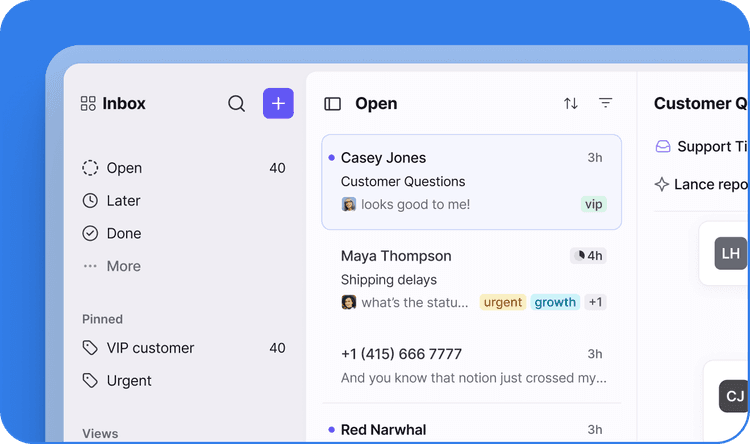
Front is the customer operations platform built for the complexity of B2B customer support. It gives teams shared visibility, preserves full context across conversations, and enforces clear ownership, so workflows run smoothly — without the manual coordination that bogs teams down. With Front, nothing slips through the cracks and your teams can offer high-touch service at scale.
Book a demo to see how Front enables high-touch workflows with full visibility and control, and explore the Coordination Tax report for a deeper look at how B2B teams manage complexity across accounts.
FAQ
How do you prioritize high-touch customer service across different account types?
Most companies offer high-touch service to complex accounts with high revenue potential or strategic importance. Lower-complexity accounts typically get self-service portals or knowledge bases instead.
What metrics should teams track for high-touch customer service performance?
Track response and resolution times to ensure operational efficiency, then track customer satisfaction, Net Promoter Score, and customer retention to measure the business impact.
How do you balance high-touch and low-touch customer service at the same time?
Define account tiers with different levels of service based on complexity and account value. High-touch accounts receive more personalized, human-led support backed by automation, while low-touch accounts rely heavily on standardized workflows and self-service options. This approach ensures every customer gets the right level of service without overextending your team.