



Explore customer personalization strategies that help B2B teams deliver more relevant customer experiences across conversations, channels, and handoffs.
In B2B relationships, customer personalization goes beyond individual interactions. Customers expect you to recognize them in any conversation across different channels and touchpoints. To do that consistently, you need the right systems and workflows that keep context visible as work gets shared between teams.
In this article, we’ll explore what customer personalization means in customer operations and why it becomes harder to maintain as you grow. We’ll also go through some reliable strategies you can use to make it work in practice at any size.
What customer personalization means in B2B operations
A personalized customer experience only works when you preserve customer context across handoffs, so teams can tailor conversations based on what they know about each account. That context might come from purchase history, lead capture, or past conversations.
Imagine a customer contacts you via live chat saying, “We’re seeing another permissions issue after yesterday’s update.” The system might identify this customer as a high-value, high-tier client that has had several issues and is showing signs of churn risk.
With strong systems, the person answering sees the full conversation history so they don’t need to ask what the customer means. Instead, they address both the customer’s previous issue and the recent update.
If the issue is serious enough that the support rep needs to escalate it to the product and engineering teams, the handoff should include that full context. This lets the customer continue the conversation with a new team without repeating information.
When the issue is resolved, the customer success manager follows up with an email or some other form of personalized communication to make sure the resolution was satisfactory. They might also personalize the response by user role: If the user is an engineer, managers could give highly technical details, but if it’s an executive, they skip the detail and focus on the business impact and resolution timescale.
The growing importance of personalized customer experiences
Personalization is everywhere in consumer businesses, and B2B customers now also expect a customized experience. Research shows that two-thirds of B2B customers expect the same or better personalization in their professional lives as in their personal lives.
Teams that give tailored responses based on customer needs and preferences reduce the need for repetitive exchanges. Customer interactions become more efficient, especially when customers must interact with multiple teams and touchpoints across the customer journey. The quality of your responses builds customer satisfaction and loyalty, leading to higher rates of retention.
Why personalization becomes harder to sustain at scale
The operational challenge for B2B customer support teams is that personalization becomes harder to maintain as companies grow.
Teams that give targeted responses based on customer needs and preferences reduce the need for repetitive exchanges. Customer interactions become more efficient, especially when customers must interact with multiple teams and touchpoints across the customer journey. The quality of your responses builds trust and drives customer satisfaction and retention.
Customer data spread across disconnected systems
Many growing B2B companies have a CRM with account information, a support platform that contains the ticket history, billing systems that hold the contract and SLA details, a customer success platform with important strategic notes, and more. Customer data is also spread across multiple communication channels, such as email, Slack, and live chat.
When information exists in silos, teams can’t give customers full answers or tailored recommendations. They give partial responses, and they don’t have access to the key context that would enable truly personalized customer service.
Teams operating without a shared view of the customer
As companies grow, teams often end up with different priorities. The support team aims to close tickets, customer success focuses on renewals, and so on. They don’t have a shared understanding of customer needs or a shared view of account health, so they give fragmented and inconsistent customer service.
Limited visibility into previous conversations
When teams lack an efficient customer messaging platform and are using outdated or disconnected tools, they can’t easily access a customer’s conversation history. It may be spread among different channels or held in one system that’s not easy to search.
Customers get frustrated if they need to repeat information they’ve already given, and although individual team members know how to personalize the customer experience, they don’t have the right tools or processes to do it effectively at scale.
Conversation continuity breaks down at high volume
As companies scale, workflows and systems can’t always keep up. The informal processes that worked at a smaller scale tend to break down under higher volume. And personalization is impossible to maintain when teams no longer have a shared view of the customer across conversations and channels.
5 strategies for personalizing the customer experience
To overcome these problems and deliver personalization that holds up as you grow, you need to organize customer operations around shared context and connected conversations. Here are five strategies to help you maintain a truly personalized customer experience as operations scale.
Centralize customer conversations across channels
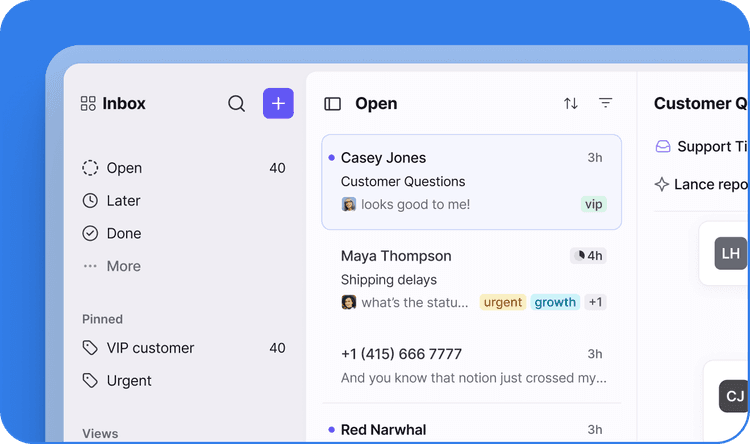
Use a modern customer support platform to bring every customer conversation into a single shared workspace, whether it takes place via email, Slack, live chat, or another channel.
When all relevant customer information exists in one place, teams can personalize each interaction by referring back to previous conversations. As work moves across channels and teams, everyone stays in the same tool — and the context moves with it.
Use customer context to personalize communication
Encourage your team to spend time reviewing customer context so that they can tailor conversations instead of giving generic responses. Relevant context includes:
Previous support tickets
Product adoption and usage
Account health and service tier
Renewal status and churn risk
Communication preferences
Customer needs and priorities
When you use all of this data, you give more relevant responses and boost customer engagement.
Align teams around a shared customer view
Organize customer work around a shared workspace where all the teams working on customer issues can see the same information, updated in real time.
When teams work from shared information, they get better insights and can deliver more personalized, relevant answers. The transparency leads to clear ownership, no duplicate work,and no gaps in what the customer has already shared.
Use automation and AI to scale personalization
Bring AI in as a support tool to help your teams find context faster, summarize issues, and draft responses. AI-powered tools can also automate routing and identify recurring issues so teams can spend more time on personalized customer communication.
Don’t use AI to replace the personal touch and deliver personalization as a service. Instead, use it to help your teams manage rising volumes and deliver better customer personalization. Keep humans in the loop on complex issues, and review automated responses regularly.
Track personalization performance across conversations and channels
Use customer data and analytics to measure whether personalization efforts are working. Here are some of the customer experience metrics to track:
Response and resolution times
First contact resolution (FCR)
Customer satisfaction (CSAT)
Net promoter score (NPS)
Customer retention and renewal rates
Escalation frequency
Analyze the metrics to identify areas where you can improve. For example, if you have fast response times but low first-contact resolution, it’s a sign that your tailored solutions aren’t successfully resolving customer issues. Make sure teams have access to customer context across all interactions so personalization works effectively.
Bring customer personalization into every conversation with Front
As B2B companies grow and conversations span multiple teams and channels, customer personalization becomes harder to maintain. Manual processes no longer work, and teams need a platform built to keep every team, tool, and conversation in sync.
Front is the customer operations platform built for this kind of complexity. It gives B2B teams the shared workspace, integrations, and context they need to keep service consistent as they grow.
With a single shared workspace, Front brings together fragmented context and gives every team full visibility. Its collaboration tools create clear ownership, reducing siloed teams and preventing poor handoffs. Meanwhile, its deep integrations bring real-time customer data into every conversation, making personalized service an operational reality.
Request a demo to explore how Front keeps conversations and context connected so that teams can maintain personalization across every interaction.
Frequently asked questions
How do customer profiles support personalization?
Customer profiles give your teams an overview of the account history, customer needs and preferences, and relationship history. These insights help them respond to each customer based on what they actually know, not what they assume.
What is the difference between personalization and customization?
Personalization is when the company adapts experiences based on customer behavior and context. Customization is when the customer chooses preferences or settings themselves.
How does personalization improve the customer experience?
Personalization improves the customer experience by making every interaction relevant and efficient. It helps your team:
Avoid making customers repeat themselves across channels
Solve problems faster by using insights from past interactions
Provide helpful recommendations before the customer even asks
Keep the experience consistent, no matter how they reach out