


Compare the top 5 customer messaging platforms for B2B teams in 2026, and see where AI helps you scale without losing the personal touch.
78% of customers are more loyal to brands when they trust the customer service. It’s a staggering insight. That level of loyalty comes from consistency, not just a few great moments.
Trust is built across every handoff and every channel the conversation passes through. When messaging shifts between channels, even small breaks — like a customer having to repeat context — can quietly erode confidence.
In B2B environments, the customer messaging platform determines whether those conversations stay connected or fall apart. The right platform centralizes messaging in a unified inbox, keeping conversations consistent across omnichannel channels and making it easier to manage support at scale.
This guide covers what a customer messaging platform is, how AI fits in, and how to choose the option that fits how your team operates.
Quick comparison of the best customer messaging platforms
Before diving deeper, here’s a high-level overview of the key tools, their standout features, and the best team fit.
Each platform has a different focus, so there’s no universal “best” option — only better fits for specific ways of working. The sections below break each tool down so you can evaluate them based on how your team actually operates.
What is a customer messaging platform?
A customer messaging platform centralizes conversations across channels, such as email or SMS, into a single workspace. It preserves full conversation history and context, giving teams shared visibility into every interaction.
These platforms also establish a clear structure by clarifying ownership and coordinating handoffs between team members. This way, critical details don’t get lost as conversations move across channels or people.
As a result, the customer experience depends less on which team member responds next and more on context continuity. That continuity is one of the clearest signs a platform is working as intended.
Benefits of using a customer messaging platform
It’s a familiar situation. A customer emails one request, then switches to live chat and adds new details. The picture changes mid-conversation, and the response already in progress no longer fits.
A customer messaging platform brings order to that kind of fragmentation — and in many cases, eliminates it entirely by keeping conversations connected across channels. Here’s how that plays out in practice.
Faster response times across every channel
Many teams assume that faster replies require hiring more people. Not quite. Shared context and smart routing play a huge part in speeding things up.
When every team member can see the full conversation history, they spend less time chasing updates and repeating work. That visibility makes it easier to resolve issues quickly — or pass them on to the right person.
When your messaging platform holds all that context and adds routing and workflow automation to the mix, it can route the issue to the right expert instantly without handoff chaos. That offers faster resolution than any new hire can.
Clear, consistent service across teams
Customers set expectations based on past experiences. If a question raised at 9 AM is usually resolved by noon, a response that stretches out for days will stand out.
Delays like that are often traced back to missing context. When context doesn’t travel with the conversation, customer reps are left piecing things together from fragmented threads and isolated notes. It’s slow, and the inconsistency shows.
But when context remains intact, that friction disappears. Conversations pick up where they left off, and handoffs happen without disruption.
Better team coordination on complex requests
B2C conversations are often quick and transactional. B2B conversations aren’t — they span multiple touchpoints, stakeholders, and decisions over time. A basic shared inbox wasn’t built for that.
Teams need to move in sync across all layers of a conversation. That requires clear ownership and real collaboration. Features like assignments, internal comments, and collision detection keep teams aligned, so conversations move forward without overlap or confusion.
Full visibility into team performance and customer satisfaction
A customer messaging platform doesn’t just unify conversations — it provides clear visibility into how customer support is performing.
Metrics like response times, resolution rates, customer satisfaction scores, and average handle times are all readily available within the interface. That makes it easier to track speed and accuracy across channels and gives leaders the signals they need to spot issues and take action quickly.
How AI fits into a customer messaging platform
For many B2B teams, AI is no longer optional. It’s part of staying competitive. The real question is where AI fits and who stays in control.
Used well, AI can speed up messaging and customer support. Used poorly, it creates problems faster than teams can resolve them — and puts the customer relationship at risk.
When evaluating platforms, look for the three As: automate, assist, and analyze. Each should improve efficiency across conversations without removing human oversight.
In the end, it comes down to control. Does the platform let teams decide where AI supports the workflow, or does it default to a bot-first setup?
The top 5 customer messaging platforms for 2026
The feature fallacy is real. Assuming more features equal a better messaging experience overlooks whether your team actually needs them. And most of the time, you’ll pay more to access those features you don’t utilize.
That’s why this list of messaging platform examples focuses on the features that each platform excels at, helping you find the best match for how your team communicates with customers.
1. Front
More than 9,000 businesses, including Uber Freight and Zoom, use Front to keep every conversation in sync.
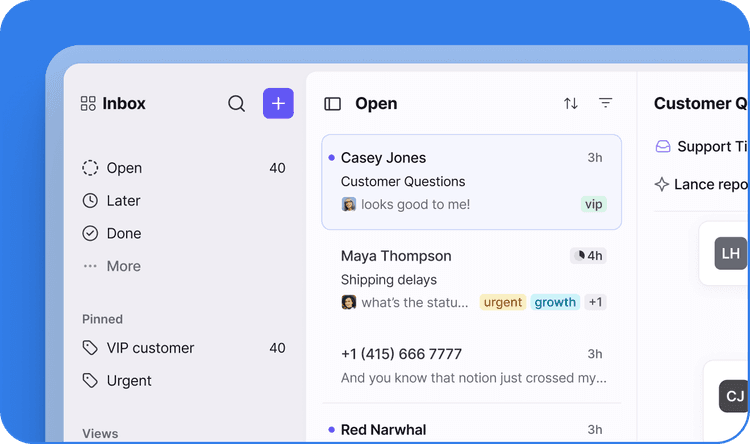
Designed for scaling B2B customer support teams, Front combines a shared and collaborative inbox, so messaging stays aligned across teams. Context carries through every handoff.
Here’s what you can do with Front:
Create assignments to make ownership and accountability explicit.
Use real-time collision detection to prevent duplicate replies and shared drafted content.
Leave and read internal comments to keep context inside a single thread and simplify collaboration.
Support high-stakes conversations with AI Copilot’s draft responses and Autopilot’s end-to-end routine conversation resolutions.
2. Zendesk
Zendesk is an enterprise messaging and customer service platform built around ticket-first workflows. As a legacy tool, it offers a broad ecosystem and is widely adopted by various industries, from startups to government organizations.
What Zendesk enables:
Zendesk supports omnichannel conversations across web, mobile, and social platforms.
AI agents and customer reps deliver personalized service within a unified workspace.
Customers and employees receive instant support when needed.
3. Hiver
Hiver helps teams manage email, chat, voice, and Slack instant messaging for businesses. Its key differentiator is a Gmail-first design, making it a strong fit for teams that prefer familiar, email-style messaging.
Hiver’s customer messaging capabilities include the following:
Hiver provides an omnichannel workspace where every conversation is visible with full context.
AI Copilot can summarize conversations and suggest replies to speed up customer support.
Real-time alerts help teams track and meet service-level agreements (SLAs).
4. Help Scout
Help Scout functions more as a shared inbox than as a full-fledged omnichannel messaging platform. For teams offering email-heavy customer support, its clean interface and simplicity reduce complexity in day-to-day conversation management.
What Help Scout enables:
Shared inboxes support organized threads, simple tagging, and built-in visibility to keep basic collaboration straightforward.
A built-in knowledge base, combined with Beacon, allows customers to find answers on their own or easily reach the support team when needed.
5. Crisp
Crisp is a customer messaging platform built primarily for chat-first conversations. Similar to other tools on the list, Crisp’s main value comes from an omnichannel inbox that brings together customer interactions and helps teams manage support through unified customer profiles.
What Crisp enables:
Crisp centralizes conversations across channels in a single inbox, keeping customer support organized and easy to manage.
Third-party integrations support automation, content management, customer relationship management, marketing, teamwork, and more.
AI-suggested replies that align with the team’s tone of voice can speed up messaging responses.
How to choose the best customer messaging platform
At this stage, most customer messaging tools look similar on the surface. What actually matters now is fit: how channels connect, how many teams share the same customer, whether you’re trying to reduce volume or strengthen relationships, and how far your team wants to lean into automation.
Before making a decision, it helps to align internally on a few key questions:
Where do customers actually reach out across different channels?
How many teams touch the same account or conversation?
Which interactions are routine, and which require deeper context?
Is the goal primarily reducing inbound volume, or managing more complex conversations end-to-end?
Remember that success in complex B2B relationships depends on context carrying across interactions and clear ownership throughout the customer journey.
Keep every customer conversation in sync with Front
Most platforms manage messaging. Fewer handle the coordination behind them.
Front is designed as an operational layer for B2B customer support, where multiple teams and workflows intersect. It helps teams assign ownership clearly, coordinate across functions, and keep every conversation connected.
The result is faster, more accurate responses — and a team that stays confidently in control.
Ready to see how Front supports customer messaging? Try it with your team today.