


Compare retention automation platforms for B2B teams. Learn what they do, explore key features, and compare best-fit platforms for different workflows.
Every customer touchpoint creates value — but it also creates another opportunity for things to slip through the cracks. Onboarding, engagement, renewals, support, and day-to-day communication each add another workflow to manage and another handoff that can break down.
The coordination adds up fast. Front’s research found that for every hour teams spend solving customer problems, they spend roughly three hours coordinating internally. As coordination consumes more time, less attention is available for customers, and service quality becomes harder to maintain consistently.
That’s the gap retention automation platforms are built to close, pulling the moving parts together so relationships don’t erode between touchpoints. Here’s what these platforms do, how they strengthen long-term customer relationships, and which ones are the best fit for different B2B retention workflows.
What is a retention automation platform?
A retention automation platform is software that uses behavioral data and pre-set rules to manage onboarding, customer communication and engagement, and retention workflows across different stages of the customer journey.
A manufacturer, for example, can use one of these platforms to catch when a customer’s usage drops or a renewal is coming — the platform automatically triggers account-manager outreach and renewal reminders to keep retention on track.
The trick is choosing one that fits your existing operations. Some lean into lifecycle automation and engagement; others prioritize onboarding, feedback monitoring, or customer communication workflows.
How retention automation supports customer relationships
Here are three ways automation earns its keep in a customer retention program.
Personalize onboarding based on customer behavior
With retention automation in place, data collection and analysis run continuously — so onboarding adapts to each customer instead of following the same script for everyone.
Automated workflows track user behavior and trigger tailored tutorials or in-app notifications based on actions a user has (or hasn’t) taken.
Say a customer skips a key onboarding step, like activating user segments. The platform catches the miss and triggers a targeted product tour or checklist to get them moving again. A delay that once added days to time-to-value turns into a few clicks the customer handles themselves.
Catch at-risk relationships before they churn
Customer retention analytics surface early warning signs at the individual level: slipping response times, threads going unanswered. Once the signal is visible, shared context lets teams act on that specific relationship before that risk turns into an actual loss.
If a customer files noticeably more support tickets this quarter, the platform can assign a real-time churn risk score. From there, your team can prioritize outreach to find out what’s going wrong — or let the platform trigger an intervention workflow that gets them help automatically.
Surface the bottlenecks and escalation trends hiding in the data
Because these platforms continuously analyze customer interactions, friction that would otherwise stay buried gets flagged. Support-ticket clustering, session analytics, time-to-resolution tracking, and sentiment analysis add up to a clear read on where things break down with the historical context and drop-off points you need to fix the cause.
Features to look for in a retention automation platform
On the surface, most B2B customer retention platforms offer similar engagement and automation workflows. What separates them is how well they handle visibility, coordination, segmentation, and the operational work that spans teams. Four areas are worth pressure-testing before you buy.
1. Workflow automation and cross-functional coordination
Customer success, support, product, and operations all end up acting on the same signals. Automating retention workflows (even partially) is what keeps those actions consistent and connected instead of duplicated or dropped.
Look for configurable workflows, task routing, triggers, and handoffs that move work across teams. When automation is scattered across disconnected tools, coordination gets hard to see, let alone enforce.
2. Shared customer context across teams
Without shared context, retention calls are made based on incomplete or stale information. The platforms worth your time centralize customer records, conversations, tasks, and operational updates in one workspace every relevant team can reach.
Consolidating data isn’t free — it takes time and money, and that upfront cost scares some teams off. But fragmented context has its own bill: hours lost hunting for information and redoing work someone already did. That tab usually runs higher than consolidation ever would.
3. Reporting and visibility across customer operations
High customer retention rates don’t come from performance dashboards alone. They come from seeing how customer-facing work actually moves through the organization.
The best platforms report on more than outcomes. They surface operational bottlenecks and continuity gaps, pulling workflows and team actions into a single view where you can track process health and coordination. Thin visibility leaves teams guessing in the moments where speed and accuracy matter most.
4. AI assistance with human oversight
As work gets more complex, AI can process information and handle routine operational tasks without piling on overhead.
Most retention automation platforms now offer AI-generated recommendations, summaries, workflow suggestions, and data enrichment while keeping humans in control of decisions and approvals.
AI’s role keeps growing, but human oversight is still what protects accuracy and accountability. If AI capabilities operate separately from human input, teams face limited transparency into how outputs are generated and have fewer controls for validating actions before execution.
5 retention automation platforms for B2B teams
These five platforms support retention automation, either directly or indirectly. Rather than a strict ranking, this selection reflects operational fit — highlighting the workflows each platform enables and the tradeoffs that come with using it.
1. Front: Best for customer communication and support retention
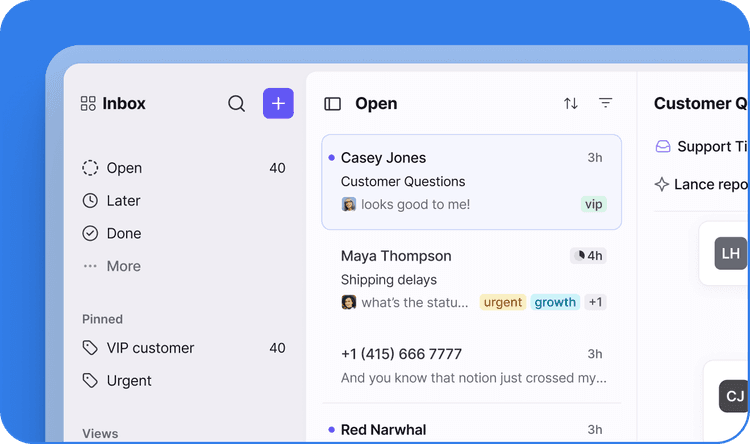
Front is a customer operations platform designed for the complex, high-stakes reality of B2B customer relationships. While it isn’t directly a retention automation platform, it supports retention by keeping teams and customer conversations in sync across different departments and workflows.
Front’s primary strength is operational coordination, where every team gets shared visibility into customer communications and ownership. Organizations looking for campaign-based lifecycle automation may find it less specialized, but it’s a great fit for B2B teams where responsiveness and cross-functional collaboration directly affect retention.
2. Gainsight: Best for enterprise retention playbooks
Gainsight is often part of the conversation when retention is an enterprise-level process. Built for enterprise customer success teams, it helps organizations standardize retention workflows through structured playbooks and health scores.
Gainsight’s strength lies in consistency at scale, but the tradeoff is complexity. Teams often need significant time and resources to implement and maintain it effectively. It’s best suited for large organizations with mature customer success operations and established churn management.
3. Userpilot: Best for onboarding and product adoption
Userpilot focuses on in-app experiences that support customer onboarding, feature adoption, and self-serve user guidance. Its operational strength comes from building and managing product-led retention workflows directly within the application experience.
However, its visibility is largely centered around product interactions rather than broader cross-functional customer operations. For SaaS companies where product adoption is a primary component of retention strategy, Userpilot is a great fit.
4. HubSpot: Best for marketing and lifecycle automation
HubSpot is a legacy customer platform that approaches retention from a lifecycle perspective, connecting customer data and automation inside a shared customer relationship management (CRM) environment.
HubSpot is powerful because it brings different lifecycle stages (from sales to marketing) in one operational system. On the other hand, retention processes are often managed through broader automation capabilities rather than customer-success-specific workflows.
It’s a great fit for teams that want retention efforts closely tied to revenue operations and lifecycle management.
5. Fin: Best for omnichannel customer engagement
Fin (formerly Intercom) is a customer communication and engagement platform designed to manage conversations across chat, email, messaging, and self-service channels. It mainly serves enterprise customers who need real-time conversational messaging through multiple touchpoints while maintaining continuity.
Since Fin’s forte is engagement and customer support interactions, teams that need comprehensive retention operations might find it limited. Teams with omnichannel engagement priority, however, will find it a great fit.
How Front improves retention by fixing what automation can’t
Retention automation can schedule and trigger the touchpoints, but it can’t coordinate the context and ownership behind them. No amount of good timing saves a relationship when the teams behind it aren’t in sync.
Front closes this coordination gap. It keeps teams and customer context aligned so information carries cleanly from onboarding through account management, and no one has to reconstruct the story at each handoff. Automation and coordination aren’t opposing bets, either: Front complements human coordination with Autopilot, intelligent routing, and service-level agreement enforcement, helping teams stay aligned without replacing human judgment.
Download the Coordination Tax Report to see why coordination plus automation wins retention as you scale.