



Looking for the best SLA monitoring tools? Compare leading platforms, key features, and what B2B teams should evaluate before choosing.
For customer-facing operations teams, especially in complex B2B environments, service-level agreement (SLA) management often feels like a lose-lose: monitor every commitment by hand, or risk breaches that erode customer trust.
SLA monitoring tools remove that tension. They track performance against your commitments and flag potential breaches early, giving teams visibility without piling on more work.
This article sorts the leading tools by the operational need they’re built for. Here’s a quick overview.
What is SLA monitoring?
SLA monitoring is how teams catch a service-level breach before it happens. It tracks the performance metrics that matter — first response time, average resolution time, escalation handling, first-contact resolution, and uptime.
It’s a staple of IT service management, but it belongs in customer operations just as much. Support, success, and operations teams all lean on SLAs to deliver reliable service.
Why SLA monitoring matters for B2B teams
As your customer base grows, so does the difficulty of hitting your SLAs. Requests come in across multiple teams, and without operational visibility, commitments start to slip.
Yet only 25% of B2B companies routinely track SLA compliance. The fallout is predictable: more escalations, more breaches, and exposure to penalties or canceled contracts.
If you put SLA monitoring at the center of your operations, every teammate is held accountable as the workload scales.
What B2B teams look for in an SLA monitoring tool
A dashboard doesn’t offer much without visibility into ownership and communication history. Here’s what separates a real SLA monitoring tool from just a chart.
1. Real-time alerting and breach prevention
Alerting and breach prevention work as one proactive system that watches ticket lifecycles continuously. Alerts flag SLA thresholds as they approach, while breach prevention rules trigger corrective actions or escalations before a formal breach or outage lands.
That shifts you from cleaning up after the fact to protecting service reliability in the moment. Instead of finding missed SLAs in a retroactive report, teams catch the risk early and step in before customers notice anything.
2. Automated escalation workflows
When response and resolution times stall, these workflows automatically route tickets to senior human representatives or specialized queues.
That takes the guesswork out of escalations. The system runs the process on predefined rules, like timing, customer tier, complexity, so your team can focus on solving the problem rather than tracking it.
3. Performance reporting and SLA analytics
Reporting and analytics tie the monitoring pieces together. They consolidate performance data to surface historical trends and expose the patterns behind breaches, turning raw metrics into something you can act on.
Many tools also keep raw data and compliance records in one place, which makes verifying uptime guarantees or service credits with leadership or customers far less painful.
4. Conversation context and account visibility
Automated tags and ticket summaries rarely capture why a customer is really struggling. The real insight lives inside the conversations and the account history.
Context pulls sentiment and intent together across channels; account history shows every past interaction, resolution path, and owner. Together, they give teams the full picture they need to honor account-specific SLAs and prioritize the conversations that carry the most risk.
5. Multi-channel coverage
A disconnected SLA monitoring system creates blind spots, especially when customers use multiple channels to get help.
Multi-channel coverage tracks commitments, response times, availability, and resolution quality accurately across every platform. With that consolidated view, teams see the whole customer journey and stop losing commitments in the gaps between tools.
The 6 best SLA monitoring tools for B2B customer ops teams
To help you find the best fit, we’ve organized the six leading tools by what they’re built to support, from observability and infrastructure to ITSM and customer support systems.
Customer operations platforms with SLA management capabilities
SLA success hinges on customer operations preventing deadlines from turning into risks, whether the risk is a delayed response or incomplete resolution. The tools below bring all communication into one platform and automate response time rules to minimize manual intervention.
1. Front
Most tools specialize in either SLA tracking or workflow complexity. Front does both.
It’s a customer operations platform built for B2B environments where SLA accountability depends on cross-team coordination and clear ownership.
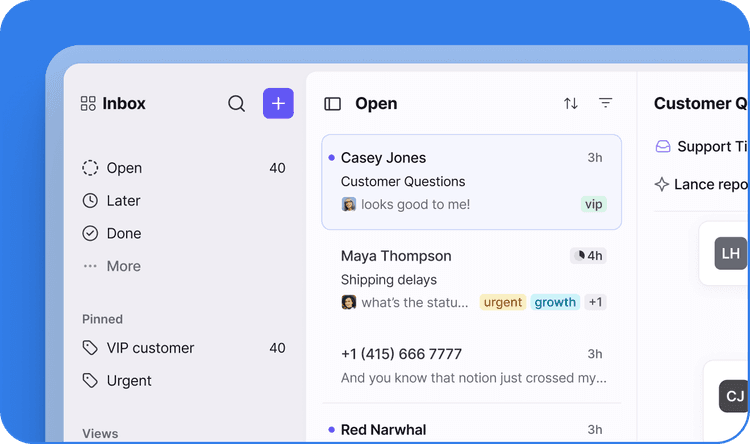
Rather than focusing on infrastructure observability, Front centralizes conversations and workflows in a shared inbox so teams can track deadlines, prevent bottlenecks, and resolve issues without losing context.
Best fit: B2B support and operations teams managing high-volume, multi-team customer communications
Limitation: Less optimized for single-team, non-collaborative support
2. Zendesk
Zendesk is an AI-powered customer service platform specializing in ticket-first workflows. SLA management is built into the ticketing process, assigning response and resolution times based on priority. The platform performs well in reporting-heavy, high-volume environments where every query becomes a ticket with a predefined status.
Best fit: Support teams that operate in isolated, tiered workflows
Limitation: Limited flexibility for cross-functional collaboration, as the SLA management system is tied to Zendesk’s ticketing platform
Service management and enterprise workflow platforms
Enterprise B2B teams serve hundreds of customers a day, so they need platforms that automate as much SLA monitoring as possible, from real-time dashboards to account-based auditing.
The tools in this group apply automation throughout the SLA management process.
3. ServiceNow
ServiceNow is an enterprise workflow platform that replaces manual or spreadsheet-based tasks with intelligent digital processes. It reduces the risk of breaches by automating timers, pausing conditions for “on hold” tickets, triggering workflows at key SLA milestones, and integrating visual dashboards.
Best fit: Teams that need better visibility into enterprise SLA records
Limitation: Less intuitive for collaborative customer communications and shared inbox workflows
4. Jira Service Management
Jira Service Management by Atlassian combines Jira’s task management capability with service management features. It helps teams manage ticketing and incidents while automating workflows. Color-coding and customizable work-hour calendars make SLA requirements easy to see.
It integrates easily with other Atlassian tools (including Confluence) and also connects with Front. Teams can create and manage Jira issues directly from customer conversations and escalate when necessary.
Best fit: IT teams looking to simplify request intake and visualize SLA performance
Limitation: Less suitable for enterprises with complex SLA structures because SLA goals are capped and historical recalculation is limited
Observability and infrastructure monitoring platforms
These platforms catch performance degradation before it affects end users. When fulfillment or processing times exceed normal thresholds, monitoring tools alert teams and observability platforms trace the root cause across integrated systems.
The following tools offer these capabilities.
5. Datadog
Datadog is an AI-powered observability and security platform for visualizing large numbers of data points in a dashboard. Its application performance monitoring (APM) provides AI-driven code-level distributed tracing across mobile and web applications.
By mapping contract commitments to service-level objectives (SLOs), Datadog translates data from remote sources into actionable insights. The platform closely monitors SLA compliance and flags breaches through status views.
Best fit: Engineering teams practicing “monitoring as code” to avoid breach fatigue
Limitation: Higher cost due to log and monitor caps
6. New Relic
New Relic monitors real-time performance of apps, servers, and infrastructure. By installing lightweight agents, it tracks metrics and errors to quickly identify bottlenecks.
For SLA monitoring, New Relic provides account-wide uptime traffic. Its APM tools check availability every 30 seconds, and teams can generate downloadable SLA reports daily, weekly, or monthly. Custom threshold alerts detect SLA breaches as soon as they happen.
Best fit: Engineering teams managing complex, full-stack, distributed microservices
Limitation: Limited query capabilities within the service-level management suite
Keep every SLA on track with Front
Choosing an SLA monitoring tool is the beginning; the real work starts when you have to establish clear ownership and coordination between teams.
Front keeps accountability tied to the work itself, so teams stay aligned as requests move through workflows. Request a demo to see how Front supports SLA management across complex customer operations.
FAQ
What metrics should teams track alongside SLA compliance?
Track response time, resolution time, backlog size, breach rate, customer satisfaction, and workload distribution for a complete SLA compliance picture.
Can SLA reporting identify operational bottlenecks?
Yes. SLA reporting highlights recurring delays and process gaps behind missed commitments.
What is the difference between SLA monitoring and SLA workflow management?
The difference comes down to what SLA management is meant to do: Monitoring tracks performance, while workflow management keeps work moving through clear ownership and automation.