

Customer support ticketing system
Fast, professional responses are a baseline expectation and a tone setter for B2B customer service. But, chaotic workflows and manual sorting get in the way of smooth operations. Enter customer support ticketing systems.
What is a customer support ticketing system?
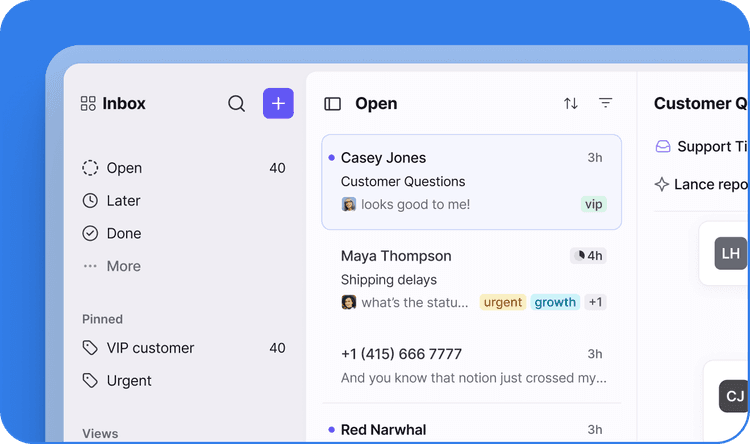
Customer support ticketing systems organize customer requests and make it easier for support teams to manage tickets. With support and help desk software, tickets don’t get lost in the noise of crowded communication channels, and support gets a centralized command center for tracking, prioritizing, and resolving every new ticket.
How does a ticketing system work?
Support ticket systems typically follow these steps:
- Capture customer inquiries and requests from omnichannel sources, including email threads, web forms, or customer portals.
- Convert inquiries into tickets with an ID number and relevant information, like issue description and customer contact information.
- Categorize and set priority levels.
- Assign tickets, routing them to the appropriate department and support rep.
- Loop in other parties if necessary via ticketing tools, like internal notes and mentions.
- Add status tracking for real-time visibility.
- Close the ticket and communicate the resolution to the customer.
Beyond this basic workflow, many ticket management systems also have automation tools for leaner, faster support teams. Automating routine tasks like ticket routing and follow-up reminders save time and effort so support teams have more bandwidth to solve high-value problems.
For SaaS companies, one of the key benefits of customer service ticket systems is service-level agreement (SLA) tracking capabilities. By defining SLA standards like response times and availability, the software automatically tracks compliance with those standards and notifies stakeholders of missed targets.
Ticket management software typically also comes with reporting analytics and data insights on key metrics, like resolution time and customer satisfaction. This lets teams identify trends and spot bottlenecks for continuous improvement.
Ticketing systems vs. customer operations platforms
Ticketing systems and customer operations platforms share some of the same features, but they’re designed for different approaches to customer support. Here’s what sets them apart:
- AI functionality: Customer operations platforms come with AI agents that go beyond canned responses to FAQs, handling complex tasks like quote requests and service scheduling that traditional ticketing systems don’t have the architecture for.
- Customer relationships: Ticketing systems help teams process requests efficiently at scale. Customer operations platforms build on that foundation by adding shared context, cross-team coordination, and more natural conversations, enabling teams to deliver personalized, human interactions that make customers feel like individuals rather than transactions.
- Workflow design: While ticketing software can easily manage routine tasks, customer operations platforms support sophisticated, multi-stakeholder workflows like cross-team escalations and coordination. Automation takes care of basic tasks, and support stays in control of decisions that require human oversight.
- Collaboration: Ticketing systems are typically designed for a single dedicated support team. Customer operations platforms provide a centralized environment for both individual and shared work, enabling internal coordination without constantly switching software tools or resyncing after context gets lost.
Other resources
- Customer support ticket
Learn what a customer support ticket is, how they work and the most common types, and why they matter for B2B teams when managing customer issues.
- Customer support
Learn what customer support is, why it matters, and the best practices B2B teams use to deliver consistent service and resolve customer issues.
- Conditional logic
Understand conditional logic and how B2B customer operations teams use if/then rules to keep routing, ownership, escalations, and follow-up clear.
- Round robin assignment
Learn what a round robin assignment is, how it works, and the best practices B2B teams use to balance workloads, improve response times, and smooth customer operations.
- Omnichannel customer service
Learn what omnichannel customer service means and how connecting context, ownership, and handoffs between channels helps teams deliver consistent support.
- Customer messaging platform
Learn what a customer messaging platform is, how it works, and the core capabilities to look for to support visibility and cross-team collaboration.
- Service-level objectives
What is an SLO? Understand service-level objectives, how they differ from SLAs, SLIs, and error budgets, and how they help teams improve customer service.
- Customer service operations
Learn how customer service operations align B2B teams, workflows, and customer conversations so service stays consistent and reliable.