



Learn how B2B teams evaluate HIPAA-compliant ticketing systems, maintain control over sensitive communications, and build secure support operations.
Who actually gets to see your health records — and when?
It’s a simple question, but it sits at the core of the Health Insurance Portability and Accountability Act (HIPAA), shaping how healthcare organizations operate every single day.
Even in adjacent industries that handle sensitive data, breaches of electronic protected health information (ePHI) often happen in the gaps, when conversations move across inboxes and platforms faster than teams can track and control them.
That’s where traditional ticketing systems fall short. They can track work, but they don’t always control conversations. A HIPAA-compliant ticketing system needs more: a conversation-first design, along with built-in auditability and structured workflows across teams.
In this guide, we’ll break down what to look for in a HIPAA-compliant ticketing and customer service platform and how to keep sensitive conversations truly secure.
Understanding HIPAA-compliant ticketing systems
Who gets access to sensitive patient information (and what they can do with it) are legal matters. And it affects how operations are designed for healthcare providers, arguably more than in any other B2B industry.
Take manufacturing as an example. A customer calls in about an order and the support rep can usually see the full history: pricing, shipment status, past issues, and more. Information is shared broadly because it helps get answers faster and the downside risk is low.
Now compare that to healthcare. A patient reaches out to reschedule an appointment. The support rep can’t automatically see everything. Access depends on their role, consent, and context. One rep might see billing details but not clinical notes.
That complexity ripples across the entire operating model. Training is heavier. Systems are segmented. Even something as basic as “follow up with the customer” can require clear guardrails around what can be said or recorded.
Here’s how HIPAA-compliant help desk software and ticketing systems further support how healthcare operations function day to day.
What HIPAA compliance means for customer operations
Nearly 57 million individuals were affected by healthcare data breaches in 2025. Customer operations teams carry much of the security burden, given that they access, share, and store ePHI every day.
In day-to-day interactions, teams need predefined safeguards to protect this information, including limited access, encrypted systems, and established breach notification protocols. If third-party software-as-a-service (SaaS) tools are used to handle ePHI, they must sign a business associate agreement (BAA), making them accountable for complying with HIPAA requirements.
Common pitfalls in B2B healthcare support workflows
These operational challenges often create friction across teams, directly impacting both response times and patient experience. Here are common pitfalls that B2B healthcare support workflows experience daily:
Duplicate work: Multiple teams work on the same request because ticketing systems split conversations across queues, lacking shared visibility into ePHI-sensitive context.
Missed handoffs: Tickets move between teams, but critical details can’t always follow due to access restrictions, leaving the receiving team without the full picture needed to act.
Delayed responses: Verification steps, permission checks, and channel limitations slow down resolution, especially when sensitive data can’t be freely shared within the system.
Traditional ticketing systems can reduce surface-level inefficiencies, but under HIPAA constraints, another layer of complexity emerges: limited built-in technical safeguards and unsecured customer communication channels.
Operational requirements beyond software features
HIPAA-compliant customer service software alone doesn’t make you compliant. Your operations do.
You need clear access policies, consistent identity verification, staff training, and disciplined workflows that control how teams handle sensitive data. Employees demonstrate compliance by using these tools effectively in their day-to-day workday.
What are the best HIPAA-compliant ticketing systems?
Most teams start the HIPAA compliance conversation in the wrong place by comparing software features. Does it have encryption? Does it offer audit logs? Is it compliant?
Those things matter, but they don’t tell the whole story. It’s important to clarify a key point before evaluating specific vendors: HIPAA alignment depends heavily on how teams configure systems, enforce governance, and maintain organizational discipline.
In other words, a platform can check all the right boxes on paper but still fall short in practice. Without structured workflows and tightly controlled conversation management, sensitive data can still drift into unsafe handling patterns.
The list below covers the top five HIPAA-compliant customer service software and ticketing systems and highlights their HIPAA approach and key differentiators.
How to choose a HIPAA-compliant help desk ticketing system
HIPAA-compliant customer service software or ticketing systems not only secure ePHI but also provide a centralized platform to manage incoming support requests or internal IT issues.
Here are key features to consider when making your decision.
Cross-channel support
Healthcare support teams increasingly manage requests coming in through multiple channels, including IT-related touchpoints. HIPAA-compliant IT support and customer service tools enable healthcare organizations to meet customers where they are by unifying communication across social media, email, chat, SMS, and even platforms like Slack.
When a query lands in the unified inbox, the system automatically creates a ticket, attaches relevant customer context, and routes it to the right team or person, helping teams deliver faster resolutions across every channel.
Self-service portal
When it comes to HIPAA compliance, self-service portals can provide controlled access to patient data with granular role-based access control, multi-factor authentication, and encrypted data handling.
When combined with ticketing capabilities, healthcare providers can also create knowledge bases and resource centers to help customers search for answers on their own and reduce the workload of support staff.
Automation and workflow orchestration
Ticketing systems offer automation in two distinct ways: routing and AI assistance.
Your team can auto-categorize and route incoming requests based on established criteria so that the ticket is visible to the right person immediately. Then, they can provide the right information the first time they see the ticket.
AI assistance is helpful to deflect routine customer questions, auto-draft responses based on customer history and context, and escalate from AI agent to a customer rep seamlessly. With less manual work, teams can focus on handling sensitive cases.
Incident, problem, and change management
Ticketing systems automatically capture timestamps, requested changes, and the reasons behind them to support approval workflows and surface potential risks in change and problem management.
In the case of an incident, ticketing systems and help desk software automatically create tickets to report the issue and prioritize them based on urgency. They can also send mass notifications when multiple customers experience the same issue.
Monitoring and reporting
When dashboards and analytics are part of a ticketing system, it’s easier to track key performance indicators, such as ticket volume, resolution time, or average handle time.
The team gets visibility into bottlenecks and trends, then uses these insights to improve their support processes.
Integrations with existing systems
Integration with existing systems, including customer operations or customer relationship management platforms, can enrich ticketing workflows with full customer context, enabling more personalized support experiences.
These platforms also often include collaboration features that help teammates coordinate on complex issues without losing context, improving resolution quality as well as response times.
Scalability and adaptability
If your help desk software can’t scale with ticket volume, you’re putting more than just ePHI at risk. Limited storage scalability can lead to lost or overwritten records, which undermines compliance and audit readiness.
Similarly, if server capacity falls short, system slowdowns or outages can delay response times and disrupt care operations. And without flexible customization options, workflows force teams to work around the system instead of working with it — increasing the risk of human error and compromising both security and patient trust.
Keep every conversation secure and compliant with Front
You don’t “enable” HIPAA. You build around it through conversation routing, controlled access, ownership tracking, workflow enforcement, and more.
Front delivers that level of control by centralizing customer conversations across channels into a coordinated operational system. It provides:
Ticketing system: Front turns every patient message into a traceable ticket, helping ensure ePHI isn’t left in personal inboxes. When a patient emails about lab results, the team can assign the request, track its status, and resolve it without sensitive information getting lost across tools or individuals.
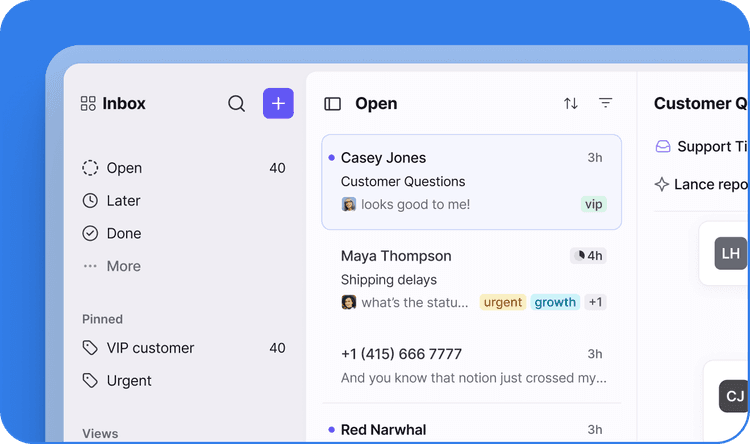
Omnichannel inbox: Whether patients reach out via email, SMS, or chat, everything lands in one secure, centralized place. For example, when a patient follows up via text after emailing, your team can see the full history in one thread and avoid switching back and forth between tools (or accidentally replying from the wrong channel).
Collaboration: Teams can loop each other in, leave internal comments, and hand off conversations without exposing PHI. A support rep can tag a billing specialist internally to clarify a charge or confirm insurance details, all behind the scenes while the patient receives a clear, compliant response.
Explore how Front supports HIPAA-ready customer operations, and start having better conversations with customers.