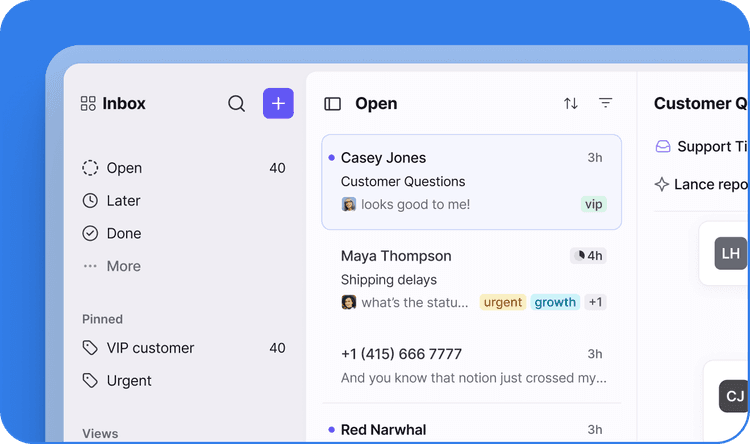





Learn what makes fintech customer service different, why support operations become harder to scale, and the best practices teams use to maintain quality.
A customer opens their banking app expecting to see their paycheck. It’s not there. Within minutes, they’re in your queue, and what looks like a simple inquiry has already become a time-sensitive issue with direct consequences: bills unpaid, trust eroding, a fraud flag potentially triggered.
That’s the reality of fintech customer service, and that support teams work inside. Not just high volume — high stakes. Resolution speed and accuracy matter in ways that most support operations aren’t built to handle.
As fintech services have grown more complex, so has the operational layer behind them. This article covers what makes fintech customer service hard to scale and the practices that help teams stay in control of fintech customer support as both volume and complexity climb.
What is fintech customer service?
When customers contact a fintech company, they’re rarely asking a simple question. More often, they’re trying to understand why a payment failed, verify their identity, report suspicious activity, or regain access to an account.
Fintech customer service is the operational layer handling all of it: missing transactions, identity verification, fraud concerns, and account access problems that directly affect how customers move and access their money.
These conversations don’t stay in one channel. They move across live chat, email, phone, and in-app messaging channels, especially for digital banks and payment apps.
And because fintech issues rarely resolve in a single interaction, frontline reps often need to coordinate with payment operations, fraud teams, and compliance specialists before a resolution is reached. That coordination gap is where most fintech support problems live.
Why fintech customer service is harder to scale
Volume is only one part of the scaling challenge. As support workflows expand across teams and policies, maintaining visibility and coordination often becomes more difficult than managing volume itself.
This strain shows up on both sides. More than one-third of companies lost a top performer to coordination burnout, leaving remaining team members to absorb the additional workload. And 64% of companies reported at least one customer-facing coordination failure in the past three months.
Top performers burn out, customers get inconsistent answers, and no single team feels accountable for the gaps in between. That’s the real scaling problem for customer experience in fintech, and it compounds fast.
6 customer service best practices for fintech teams
1. Treat the conversation — not the channel — as the unit of work
In fintech, customers rarely experience problems through a single channel. A card dispute might begin in chat but quickly shift to email once the customer needs to provide supporting documents. Channel switching isn’t the risk; context loss is.
The most effective fintech service teams build toward a shared customer record that travels across every touch point — previous conversations, contact activity, risk signals, and actions already taken.
Here’s a useful test: If a customer moves from live chat to phone, can the support rep immediately explain what already happened and what comes next? If not, continuity is breaking somewhere.
2. Build workflows across cross-functional ownership, not sequential handoffs
Most fintech support issues touch multiple teams before they’re resolved: operations, compliance, fraud, payments, and risk may all be involved before a customer gets an answer. The coordination layer between those teams is where resolution delays most often originate.
Teams that design workflows around shared ownership rather than departmental hand-offs are better positioned to manage this. Clear routing rules, defined responsibilities at each stage, and shared visibility across teams keep issues moving forward instead of stalling between inboxes.
One signal many teams miss: Customers experience internal coordination delays at service failures, even when the underlying work is progressing. The less visible your internal workflow is to frontline reps, the harder it becomes to provide accurate updates and maintain trust.
3. Use AI and automation where it removes friction, not where it replaces judgment
AI customer service in fintech is valuable when it removes unnecessary operational friction. High-performing fintech teams automate classification, routing, prioritization, document collection, and repetitive administrative tasks.
When customers are dealing with fraud concerns, context matters more than process efficiency. That’s what reps bring.
The goal is AI assistance that makes human judgment faster and better — not automation that forces every issue into a workflow it wasn’t designed for.
4. Build escalation processes that maintain accountability
Escalations frequently fail because ownership becomes unclear as cases move across teams. Every escalation should have a clear owner, documented workflows, expected service levels, and an audit trail of decisions made along the way.
Watch for escalation drift — the number of times a case changes ownership before resolution. Frequent handoffs usually signal process gaps or routing issues that create delays without adding progress. From the customer’s perspective, they don’t care which team resolves the issue. They care whether someone stays accountable from start to finish.
5. Track operational health, not just response speed
Fast first responses create a strong initial impression, but they’re a weak signal of service quality in fintech. As operations grow more complex, teams need visibility into the health of the entire resolution process — not just how quickly the first reply went out.
The most useful metrics measure friction. How many teams touched a case? How often are issues escalated? Where do approvals stall? Which workflows generate the highest rework rates?
These questions expose structural problems that response time dashboards routinely hide.
6. Handle customer communication during high-stakes support workflows
The most challenging customer service moments in fintech are often the periods when there’s no immediate resolution to give. A fraud investigation is a good example of why.
Support collects initial details and freezes the card. Fraud reviews transaction data and account activity. Payments works with card networks. Compliance reviews documentation requirements.
From the customer’s perspective, none of this complexity is visible — they know money is missing and want answers.
This is where many fintech organizations fall short. Internal work continues, but customer communication slows down because no single group feels responsible for providing updates. The result is a customer who contacts support repeatedly — not because work isn’t happening, but because visibility has disappeared.
Teams that treat communication as a parallel workflow keep ownership of customer updates clear across every team involved. Customers receive realistic timelines and straightforward progress updates, even before a resolution is reached. A five-day investigation with predictable communication often creates less frustration than a two-day investigation with none.
How Front helps fintech teams stay aligned at scale
Lydia, a peer-to-peer and banking company operating in France, was growing at an average of 4,000 new users a day. More users meant more requests, more escalations, and more coordination across teams — and the tools they had weren’t built for it.
Zendesk’s ticket-first setup didn’t support smooth cross-functional coordination. Slack simplified communication but couldn’t preserve context when issues escalated.
After moving to Front, four things changed: shared visibility, cross-team collaboration, automated routing, and conversation history that traveled with every issue. Work stayed connected. Teams stayed focused on resolution instead of managing fragmented updates. Today, Lydia resolves issues for 70% of its 6 million users in under an hour.
Ready to close the visibility gaps in your fintech support operation? Request a demo today and see how Front keeps every team, tool, and customer conversation in sync.
FAQ
What metrics matter most in fintech customer service?
Focus on first response time, resolution time, customer satisfaction, and compliance-related metrics. The most successful teams also track escalation rates and customer retention to understand long-term impact.
What tools are used in fintech customer service?
Fintech teams rely on shared inboxes, omnichannel communication platforms, automation, knowledge bases, and secure workflows to keep support fast and compliant. Customer operations platforms like Front bring those capabilities together, along with the cross-team coordination fintech support actually requires.
What makes fintech customer service different from traditional banking?
Customers expect instant, digital-first support. Fintech teams must deliver fast resolutions while maintaining accuracy and meeting strict compliance requirements — across channels, teams, and high-stakes workflows that move faster than traditional banking infrastructure was built to handle.