



Learn how B2B teams use customer service analytics to track performance, maintain context across teams, and optimize operations with Front.
In B2B, engagement isn’t a marketing initiative. It’s what happens when customers feel like your team has their back — during renewal conversations, escalations, and the day-to-day interactions that keep accounts happy. Customer experience in these moments shapes engagement.
To keep customers engaged, you don’t need bigger campaigns or more webinars. You need reliable coordination and follow-through. But as companies grow, more internal teams work on the same account, more stakeholders join the conversation, and coordination becomes harder.
This added complexity leads to siloed conversations and missed context, which forces customers to repeat information and erodes the overall relationship. Stronger engagement depends on better workflows that improve how teams coordinate at every stage of the customer journey.
Here’s why engagement matters, how it breaks down, and how to engage B2B customers consistently.
What B2B customer engagement means
B2B customer engagement is the coordinated management of conversations, stakeholders, and actions across the customer life cycle in a way that preserves context and builds trust.
It’s not about how often you run marketing campaigns, send automated check-in messages, or hold quarterly review meetings. It’s shaped by how well teams work together to respond to customer feedback and address the priorities of different stakeholders.
To sustain customer engagement at scale, make sure handoffs between internal teams are smooth — including teams that never talk to customers directly. Use systems that connect conversations across channels and keep ownership visible at all times.
Why customer engagement matters for B2B teams
When B2B customer engagement slips, the effects are concrete: missed SLAs, slower renewals, and accounts at risk. Here’s what strong engagement protects—and how to maintain it.
Prevent context loss from compounding across touchpoints
Context matters in every interaction. Each time customers must repeat details or get contradictory responses from different teams, trust erodes and the experience feels disjointed. Strong customer engagement depends on preserving context across channels, handoffs, and life cycle stages.
When the experience feels predictable and well-coordinated, retention improves and contract renewals move smoothly. And when engagement breaks, the impact on customer loyalty is significant: 59% of B2B customers say they’ll leave a brand after only three or fewer bad experiences.
See how Uber Freight replies to emails 50% faster with Front.
Maintain consistency when multiple teams touch the same account
B2B customers value consistency, not just in the tone and messaging but also in context and follow-through. Build that consistency through shared visibility into conversations and decisions.
When different teams handle the same account without a unified view, customers feel the disconnect, even when individual interactions are strong. Gaps in visibility lead teams to repeat questions or duplicate work, slowing everyone down and undermining engagement.
Keep accountability visible as complexity grows
Accountability often breaks down as accounts scale. More stakeholders and more teams increase the chances for ownership to blur and commitments to go untracked. When that happens, customers experience delays, escalations rise and teams spend more time searching for answers instead of moving work forward.
Clear ownership and accountability prevent these issues. When responsibilities, decisions, and next steps are transparent, teams stay aligned and customers get faster resolutions — keeping customer engagement high as complexity increases.
See how Morningside’s team of 250 manages global projects at scale with Front.
Reduce the friction that erodes customer relationships
Even when individual team members perform well, poor coordination can erode customer experience. Missed SLAs, slower renewals, and delayed responses usually stem from a lack of coordination, not lack of effort. When teams don’t share information, they work from different contexts and misunderstandings multiply.
Strong engagement reduces this friction through shared context, clear ownership, and predictable follow-through. When teams are coordinated, customer relationships stay stable under pressure — leading to retention and customer loyalty.
Why B2B customer engagement breaks down
Even high-performing teams struggle to maintain engagement when the systems connecting them aren’t working. Here are the most common causes of breakdowns in B2B customer engagement.
Siloed teams and disconnected tools
Disconnected systems are one of the biggest drivers of disengagement. When teams operate in separate tools and context is scattered across inboxes, coordination becomes difficult. Without shared visibility, teams offer inconsistent responses and erode customer engagement.
Lack of clear ownership
To deliver confident, accurate responses and keep customers engaged, teams must know who’s responsible for every issue at every stage of the customer journey. Without that clarity on ownership, interactions feel hesitant and stilted and don’t meet customer needs, which can lead to disengagement.
Inconsistent communication across channels
In a B2B environment, teams interact with multiple stakeholders across different channels. Without the right tools and processes to connect those interactions and share context, inconsistency is inevitable. Customers have to start fresh on each channel and repeat information — a pattern that ultimately causes them to disengage.
Overreliance on automation without oversight
Automation is an important element of most B2B customer service strategies. When used right, it improves the customer experience by speeding up response times and supporting personalization. But when teams rely too heavily on automation without human judgment, they give generic responses that weaken customer engagement.
Automation can support shared visibility, clear ownership, and connected workflows — but it can’t read between the lines or make judgment calls. Without human oversight to reconcile conflicting updates or align next steps, automation widens the gaps instead of closing them.
See how Founder Shield saves 300 hours a month with Front’s automation.
6 B2B customer engagement strategies for multi-team operations
Now that we’ve seen how engagement breaks, let’s look at six practical strategies to maintain engagement in complex workflows.
1. Connected channels
When trying to improve engagement, it’s tempting to add more channels to give customers more ways to reach you. But without the right operational layer to connect interactions, more channels only increase confusion, not engagement.
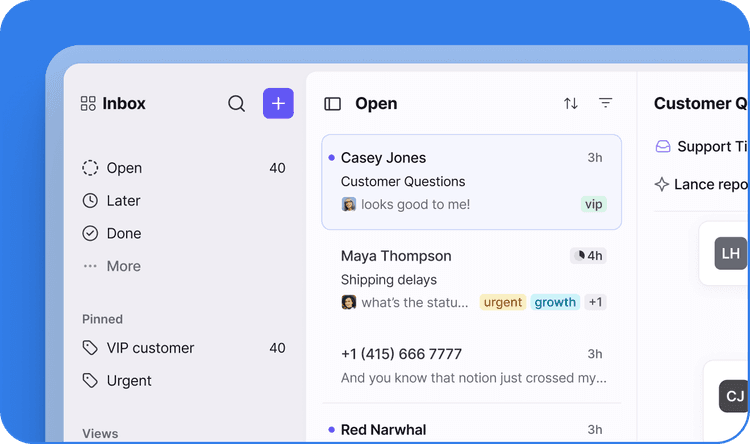
Start by bringing all conversations — regardless of channel — into a single view. When teams have full visibility and a unified context, conversations stay consistent and customers get a more connected experience. Once you have the right operational structures in place, you can add more channels without hurting engagement.
2. Clear ownership and accountability
Clear ownership is essential to any B2B customer engagement model. Define roles and responsibilities, ensuring a single owner for each issue, structured handoffs, and documented escalation paths. Use a support platform that allows teams to collaborate while keeping ownership visible by assigning issues to specific team members. This clarity preserves continuity and engagement despite growing account complexity.
3. Personalized communication at scale
Personalization isn’t just using a customer’s name in conversation or adding a few account details. It’s about understanding the full context of the relationship: the account history, stakeholders involved, and prior commitments.
As the company grows, use systems that preserve conversation history and shared context across teams. When everyone has access to the complete picture of an account, teams can give tailored, relevant responses that keep engagement high at scale.
See how Ridepanda scaled their human touch with Front, handling 4x higher volume while achieving high CSAT scores.
4. Stakeholder-specific engagement for B2B clients
B2B customer accounts include multiple roles with distinct priorities that need different engagement strategies. For example, emphasize strategic value and business impact in interactions with executives, but focus on actionable advice and problem-solving in conversations with end users.
Build systems that show teams what’s been discussed with each stakeholder. The right tools let teams maintain a unified view of the account — even as they engage differently across roles.
5. Repeatable engagement workflows across the customer journey
Consistent communication is only possible when teams rely on repeatable workflows to guide them. As account complexity increases, teams need a predictable B2B customer engagement model to avoid inconsistent responses and gaps in follow-through.
Create step-by-step playbooks for each stage of the customer journey, and use automation to trigger emails and alerts as customer milestones or renewal dates approach. Teams that know how and when to engage customers sustain high B2B customer engagement at scale.
6. Proactive customer support
Friction is a constant risk as customers move across life cycle stages, such as onboarding transitions, renewal cycles, and operational escalations. To maintain high-quality interactions, the customer support team needs to anticipate problems and address them. Use engagement tools that highlight conversation trends and account signals — like shifts in sentiment, usage, or activity — so teams can offer proactive support.
Front is the operational layer that holds B2B customer engagement together
All six customer engagement strategies listed above have one thing in common: they’re all about systems and workflows. With the right systems in place, teams preserve continuity and maintain B2B customer engagement as the company scales.
Coordination is the foundation of customer engagement in B2B. Front is a customer operations platform that keeps all teams, tools, and customer conversations in sync so the business can scale without losing engagement. Replace scattered inboxes and tools with a system that centralizes conversations across channels. Preserve context, make ownership visible through assignments, and enable real-time collaboration with Front.
See Front in action — book a demo to explore the platform and see how it gives you a solid foundation to protect B2B customer engagement as your business grows.
FAQ
How does AI support B2B customer engagement?
AI tools help teams work more efficiently and give better support to customers. They do the heavy lifting on context, insight, and timing so your teams can focus on high-quality customer interactions. AI sentiment analysis identifies emerging issues, making it easier for teams to provide support proactively before engagement drops.
How can I measure B2B customer engagement?
Track operational metrics like ticket volume and time to resolution (TTR), customer satisfaction metrics like CSAT and customer effort score, and retention signals like renewal rate and churn.
How should we prioritize accounts for churn prevention?
Focus on accounts where the revenue is high and the warning signs are piling up: shrinking contract value, renewal delays, product usage drops, unresolved support issues, and declining engagement from key stakeholders. Focus first on high-value customers showing multiple risk indicators, especially where cross-team friction suggests the customer experience is breaking down.
What role does AI play in customer engagement?
AI customer service tools help support teams to personalize communication, even when dealing with many different customers. Automation also helps teams work more efficiently and resolve issues promptly, creating engaged customers and boosting customer retention.
What common pitfalls prevent engagement at scale?
Customer service challenges in scaling companies stem from inadequate systems and workflows, which lead to poor coordination, slow responses, and disengaged customers.