



Learn how B2B teams use customer service analytics to track performance, maintain context across teams, and optimize operations with Front.
Not long ago, submitting a support ticket was a linear process: It landed in a rep’s inbox, and you waited while they tracked down answers. Today, that same request might be solved instantly by AI, handled by a human, or passed between both, depending on its complexity.
That complexity has changed the game. Support is no longer a straight line but a web of systems and handoffs. Speed alone isn’t enough — fast resolution means little if context gets lost between systems. More systems means more places for work to stall.
What matters now is visibility: a clear view of how work actually flows across teams and systems. When you see that flow in real time, you can build a smarter customer service analytics approach and consistently deliver on your promises.
In this guide, we’ll break down how customer experience analytics solutions expose friction in workflows and provide the operational insights needed to stay in control and scale effectively.
What is customer analytics, and why does it matter in B2B?
Customer-centric service sounds great — until you start operating at scale. Conversation volumes rise quickly across channels like chat, email, and social, and teams end up juggling multiple steps and handoffs just to resolve a single issue. What should be a simple exchange turns into a long chain of back-and-forth across systems and people.
That’s why customer service analytics matter They help you report on what happened and what to do next. Capture the right customer service data, surface where workflows break, and use those insights to guide teams toward faster, more consistent resolution in real time.
When tickets stall, service-level agreements (SLAs) slip, or customers keep returning with the same issue, analytics gets to the root of it: Why is this happening, and where’s the friction?
Key metrics to track in complex customer operations
For real visibility into customer operations, your metrics need to track team performance across across AI-led work, human-led work and the handoffs in between.
Here are six key metrics to track in complex customer operations.
Conversation volume and distribution across teams
Conversation volume tracks how many conversations enter support and how they’re spread across teams and channels. Operationally, this metric highlights load imbalances and routing inefficiencies, so you can rebalance staffing and refine routing rules before volume starts affecting response quality.
Average handle time per team/department
Average handle time captures how long teams take to resolve a conversation, including active work and wait time. It compares performance across teams and identifies where tooling or knowledge gaps are slowing resolution and putting quality at risk.
First response time and SLA compliance
First response time and SLA compliance go hand in hand. The first measures how quickly customers get an initial reply; the second tracks whether that reply meets your committed SLAs.
Together, they form an early warning system for backlog or staffing issues. This helps you prioritize the right queues while maintaining consistency and responsiveness across both human- and AI-led interactions (which can protect customer retention).
Customer effort score across interaction types
Customer effort score (CES) measures how easy (or difficult) it is for customers to get help across channels. It captures friction points such as repeated inputs, unclear responses, or excessive steps. Using CES, you can focus on simplifying journeys and reducing unnecessary customer effort.
Cross-team handoff delays
Cross-team handoff delays track the time lost as conversations move between teams or functions. It reveals breakdowns in ownership or context sharing, highlighting where work stalls. Addressing these breakdowns reduces lag, tightens collaboration, and ensures customers don’t feel the friction as issues pass between specialists.
Customer satisfaction inferred from interactions
Customer satisfaction (CSAT) uses signals from conversations, such as language, sentiment, and even resolution patterns, to estimate satisfaction without relying solely on surveys. At scale, CSAT gives you continuous feedback — so you can catch dissatisfaction early and see how AI and human interactions each shape the customer experience.
Best practices for B2B customer service analytics
Among its use cases, customer service analytics also sets your business apart by adding context to every interaction and surfacing patterns in customer relationships. These insights act as a connective data layer across systems. But data alone isn’t enough to hold operations together for long. It needs to be supported by repeatable and outcome-focused practices.
Below are four best practices to take your analytics strategy to the next level.
1. Track both conversations and tickets for complete visibility
Conversations provide the context while tickets capture the outcome. One without the other leaves you with only half the story and half the visibility. And without the full picture, it’s much harder to stay truly proactive or scale efficiently.
Use conversations to understand what customers are asking and struggling with in real time. Use tickets to quantify what’s been logged, prioritized, and owned. Together, the two close the feedback loop — helping teams improve while staying connected to the actual customer experience.
2. Maintain cross-functional alignment using unified dashboards
Visualizing raw data from customer feedback in analytics is the first step toward a clear action path. Supplement that data with unified dashboards and bring together all comments, threads, insights, and customer history into a single interface across every channel.
When every department can see the same connections, a shared source of truth emerges and silos start to fade. Teams see the same patterns, align on what they mean, and coordinate solutions without guesswork or duplication. This supports a more consistent customer experience and faster, more unified decision-making.
3. Set benchmarks per team, not just per company
Analytics provide the performance data, while benchmarks give that data meaning by grounding it in industry standards and historical trends. However, here’s what leaders keep getting wrong: They neglect to benchmark by specific team, defaulting instead to company-wide benchmarks.
That approach flattens important differences between teams and channels, leading to overly generic (and ultimately, unhelpful) expectations.
Instead, anchor benchmarks at the team level, aligned with specific commitments and updated regularly. Prioritize contextual data so you can accurately measure effectiveness and performance where it actually happens.
4. Regularly review trends to anticipate spikes or friction points
Trends are another critical part of customer service that require ongoing attention. Customer data you collect is never static, and relying on a single snapshot risks missing potential friction points and spikes in repeat requests.
Regular trend analysis, on the other hand, helps you iterate faster — or discover where customers need support the most.
How Front unifies analytics across teams
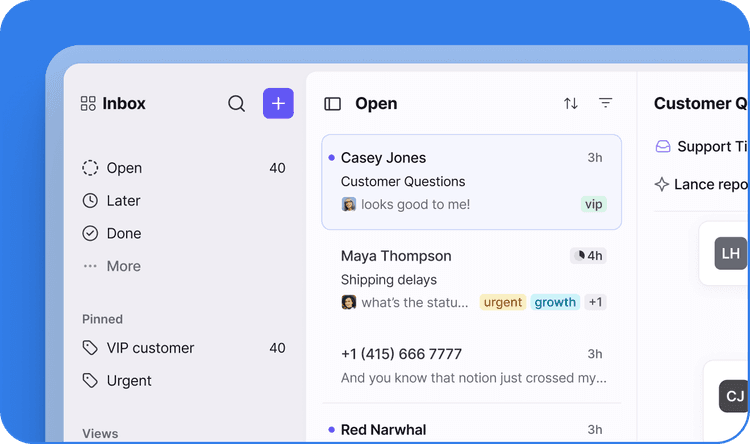
Customer service analytics should help run a tighter, more responsive operation. That’s where Front stands out, bringing workflows, data, and context together in one place so visibility and context stay consistent across the team.
Here’s what that looks like in practice:
Dashboards show workload and performance in real time, providing immediate visibility into operations.
Smart assignments and collision detection prevent duplicate work and ensure every task has a clear owner.
Context carries through every handoff, so information isn’t lost as conversations move between teams.
AI-driven insights highlight trends and uncover opportunities to work smarter.
If you’re ready to bring your analytics and workflows into one system, Front makes it easy to get started.
Try the platform today, or download the Front Analytics webinar to see how these insights translate into action.
FAQ
What are the challenges of using analytics to track both human and automated responses?
Automated systems like chatbots generate structured, predictable data, but often lack the nuance of human interactions. Human conversations, meanwhile, are unstructured and harder to categorize, making it difficult to compare them directly. Attribution adds another layer of complexity — when a bot handles the first touch and a human resolves the issue, it can be unclear how to assign outcomes like resolution time or escalation.
What legal or compliance considerations should B2B teams keep in mind when analyzing support data?
Support analytics often involve sensitive customer information, so compliance isn’t optional. Regulations such as GDPR and CCPA might apply, setting strict rules on how data is collected, stored, used, or deleted. Limiting data collection to what you actually need and controlling access to raw support data reduces privacy risks and strengthens security.
What challenges do companies face when implementing omnichannel analytics?
Many companies struggle with fragmented systems, inconsistent data, and unclear ownership across teams, which makes it hard to get a complete view of customer conversations. They also face resistance to new workflows, requiring careful change management to make sure teams adopt omnichannel analytics effectively.