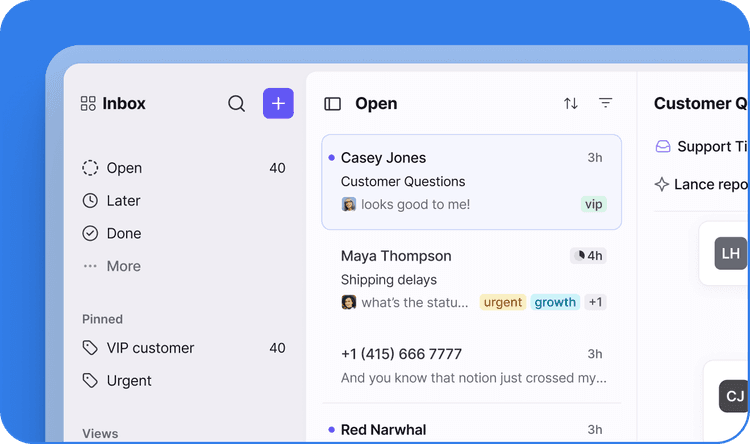





Use a customer journey map to surface handoff gaps, unclear ownership, and lost context across B2B workflows, then turn those signals into action.
The customer journey is more than a sequence of touchpoints — it’s an operating system for how customers experience your business. In B2B environments, the journey spans multiple teams, systems, timelines, and decision-makers.
A comprehensive customer journey map is essential because the customer experience breaks down when teams can’t see how conversations flow across the entire journey. Without that visibility, ownership becomes unclear, and context gets lost. And then, delays and inefficiencies multiply. According to The Coordination Tax report, the typical B2B company spends nearly three hours coordinating customer requests for every hour spent solving them.
When you create a clear, step-by-step visual representation of how customers engage with your business, it becomes easier to spot friction points and address them directly. It also enables smoother handoffs and preserved context across all customer touchpoints.
In this article, we’ll explain what a customer journey map is, how to build one for complex B2B operations, and how to use it to improve coordination and outcomes.
What is customer journey mapping?
A customer journey map gives B2B companies a way to visualize how customers interact with them. Think of it as a customer service blueprint — showing not just touchpoints, but also internal workflows, team ownership, system dependencies, and handoffs for each stage of the lifecycle.
A well-built journey map helps teams become more customer-centric by clearly revealing what the customer experience actually looks like, along with key needs, pain points, and operational friction. Like any blueprint, it acts as a guide to help define goals and make improvements.
Why customer journey mapping matters in B2B operations
For teams managing complex customer relationships, the main benefits of a customer journey map are:
Stronger visibility: When you create a visualization of how customers engage with you, it shows a clearer picture of where customers experience delays, redundant effort, and common pain points.
Clearer ownership: By mapping how work moves across teams and stages, you can pinpoint where accountability breaks down and define ownership more clearly at each step of the journey.
Better coordination: As operations scale, coordination between support, operations, account management, and other teams becomes challenging. A journey map shows how each function fits into the broader system, improving alignment and collaboration.
Consistent communication: A complete map of customer touchpoints helps ensure messaging stays consistent across channels, stakeholders, and internal teams.
Earlier problem detection: A customer journey map makes it easier to spot workflow gaps that lead to frustration and put accounts at risk of churn. When you spot problems early, you can fix them to improve retention and account health.
What to include in a B2B customer journey map
Here are some examples of customer journey map elements to include.
Customer stages
Begin by listing the core stages in the customer journey, like onboarding, active support, renewals, escalations, and expansion. This gives the structural backbone of your customer journey map, with other elements layered onto each stage.
Customer touchpoints and channels
For each stage, map all the ways customers interact with your business, from email to live chat, calls, meetings, and follow-ups. Channels matter because context needs to carry across every touchpoint, and channel switching is often where friction emerges.
Internal teams and owners
For each touchpoint, name which teams are responsible at each stage. For example, operations leads customer onboarding meetings, support handles inbound requests for each channel, and customer success manages ongoing check-ins and follow-ups.
Handoffs and dependencies
Map the ways that work moves between teams, tools, and systems. Your map will look different for each stage. Focus on the places where ownership shifts — this is where operational risk typically appears.
Metrics and signals
Finally, define the metrics you’ll use to evaluate how well the system is working. Common examples include service-level agreement (SLA) compliance, response times, escalation rates, handoff delays, repeat contacts, and customer satisfaction (CSAT).
How to create a customer journey map for complex B2B workflows
The goal is a map built on real operational data — not an idealized version of how things should work. Here’s the process.
1. Start with a real customer workflow
Pull feedback surveys and historical data from your customer support platform to build a map of how a specific customer engages with you. What does onboarding look like for a new logistics customer? How does that customer then engage during support, escalations, and renewal?
2. Map every team involved
At each phase, review your conversation history to create a list of all the internal teams that touch the customer relationship. Core teams like customer support and operations are central, but don’t overlook less visible contributors. For example, the finance team mostly operates in the background but is occasionally involved in resolving billing issues.
3. Identify where context changes hands
Document every handoff and shift in ownership. Note how successfully context is passed along and whether customers need to repeat information. For instance, when a logistics customer moves from onboarding to ongoing support, does the support team have full visibility into shipping routes and custom integrations?
4. Connect customer-facing moments to internal work
Link every customer interaction to the operational work required behind the scenes. The level of coordination between cross-functional teams determines whether you meet customer needs or create delays. Create a detailed map of all those connections.
5. Validate the map with real conversation data
Review the map regularly using customer conversations, support ticket data, and team and customer feedback. The goal is to reflect how customer interactions and handoffs happen in reality, not how they should work in theory.
Where B2B customer journeys break down in practice
A customer journey map is one of the clearest ways to find the gaps that frustrate customers and slow down teams. Here are some of the most common issues it exposes.
Lost context between teams
When conversation history doesn’t follow the work, customers have to repeat themselves. If the customer success team can’t access context from support conversations, for instance, they won’t be prepared for issues the customer raises during renewal conversations.
Unclear ownership during handoffs
When nobody knows who’s responsible for the next step, work stalls and resolution slows. Mapping handoffs helps reveal where ownership becomes ambiguous, and work falls through the cracks.
Inconsistent communication across channels
When teams use different tools for the same customer, customers often get conflicting information. Examine all the channels used for each touchpoint, and look for areas where teams using one channel can’t see conversations happening with the same customer elsewhere.
Bottlenecks hidden inside internal workflows
Use your map of internal processes to understand how operational issues like slow approvals, manual routing, or disconnected systems create a confusing and fragmented experience for customers. An urgent escalation without a clear routing process can bounce between teams before reaching the right owner, increasing resolution time and confusion.
How to turn a customer journey map into operational improvements
When you’ve used your map to identify operational problems, the next step is to fix processes based on the identified gaps. Use these best practices for stronger, more durable B2B workflows.
Assign clear owners for each stage
Avoid dropped handoffs by creating accountability at every stage. For every touchpoint in your customer experience map, make sure there’s a clear process for defining a single owner with responsibility for the next steps.
Standardize high-risk handoffs
Create repeatable workflows to reduce inconsistency by creating clear processes and escalation paths when work moves across teams. Standardization improves coordination, reducing the risk of delays during important handoffs.
Centralize conversation context
Close operational gaps by giving teams shared visibility into customer history, decisions, and next steps. With multiple teams interacting with customers across different touchpoints, centralized context ensures they can pick up conversations without making customers repeat information.
Track whether changes improve workflow movement
As you make improvements based on your customer journey map, track their impact using operational metrics like SLA adherence, handoff frequency, escalation trends, and repeat contacts.
Keep the customer journey connected with Front
A customer journey map is only useful if you act on it. Review the map often, and identify opportunities to create stronger processes that reinforce ownership and coordination.
Front’s omnichannel workspace keeps every team, tool, and customer conversation connected so customer work stays visible across the journey. Use assignments for clear ownership, internal comments for team coordination, workflow automation to route work consistently, and analytics to find bottlenecks.
Book a demo to explore how Front helps teams manage complex customer journeys with coordinated workflows. And download the Coordination Tax Report to uncover where time is lost to misalignment — and how to unlock more efficient teamwork.
FAQ
What metrics should be tracked in a customer journey map?
Track key customer experience metrics like CSAT, Net Promoter Score, churn, retention, and resolution times. These signals help pinpoint where friction builds up and where improvements have the greatest impact.
How often should a customer journey map be updated?
Consider a customer journey map to be a living document that you update whenever your product or workflows change. Review it at least every six months.
What tools are used to create a customer journey map?
Start with analytics from your customer support platform to gather the data, then build a structured visualization using tools like Lucidchart, Miro, Microsoft Visio, Smaply, or Canva.