



CSAT tells you how customers felt, not why. See the touchpoints and operational signals (handoffs, escalations, repeat contacts) that actually explain it.
Growth brings complexity. In B2B, that complexity shows up as a rapid increase in customer touchpoints. Conversations start happening across different tools, teams, and moments in the customer journey.
Without a coordinated approach, it becomes impossible to keep interactions consistent or give everyone on your team a complete view of the customer.
In this article, we’ll help you see how touchpoints function in real B2B workflows, where they commonly go wrong, and how to create a connected experience across the entire customer journey.
What are customer touchpoints, and why do they matter in complex operations?
Customer touchpoints are all the interactions a customer has with your business, whether they’re making initial sales inquiries, asking onboarding questions, or reaching out to support.
Each touchpoint depends on people, processes, and tools working in sync. As requests move between teams, you need strong processes to preserve context and ensure someone is always responsible for the next step.
Here’s why customer touchpoints matter:
Consistency across teams and channels: B2B customer interactions often span multiple teams. Well-managed touchpoints ensure customers get consistent service no matter who picks up the conversation.
Resolution quality and speed: When each touchpoint preserves full context, teams avoid unnecessary back-and-forth and can get up to speed immediately. Fewer gaps mean faster, more accurate resolutions.
Retention and expansion: Positive experiences across all touchpoints build trust, making customers more likely to renew contracts and expand business with you.
Types of customer touchpoints across the lifecycle
Here are three examples of customer journey touchpoints to illustrate how B2B support teams engage with customers at different stages of the lifecycle.
1. Pre-interaction
Before a customer ever submits a request, your team is already setting the stage. That includes planning onboarding, coordinating implementation, and answering pre-sales questions from operations.
Consider a logistics company that closes a deal with a major new account. For a smooth start, all internal teams — from account management to implementation and operations — must align quickly on roles, workflows, and timelines. That way, when the new customer is onboarded and shipments go live, the company already has the coordination needed to handle customer touchpoints across multiple channels.
2. Active support
Once onboarding is complete and the customer is active, the team must manage regular support interactions, everything from billing issues and technical queries to urgent requests that require smooth escalations and handoffs across teams.
Imagine a manufacturing customer flags sudden delays in new orders. The support team must escalate fast, making sure it reaches the correct internal team without losing context.
Strong coordination with product and account teams is essential here, all while keeping the customer updated across different channels. Any missing context or unclear ownership will delay resolution, create frustration, and harm the customer experience.
3. Post-resolution
Resolution isn’t the end of the customer journey. Every touchpoint afterward shapes trust and satisfaction. That’s why customer feedback surveys, check-ins, and follow-up messages to confirm satisfaction matter. They validate the customer’s experience and open the door to stronger relationships.
For example, the support team for a B2B financial services company follows up on a recently resolved payment processing issue. Meanwhile, the customer is also discussing renewal terms with the account team. To avoid conflicting messages or duplicated outreach, both teams must coordinate their communication so the customer receives one clear, consistent experience.
Customer touchpoint mapping across teams and channels
B2B companies often create customer journey maps to keep touchpoints running smoothly. They help teams understand how work actually moves across tools, people, and handoffs.
Here’s how to identify customer touchpoints and map them across the customer lifecycle.
Step 1: Identify where conversations start and how they move
List all the ways customers start conversations with you, including email, live chat, Slack, Teams, and self-service portals. Note which channels customers prefer for different types of inquiries and how those conversations move from one team to another.
Map the communication flow across sales, onboarding, customer success, customer support, and account management. This end-to-end view of customer communication will help you identify escalation paths and pain points for customers.
Step 2: Define ownership at each touchpoint
Assign clear ownership at each stage. Clarify who’s responsible for communication quality, issue resolution, and follow-ups. Also pay attention to handoffs between different teams, and make sure conversations proceed smoothly without lost context or delays.
Step 3: Surface gaps in context and coordination
For each touchpoint, look for places where context gets lost — incomplete handoffs, siloed tools, missing follow-through. When customers have to repeat themselves, it’s a sign of a process gap that ultimately creates delays and harms customer experience and loyalty.
Step 4: Align touchpoints with actual workflows
Skip the theoretical journey maps. Build the touchpoint map around actual workflows and escalation patterns. When the map reflects how work really moves, you can spot bottlenecks and fix them.
Common challenges in managing customer touchpoints
As B2B companies grow, managing customer touchpoints becomes more complex. Here are the main challenges they face:
Fragmented communication: With customer interactions spread across different tools, teams waste time searching for information and deliver slower customer service.
Lack of visibility: Teams often operate without a shared view of customer context, leading to inconsistent responses and conversations landing with the wrong person.
Unclear ownership: When accountability isn’t defined, no one is sure who should respond next. This creates unnecessary delays and duplication.
High customer effort: Poor handoffs and lost context put the burden on the customer to re-explain their situation, creating frustration and eroding trust in the service.
How to improve customer touchpoints
Here are the operational practices that will help you show up well in every interaction.
Centralize conversations across channels
Overcome the problem of fragmented communication by using an omnichannel support platform to bring all customer conversations into a unified workspace. With email, live chat, conversations, and other channels consolidated in one place, teams can collaborate more easily and resolve issues faster.
Clarify ownership and simplify handoff routing
Every customer interaction should have a single owner at each stage. Define when handoffs and escalations should happen, and set up clear routing rules. Clear ownership and predictable workflows keep routine requests from bouncing between teams. Fewer handoffs mean faster resolutions and more customer satisfaction.
Maintain context across every interaction
No matter which channels customers use to reach out, they expect your team to know the relevant context. Use a customer support platform that makes the full context accessible to all teams, so they can reference past interactions in conversations and deliver truly personalized customer service.
Standardize workflows without losing flexibility
By defining workflows for onboarding, customer support, escalations, and follow-ups, you give customers the consistency they expect. At the same time, the customer service strategy should leave room for judgment calls — for example, letting a support rep adjust the onboarding sequence for a customer with an urgent deadline or unique technical constraints.
Front keeps these workflows running. It keeps every team, tool, and customer conversation in sync, giving teams full visibility into how touchpoints are handled across the organization.
Keep every customer touchpoint connected with Front
As you map and manage customer touchpoints, remember that their success depends on how well your teams are set up to handle them. To deliver a consistent experience across touchpoints, your team needs clear ownership, preserved context, and smooth collaboration.
Front makes all this possible. By connecting conversations, teams, and workflows, it gives you the visibility and coordination needed to manage all touchpoints as the business scales.
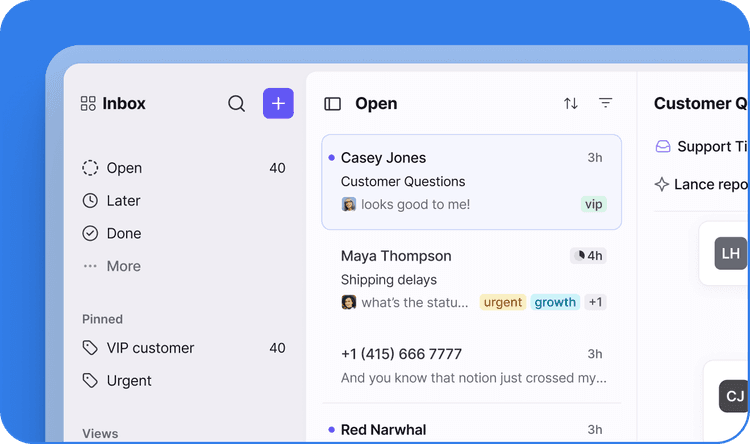
Here’s what Front looks like in day-to-day use:

Book a demo to see how Front works in action, and download the complete guide to customer communication to develop your own B2B customer communication strategy.
FAQ
What tools help manage customer touchpoints effectively?
Omnichannel customer support platforms are the best way to manage customer touchpoints. They centralize customer context and coordination in a single workspace, making it easier for teams to deliver consistent, high-quality service.
How do customer touchpoints change as a company scales?
As a company grows, interactions take place across more teams, channels, and systems. Coordination becomes more challenging, and the company needs structured workflows to maintain consistency.
How do you measure customer touchpoint performance?
Track response and resolution times for each touchpoint, along with the frequency of handoffs and escalations, and the repeat contact rate. These operational signals tell you how quickly work progresses, how clear ownership is, and where you have friction. Use customer satisfaction scores as a supporting signal, not the sole indicator.