



Compare top customer communication platforms and see how B2B teams keep conversations, workflows, and ownership aligned across channels.
It often starts with a simple email. An account manager notices a billing issue that doesn’t add up. A day later, the customer jumps on chat with support to get answers. Soon after, the issue escalates into a call with an engineer. Now three teams are involved.
By the time it’s resolved, each handoff has reshaped the story. Context didn’t carry through, and the customer explained the same problem multiple times, in slightly different ways, to different people.
The good news? Customer communication platforms are built to prevent exactly this. They keep context intact and make ownership clear from the first touchpoint to the last. Customers spend less time re-explaining themselves, and teams spend less time searching for answers.
What is a customer communication platform in B2B operations?
A customer communication platform gives teams a single system to manage conversations, ownership, context, and coordination across multiple channels and handoffs.
B2B conversations span multiple channels and unfold over time. A single issue can stretch across weeks or even months, with scattered touchpoints along the way. A customer might email about one issue, hop on live chat for another, and later schedule a call to unpack the details.
That creates two problems: Teams lose context, and important details fall through the cracks, which can lead to missed follow-ups, inconsistent communication, and slower decisions.
Teams need an omnichannel communication platform that brings all of those challenges together, so ownership stays clear and full customer context travels with every interaction.
Why fragmented communication creates operational risk
When communication and context remain fragmented across channels, teams take on operational risk. And over time, that risk compounds and gets expensive. Here are three ways it shows up in your workflow.
Lost context across handoffs
When communication is scattered across tools and text updates, teams lose the “why” behind decisions. Customer history and intent often vanishes in a “black hole” at the exact moment a request moves from one channel to another — or from one expert to the next.
And it’s not just a human problem. It affects AI tools, too.
Research from Stanford and UC Berkeley found that even when the right information is present, a large language model’s ability to use that context can drop from roughly 70–75% to 55–60% as the input grows longer and more complex.
Some developers call this “context rot.” In AI systems, as inputs grow, useful signals turn into noise. Attention gets diluted. And the details that matter get buried right when you need them most.
Conflicting responses across teams
When context slips, alignment goes with it. Your team might have all the necessary details but not the same picture, so they can’t get on the same page.
That’s when work starts to break down: duplicate work, repeat conversations, and internal back-and-forth. On the customer experience side, this breakdown is even more visible with inconsistent answers and slow response times that erode trust.
Delayed follow-through when ownership is unclear
“Someone else is handling it.”
You hear that a lot in dysfunctional systems — but how do you know who is really handling it?
The impact is often invisible — until it isn’t. When ownership is unclear, customer communication stalls. Decisions get stuck in loops, deferred, or endlessly escalated just to create the appearance of forward movement. At that point, even the best omnichannel tools can’t compensate for the lack of clear accountability.
What B2B teams need from a customer communication platform
Many B2B teams equate the “best” customer communication platform with the most features or the most channels.
So they end up optimizing for shared inboxes and faster AI-generated replies, as if speed and surface area alone define effectiveness. They don’t.
What most teams need is visibility and coordination, reflecting how their operations actually function. Here’s what to look for if you want a platform that’s genuinely the right fit.
Shared visibility across every interaction
Every interaction (email, SMS, chat, or messaging) should live in one unified thread, accessible to all relevant stakeholders. No digging, no guessing. Full context should be preserved and easy to follow so teams can pick up exactly where things left off without losing critical detail.
Clear ownership and coordination across teams
Every conversation needs a clear owner at every stage. Without it, work either stalls or duplicates. The right platform makes responsibility explicit and ensures everyone knows who’s accountable for moving things forward.
Routing and workflows that reflect real operations
Customer service workflows shouldn’t have to bend around the tool — the tool should fit how you operate. Smart routing, flexible processes, and support for real-world complexity ensure the right people engage at the right time without unnecessary friction.
Where communication platforms prove their value: 3 use cases
Customer communication platforms prove their value when things get messy and the stakes are high. Below are three real-world situations where coordination either breaks down or becomes a true competitive advantage.
Managing high-stakes communication across multiple teams
Picture a product outage during peak hours. Support is flooded with tickets, while engineering is diagnosing the issue, and leadership needs timely updates. In situations like this, the customer experience quickly suffers when teams are working from different information.
When coordination works, there’s a single source of truth. Updates flow in real time and every team delivers consistent messaging.
Coordinating service updates across channels without losing context
Strong execution depends on keeping messaging aligned everywhere customers interact. Teams need full visibility into customer history across channels so conversations continue without repetition or resets.
Instead of stitching together the experience, every bit of context moves in sync across channels whenever you roll out a pricing change or feature update.
Keeping customer conversations moving during escalations and exceptions
Escalations often stall progress. When communication platforms work well, conversations keep moving with context intact. Every team sees the full thread and issues keep advancing. Customers experience none of the complexity — only the resolution.
How to measure whether a communication platform is working
Here’s an ideal scenario: At 8:30 AM, a key client flags a supply delay. By 9:30 AM, your team responds with a clear timeline, a partial shipment option, and an expedited delivery upgrade. The account gets back on track quickly. But how do you know it’s your client communication software driving the outcome?
Here are four indicators that show whether a customer communication platform is truly working:
First response time across channels: First response time shows how quickly teams pick up work across entry points. This metric helps measure speed at intake, but you need to pair it with downstream progress because speed at the start does not guarantee resolution.
Handoff frequency: Handoff frequency reveals how often work moves between teams and whether they coordinate or scatter ownership. Fewer, more intentional handoffs — without repeated context gathering — indicate stronger cross-team alignment.
Reassignment rates: Reassignment rates signal confusion in ownership or misrouted requests. High rates signal unclear accountability at intake or weak routing logic that prevents the right owner from taking action early.
SLA adherence: Service-level agreement (SLA) adherence shows whether teams complete each workflow stage within expected timelines, not just how quickly they respond initially. This metric reflects consistency and reliability across the entire process.
It’s easy to focus on faster inboxes and cleaner interfaces, but that only captures part of the story. A strong communication platform should improve how work flows across teams and drives outcomes. Making it easier to send messages isn’t enough.
A quick comparison of messaging and communication platforms
Customer communication platforms, customer messaging platforms, customer communications management platforms — they sound interchangeable, right? Not quite.
They overlap in some areas, but each category takes a different approach and solves a different operational problem. To make that distinction clearer, here’s a side-by-side comparison with a representative tool for each category.
Each category prioritizes a different layer of the problem, but they all address the same underlying need: keeping context and ownership intact as work moves.
Keep all customer communication connected with Front
Having a shared inbox doesn’t automatically make B2B communication easier. Teams need an operational layer that keeps conversations visible and coordinated across functions.
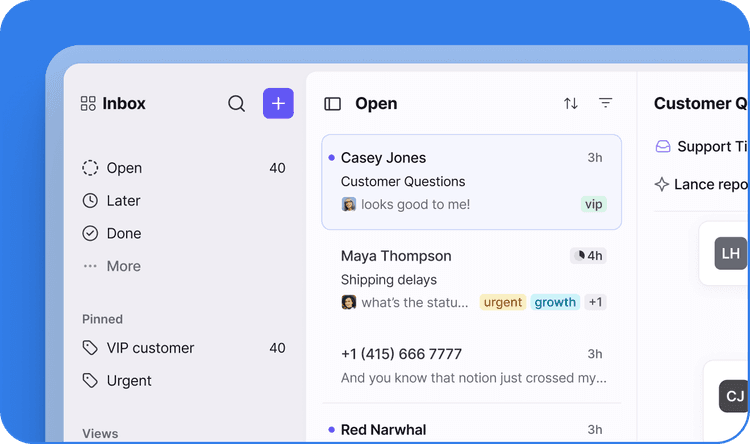
Front is that layer, bringing every team, tool, and customer interaction into one shared workspace. Teams maintain clear ownership without losing control of their workflows, and collaboration happens directly in the context of the work itself. The result: no lost context and no need to force complex customer relationships into rigid ticket queues.
Try the platform with your team today. And for a deeper look, read The Coordination Tax Report.
FAQ
What is the difference between a customer communication platform and a help desk?
A help desk tracks and manages tickets, while a customer communication platform connects conversations across teams and channels to preserve context as work unfolds.
What key questions should you answer to choose the best client communication tool for your needs?
Ask where the customer journey might break: which channels matter, where context gets lost, and how teams coordinate when volume and stakes increase.
What should you prioritize when evaluating a customer communication platform?
Focus on what holds up under pressure, such as shared context, clear visibility, intelligent automation, and systems that keep everyone in sync.