



Explore customer support auto-response examples that set expectations, clarify ownership, and keep B2B conversations moving across teams.
B2B customer service takes time. A customer emails about a billing discrepancy. Behind the scenes, your team needs input from finance, account management, and maybe a specialist, which means the honest answer is, "We don’t know yet, but we’re on it." The customer doesn’t see any of that coordination. All they see is silence, and silence reads as being ignored.
That’s what customer support auto-response examples are for — not just confirming receipt, but buying your team time to coordinate while the customer still feels informed. Here are six practical examples for the moments B2B support teams hit most often.
What is auto-reply in B2B customer support?
Auto-responses are automated messages that tell a customer where their request stands. The usual versions acknowledge a request, flag after-hours coverage, confirm a ticket number, send a status update, or point to self-service resources.
How it’s phrased matters less than what it actually tells the customer. A generic, one-size-fits-all auto-reply does more damage than no reply at all — it signals nobody’s paying attention, even faster than silence would.
6 auto-response examples for common B2B support scenarios
Here are some practical help desk auto-reply examples for day-to-day B2B customer support.
1. New support request acknowledgments
Send this the moment a customer’s request comes in, on any channel.
Example: “Hi [name], thanks for contacting us. We’re on it, and you can expect a response within [x] hours.””
The goal here is to reassure the customer and set expectations about your response time.
2. After-hours coverage
Send this message when a customer contacts you outside of your normal business hours.
Example: “Hi [name], thanks for your message. Our hours are Monday–Friday, 9 am–5 pm EST, so we’ll follow up when we’re back on [date/time]. In the meantime, our knowledge base has answers to common questions.”
B2B support requests are often urgent, so this message clarifies when your team will return and provides self-service options in the meantime.
3. High-volume or delayed response
Send this the moment you know you’ll miss your usual response window.
Example: “Hi [name], we’re sorry for the delay. Your issue needs more investigation and coordination across teams than we expected, and we appreciate your patience. You can expect a full resolution within [x] hours.”
The point isn’t the apology; it’s the updated timeframe based on what you now know about the work involved.
4. Urgent issue or incident updates
Send this proactively, on a channel customers will actually see in real time — Slack, SMS — when an issue affects multiple accounts.
Example: “We’re investigating an issue affecting [product/service]. You may have trouble connecting during this time. We’re aiming to restore service within [x] hours, with updates every 30 minutes.”
Speed matters here more than anywhere else on this list. The goal is to get ahead of the support volume this incident is about to generate.
5. Escalation or specialist review messages
When you escalate a ticket, send this the moment a ticket changes hands.
Example: “Based on our initial investigation, we’ve escalated this to our engineering team for deeper analysis. They’re working to reproduce and fix the issue, with an update by [date/time]. Thanks for your patience — [name].”
This customer service email response example is all about transparency. This is where most B2B support experiences quietly break: a handoff happens, and nobody tells the customer. This message closes that gap.
6. Billing or account review request
Send this for a specific, named request rather than as a generic acknowledgment.
Example: “Hi [name], thanks for reaching out. We’re pulling together your usage data and metrics so the review is as useful as possible, and your account manager will reach out to schedule a time."
This tells the customer their request is already in motion, not sitting in a queue.
Why auto-replies matter more in B2B than anywhere else
Automatic responses help B2B support teams manage expectations and update customers while requests move through the pipeline. These are the main benefits you can expect when you use automation to generate quick reply messages for business.
They get ahead of the question before it’s asked
When an onboarding issue lands with the implementation team, an auto-reply that explains next steps means the customer isn’t the one who has to ask what’s happening — you already told them.
They keep the customer oriented through every handoff
A conversation that starts with support and ends with a specialist has at least one moment where the customer could reasonably wonder who’s even looking at this anymore. An auto-reply at the handoff removes that doubt before it becomes a follow-up email.
They protect the customer experience when volume spikes
When your customer support team is struggling with high ticket volume, automated messages keep communication consistent and professional.
An urgent billing question that lands during your busiest hour doesn’t get a slower answer if the customer at least knows it’s been received and is moving. The wait becomes tolerable instead of alarming.
They absorb the "any update?" emails so your team doesn’t have to
A logistics client with a complex, multi-team issue is going to want updates. Auto-replies deliver those updates without pulling someone off the actual fix to type "still working on it."
What separates a good auto-reply from a placeholder
Front’s Coordination Tax report found that nearly two-thirds of companies have reported at least one customer-facing coordination failure in the past three months, including customers repeating themselves and messages missed because ownership was unclear.
A well-built auto-reply system is one of the more direct ways to close that gap. Here’s what that actually requires.
1. Say what happens next
Avoid vague descriptions or simple confirmations. Instead, use AI support tools to pull in relevant context and give customers a clear sense of what to expect.
"We confirm receipt" tells the customer nothing useful. Naming the team handling it, and when they’ll hear back — grounded in a real SLA, not a guess — does the job. If that estimate changes, update it.
2. Make ownership visible at every handoff
When a ticket moves, say so, and say who has it now. The alternative is a customer quietly wondering if their issue fell through a crack.
3. Match the channel
Your customers use multiple channels to communicate with you, so use those same channels for your automated messages. Auto-reply text messages, for example, should be short and simple, whereas an email can be longer and more formal. The same message copy-pasted across channels reads as if nobody thought about where the customer actually is.
4. Automate the update, not the relationship
Don’t rely too heavily on customer service automation. Auto-replies handle status; they shouldn’t replace the follow-up where an actual person adds context, empathy, or the detail a template can’t anticipate.
Front keeps auto-responses tied to what’s actually happening
The auto-reply is what the customer sees. What matters more is whether it’s telling the truth about what’s happening behind it.
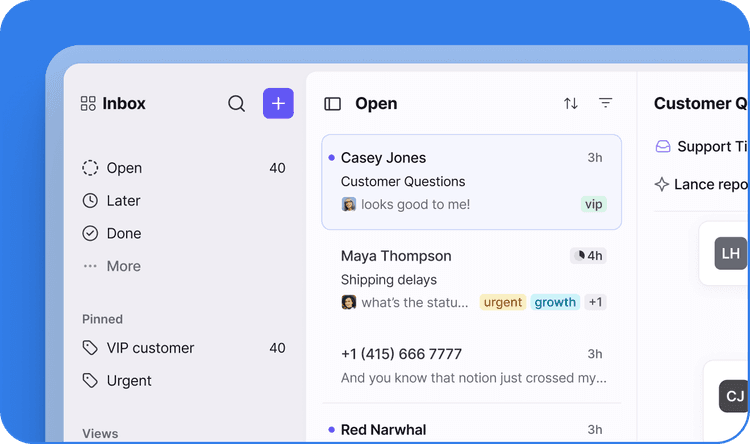
Front is the customer operations platform that lets you build auto-reply rules around the moments that matter — a new request, a missed SLA, a handoff to another team — so customers get an update at the moment it’s true, not a generic message disconnected from what’s actually happening. Set the rules once, across every channel, and Front handles the messaging while your team focuses on the resolution itself.
Book a demo to explore how Front helps B2B support teams keep automated responses, context, and follow-up work connected.