




Explore real examples of bad customer service in B2B operations, from disconnected teams and unclear ownership to inconsistent communication.
Ask someone about their worst customer service experience, and the stories tend to sound similar: an onboarding process so frustrating they gave up on the product, a chatbot that wouldn’t hand them off to a human, or the third support conversation of the day spent re-explaining the same issue.
The details change, but the root cause is often the same. In B2B, issues are high-context by default — resolving them usually means pulling information and decisions across multiple teams and workflows. A single missed handoff is enough to derail the experience. Front’s Coordination Tax Report found that 64% of companies experienced at least one customer-facing coordination failure in the last three months.
The good news is that these failures follow predictable patterns. Once you can name them, you can fix the operational gap causing them instead of just coaching the person on the front line.
What bad customer service looks like in B2B
In B2B, poor customer service rarely comes down to one rude interaction. It shows up as repeated explanations, inconsistent answers across channels, and escalations that stall out with no clear owner.
These experiences aren’t usually intentional, and they rarely start with the person the customer is talking to. They emerge when conversations, context, and accountability break apart as work moves across teams and systems. What gets labeled as bad customer service is often a coordination failure happening one step removed from the conversation itself.
Consequences of poor customer service are expensive. Front’s research on the state of service expectations found it can take as few as three negative experiences before a customer ends the relationship entirely. In B2B, where deals often involve multiple stakeholders and a renewal cycle, that’s not a lot of room for error.
This article breaks down six common bad customer service examples in B2B, the coordination failure behind each one, and how to address the issue.
6 B2B bad customer service examples and how to address them
1. Customers repeat information across teams
A logistics customer reports a shipping-sync error once, then explains it again to support, and a third time to engineering. The issue eventually gets resolved, but the customer had to act as the system of record at every step. Each handoff sheds context because teams lack visibility into conversations happening in other tools and departments.
Solution: Make context transferable instead of something customers have to re-supply. A shared conversation history, internal collaboration tools, and documented handoff steps ensure every team has what it needs before engaging the customer. No one should have to repeat themselves just because work changed hands.
2. Requests get passed along without clear ownership
A new customer hits an integration issue during onboarding. The customer success manager escalates to technical support, who forwards it to engineering. Meanwhile, the customer asks for updates and gets different answers from different people. Days pass, and no one is actually accountable for driving the issue to resolution. In other cases, an AI agent gives an incomplete answer with no path to a human who could help further.
Solution: Establish total ownership, where a single customer-facing owner stays accountable until resolution, even after work is escalated elsewhere. Before handing a ticket off, the current owner should document the issue, the context, and what’s already been tried in a shared system. The customer should always know who’s responsible and when to expect an update.
3. Automation creates confusion during complex issues
A customer asks a company’s chatbot about an issue, and no matter how they rephrase the question, the bot can’t parse it. What follows is a maze of "Did you mean…?" prompts that never get to the actual problem.
Customer service automation is well-suited to predictable, routine requests. But its limits show up fast once nuance and context enter the picture — and AI still can’t match a human’s ability to switch context and coordinate across a complex situation.
Solution: Automation should be scoped to what it’s actually good at, with a fast, obvious handoff to a human the moment a request gets complex. The goal of every interaction is to understand the underlying problem, not just process the literal input.
4. Escalations lose context and reset the clock
A customer is on the phone with a rep when the issue needs to go to a manager. The call wasn’t recorded and no notes were taken, so the customer has to explain the issue again and loses a few details in the retelling that end up mattering.
When critical information lives in private inboxes and disconnected systems, every escalation effectively resets the resolution clock. Without shared visibility into prior decisions and actions, teams waste time reconstructing history instead of resolving the issue in front of them.
Solution: Maintain a shared source of truth that every team involved in a case can access. Before escalating, the current owner should centralize what they’ve learned and what they’ve already tried, so the next person picks up where the last one left off instead of starting over.
5. Teams rely on manual follow-ups
One particularly communicative customer keeps a rep busy constantly updating spreadsheets, taking notes, and pushing context to other teams. That work matters, but it’s also time-consuming, and it’s bandwidth that comes directly out of the time available for every other customer who needs help.
For many B2B teams, coordination happens through constant follow-up and individual effort rather than a workflow built to keep work moving on its own. Every additional update request becomes another task competing with more impactful work.
Solution: Before adding another manual process or spreadsheet, look for what can be automated or built directly into the existing workflow. Where possible, let systems track progress and prompt the next action instead of relying on individuals to remember every step.
6. Service quality becomes inconsistent as operations scale
A marketing push drives a spike in incoming leads. As the team evaluates each new inquiry, they have less time for existing customers. Slower responses, inconsistent answers, and fragmented communication accumulate into a broader sense that service quality is declining.
Scale magnifies these service problems. As customer volume grows and more teams get pulled into delivery, inconsistencies that were once manageable become impossible to miss. Without an intentional customer support operations strategy, complexity compounds faster than teams can keep up.
Solution: Before scaling operations, continuously review customer feedback, response-time trends, and common friction points to find the gaps. That’s where systems need to be built out before volume increases, not after.
What unaddressed coordination failure costs teams
You can’t improve customer satisfaction or fix someone’s experience overnight. But leaving these patterns unaddressed has costs that add up well past any single interaction.
Operational inefficiency: When context drifts across spreadsheets and side conversations, coordinating the work starts to take up more time than doing the work itself.
Team burnout and turnover: Constant follow-ups and manual handoffs create invisible work that drains productivity. Over time, that’s what pushes good people out the door.
Lower retention: Inconsistent experiences and unresolved friction give customers a reason to look elsewhere, even in relationships that otherwise look healthy.
Keep customer work connected with Front
Most customer service problems start with a coordination gap, not with an agent who didn’t try hard enough. When conversations move between disconnected tools and teams, history becomes harder to track, and resolution times stretch as teams spend more effort coordinating work than completing it.
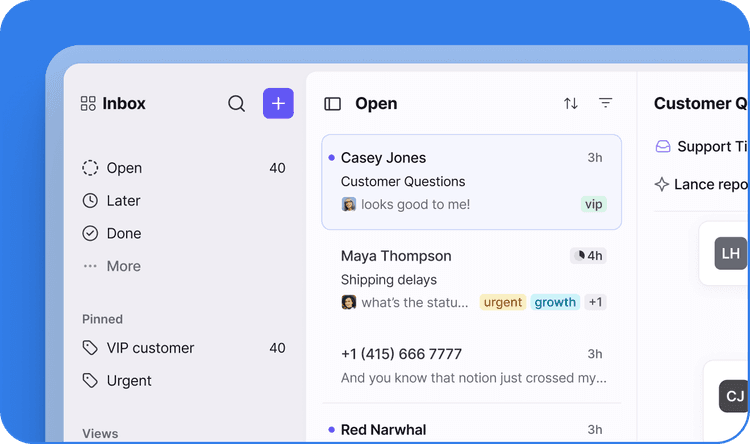
Front brings customer work and coordination into one place. Shared inboxes keep collaboration and context connected in a single thread, so no team enters a conversation blind. Autopilot handles routine requests end-to-end, while Copilot gives agents context-aware suggestions on the complex ones. @mentions bring the right person into a conversation without a handoff that loses context along the way.
With Front, your team coordinates without switching tools, and customers get faster, more consistent resolutions.
For a deeper look at how coordination overhead affects service quality, read Front’s Coordination Tax research.
Try Front for free today.