


What makes for a good customer experience in B2B? Explore B2B vs. B2C expectations, key elements, and real examples of reliable customer operations.
“Good customer experience,” or CX, has turned into a corporate catchphrase. Customers hold high standards and call out poor execution, so companies promise great CX whether or not they can actually deliver it.
But customers don’t buy the slogan; they judge the outcome. Was the answer right? Was the issue resolved quickly? Did the process feel smooth or exhausting?
In B2B, those expectations compound. Customers weigh the experience across months and years, not one interaction — so reliability and consistent follow-through matter far more than a single standout moment.
This article breaks down what good CX means in B2B, how to build it intentionally, and what leading teams are doing to get it right.
What makes a good customer experience: B2B vs. B2C
CX is shaped by every interaction a customer has with your product throughout their lifecycle.
In B2C, the bar is convenience: A good CX is finishing a purchase or fixing an issue fast, often in a few clicks. B2B raises the stakes. A good CX in B2B means accurate answers, efficient resolution, and continuity that holds across touchpoints — delivered consistently, again and again. Each interaction has to build on the last, because that’s what turns service into trust.
Why customer experience is important in B2B
B2B customers run their operations on your product, your platform, and your team. Every interaction carries real weight. One missed update or wrong answer can derail their day, and once mistakes become a pattern, customers begin to question your expertise.
That’s why consistency beats individual moments. Strong, repeatable experiences lift satisfaction and protect retention, while shaky ones make service gaps intolerable.
How to create a good customer experience
B2B teams don’t need another lecture about understanding the customer. They need CX advice that connects directly to daily work. Improving CX in B2B means building repeatable processes that deliver accurate, timely resolutions across the customer lifecycle. Start with the fundamentals.
Carry customer context into every interaction
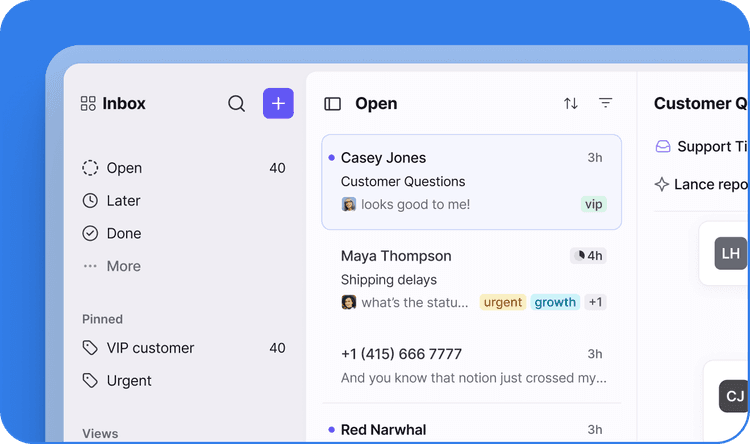
Nobody wants to re-explain their problem every time they reach out. This puts the coordination burden on them, increasing the time to resolution. Pull every customer interaction into one shared view, so everyone on the team sees the same history and the same context.
With shared context, teams can collaborate and pass the issue to the right person without losing momentum. A single workspace with internal threads keeps information connected and prevents the fragmentation that private chats and scattered spreadsheets create.
Set expectations your team can actually meet
A promise only holds if the operation behind it can back it up. A two-minute service response time sounds great, but it’s noise if your team can’t follow through.
The goal is to balance what customers expect — fast, accurate responses — with what your team can realistically deliver at scale.
Pressure-test it with a few practical questions: Do you have clear escalation paths? Can customers self-serve through a knowledge base? Can a chatbot or conversational AI clear the repetitive questions before they reach a person? These foundations turn response targets from aspirational numbers into commitments your team can actually uphold.
Make the right answers easy to find
Customers shouldn’t have to dig through outdated blogs, watch a 20-minute how-to video, or scroll endless community threads just to find a glimpse of an answer. They want a clear resolution, and they want it fast.
A well-maintained knowledge base delivers exactly that. Centralize your product information, and customers can solve the common stuff on their own. Connect that knowledge base to a chatbot or conversational AI, and the repetitive questions get handled automatically — freeing your support team for the conversations that actually need them. Routine queries get quick answers; complex issues get routed to the right person from the start.
Keep ownership visible when work crosses teams
In the past three months, 64% of companies reported at least one customer-facing coordination failure. The cause is usually the same: One team can see the work, the next team can’t.
When context drops during a handoff, the receiving team has to reconstruct the whole story — old conversations, past actions, notes buried in disconnected systems — before they can even start solving the problem. That’s why cross-functional alignment isn’t just an internal operations concern. Get it right and customers feel supported; get it wrong and they’ve had enough.
Good customer experience examples from teams that got it right
Teams that follow the CX best practices above feel the impact: less manual coordination internally and quicker resolution for customers. Here are three of those success stories.
1. Faster, higher-quality responses: Uber Freight
Behind every shipment — from fresh produce to gifts delivered to your doorstep — is Uber Freight, a digital logistics platform that connects shippers and carriers. Its operational teams coordinate thousands of loads every day while managing both first- and third-party tools to deliver an exceptional CX.
But that wasn’t always the case. As Uber Freight scaled, performance monitoring and accountability slipped. Teams juggled personal inboxes, shared workspaces, and distribution lists on separate platforms, and switching between accounts or teams often caused crashes or lost context.
So they replaced the fragmented stack with a single platform: Front. Where teams once spent half the day in email with no read on quality, collaboration now happens in one place, with no time lost chasing information down. Response times and quality both climbed — even as email volume grew.
“The cross-workspace, cross-functional collaboration has transformed how we work in ways I couldn’t have imagined,” says Jordan Dunn, Senior Manager of Strategic Customer Success.
2. Stronger SLA performance: Reed & Mackay
Reed & Mackay, a corporate travel management company, built its reputation on personalized service — a unique contact point and a backup consultant for each customer. Running relationships that way relies heavily on collaboration between operations and tech.
But their legacy tools couldn’t keep pace. Consultants bounced between multiple inboxes and backup accounts, which slowed responses and made the promised level of personalization tough to sustain.
Moving everything into Front unified conversations in shared email threads and preserved full context on every interaction. With Front Analytics and AI-powered workflows, they met service-level agreements (SLAs) easily and gained deeper visibility into team performance.
Despite complex customer needs, Reed & Mackay didn’t just meet SLAs — they surpassed them. “We normally exceed our clients’ SLAs by an average of 50%,” says Tanya Michaud, Global Operations Director.
3. Connected order context and routing: Mixam
Mixam, an online and on-demand printing company, helps creative businesses design, produce, ship, and sell creative work all over the world.
As it scaled, legacy systems turned into bottlenecks. Mixam’s custom-built internal dashboards ran its ecommerce workflows but had no automation, so every repetitive task got handled by hand — often with no clear owner.
Mixam chose Front for its flexibility: custom workflows, API integrations, and automation. Front auto-assigns tasks based on tags and categories, making sure each query lands in the right person’s inbox, no matter where it comes from. With Front Chat, Mixam controlled conversations in real time and used automations to handle FAQs, freeing the team to focus on complex issues that require undivided attention.
The outcome: First response times dropped 60%, and email and chat inquiries fell 16%. “With Front, we’re able to respond in under a minute, with an average resolution time of 16–18 minutes,” says Lucian Puca, automation and workflow lead.
Good customer experience needs an operational layer — that’s Front
Understanding what customers expect is the easy part. Delivering on it consistently across teams, channels, and touchpoints is the real work.
And it doesn’t happen when work gets handed off without context or automated without oversight. It happens when every team shares the same customer history, knows who owns the next step, and can collaborate without dropping the thread.
Front provides that operational layer. It keeps conversations, context, ownership, and next steps visible as work moves across the business. With that shared visibility, teams stay coordinated and deliver a consistent experience at scale.
See how Front protects the context your customer experience depends on. Get a personalized demo today.