



Companies using AI for customer service assign AI different roles to improve workflows. Explore six real-world examples of AI in customer service.
For B2B companies just starting with AI in customer service, the hard part is deciding which work AI should own. Give it too little oversight and it mishandles the sensitive issues that should have gone to a person.
Many companies struggle to find the right balance. Front’s Coordination Tax report found that 71% of B2B companies faced at least one significant AI issue in the past three months. In these cases, AI lacked the context it needed or handoffs fell apart, damaging the customer experience.
But the companies doing it right — leaning on AI while maintaining the right level of human intervention — are seeing benefits. Here’s how six of them structured their AI customer service workflows to run more efficiently without giving up quality.
How companies are using AI for customer service
Every AI for customer service deployment looks different, depending on the industry and how much judgment the work usually requires. These real-world examples of AI in customer service show what AI can do for a support operation.
Podium Education
Podium Education is an experiential learning platform that partners with universities and companies to connect students with career readiness programs. It uses a multi-step customer retention process that spans conversation and follow-up actions.
Instead of using AI only to answer questions, Podium puts AI inside the retention workflow itself. When a student says they’re no longer interested, Autopilot can send a follow-up to address their concerns, then automatically categorize and log the conversation in Salesforce if the student still opts out. Anything that needs judgment or sensitivity routes to a person with the full conversation context intact.
Podium’s implementation of AI in customer service shows that AI can participate in retention and customer engagement processes that span multiple steps. The key is that the workflow defines where AI hands off and maintains context during the transfer.
Central Storage & Warehouse
Central Storage & Warehouse (CSW) is a third-party logistics provider specializing in temperature-controlled warehousing, operating facilities across the Midwest. Its teams coordinate scheduling requests across locations for food manufacturers. Most of those messages include a PO number, requested dates, and whether it would be inbound or outbound.
A scheduler used to manually read the emails, copy the information over to a separate tool, and respond based on dock availability. Now, CSW has automated repetitive booking requests with Autopilot, so requests move through a defined process without manual intervention. Unusual inquiries and higher-stakes changes still surface for human review instead of staying in the queue.
Fathom
Fathom is a meeting recording and AI notes platform. Its support team handles a wide range of customer queries, from quick setup questions to billing disputes and technical questions.
Fathom sorts customer needs into three tiers by how much judgment they take: fully automated, AI-assisted, and human-led. Fully automated workflows handle predictable inputs like meeting names, dates, and times. AI-assisted workflows use Front Copilot to draft replies from help center content, but a support rep checks accuracy and tone before it goes out. Human-led workflows cover high-emotion escalations, revenue-impact issues, and apology moments where the team wants AI to stay out of the conversation entirely.
Fathom’s team uses more than 65% of Copilot’s suggested replies. After implementing the tool, the company’s average response time improved by 60% year over year, even as total conversation volume increased by more than 41%.
Hermes Worldwide
Hermes Worldwide is a private luxury ground transportation company based in Denver, with teams managing 24/7 operations for clients around the world.
Before adopting AI-powered quality assurance (QA), Hermes performed manual QA by randomly sampling emails. A small, random sample gave managers an incomplete picture of quality patterns. With Front’s Smart QA, AI now automatically evaluates every client communication against the team’s standards for comprehensiveness, professionalism, tone, and personalization.
Hermes uses weekly score reports to analyze where the team members excel at meeting customer needs and where they need coaching. AI expanded the team’s visibility into QA from a random handful of emails to the full volume of customer conversations. Managers receive key insights into customer satisfaction patterns, which they use to coach the customer service reps.
Boundless Immigration
Boundless Immigration simplifies the U.S. immigration process for individuals, families, and businesses. With a 99.7% success rate for processing applications, the company is focused on accuracy. Wrong answers on immigration questions carry real consequences for customers.
Boundless uses Front’s AI knowledge base to give its AI chatbot an accurate source for answers. The company also uses AI to consistently categorize its high volume of emails and calls. The operation has saved more than 10,000 hours per quarter by implementing Front’s AI-powered features.
Uber Freight
Uber Freight connects shippers and carriers across a fully digital logistics ecosystem. Its operational teams handle complex requests where a single email thread can run 20 messages deep.
Uber Freight uses Front’s AI Summarize feature to give support reps and managers an overview of a long thread in seconds. The summary lets team members quickly decide whether they need to read deeper or can act on the overview.
AI’s job in this workflow is recovering the context a person needs before they act. Across a high volume of daily conversations, the customer support operations benefit is significant.
AI customer service best practices
The right level of AI involvement varies by company, but the best AI customer service solutions have one thing in common. They let teams make deliberate decisions about context and handoffs before allowing AI agents to interact with customers.
In B2B, customer service automation works when the system around it is designed for complexity. Companies have found success with the following approaches.
Keep humans on the high-stakes work
Focus AI use on predictable, straightforward tasks, while maintaining more human involvement on anything with high emotional stakes. How much judgment a request takes should decide whether AI owns it, assists on it, or stays out entirely.
Phoebe Killick, an engineer in Front’s AI team, emphasizes that successful AI adoption requires teams to know their members’ customer support archetypes. Different people bring different strengths to workflow adaptation, and leaders who understand those differences can roll out AI in ways the team really finds useful. Clearly defined guardrails ensure everyone knows what the AI agent is responsible for and when the reps are expected to step in.
Give AI the context it needs
AI tools are only as good as the knowledge, conversation history, and customer context they can reach. Without those inputs, they make calls on incomplete information.
Front’s Coordination Tax report found that 48% of operations leaders said they need AI to understand context across multiple teams and systems, making it the most requested AI capability. Make sure any tool you use can reach the relevant context every time it makes a decision.
Design the handoff before you launch
Before you turn on an AI agent, define when the agent should escalate, who takes over, and what context moves with the conversation. This is an area where many teams struggle; the Coordination Tax report found that 22% of companies experienced AI losing context during handoffs, and 20% experienced AI routing requests incorrectly.
This doesn’t mean that every interaction requires human review. AI tools can often handle basic conversations without human oversight. You just need a clear plan for when work falls outside its range.
Measure whether outcomes improve
Automation rates tell you how many conversations AI handled, but they don’t indicate whether the customer’s problem was really resolved. Luke Atkins, an AI support programs specialist at Front, highlights that a fast, accurate response creates more work down the line if it reads as purely transactional to the customer. Evaluate AI-assisted conversations on customer satisfaction, not just activity.
Front keeps AI tools connected to context
The examples show what’s possible with the right approach. When AI customer service software fails, it’s often because the tools are operating in isolation from the context surrounding conversations. Front gives support teams a single platform to coordinate AI tools and people across the same customer workflows, whether through Front’s built-in AI or custom-built automation.
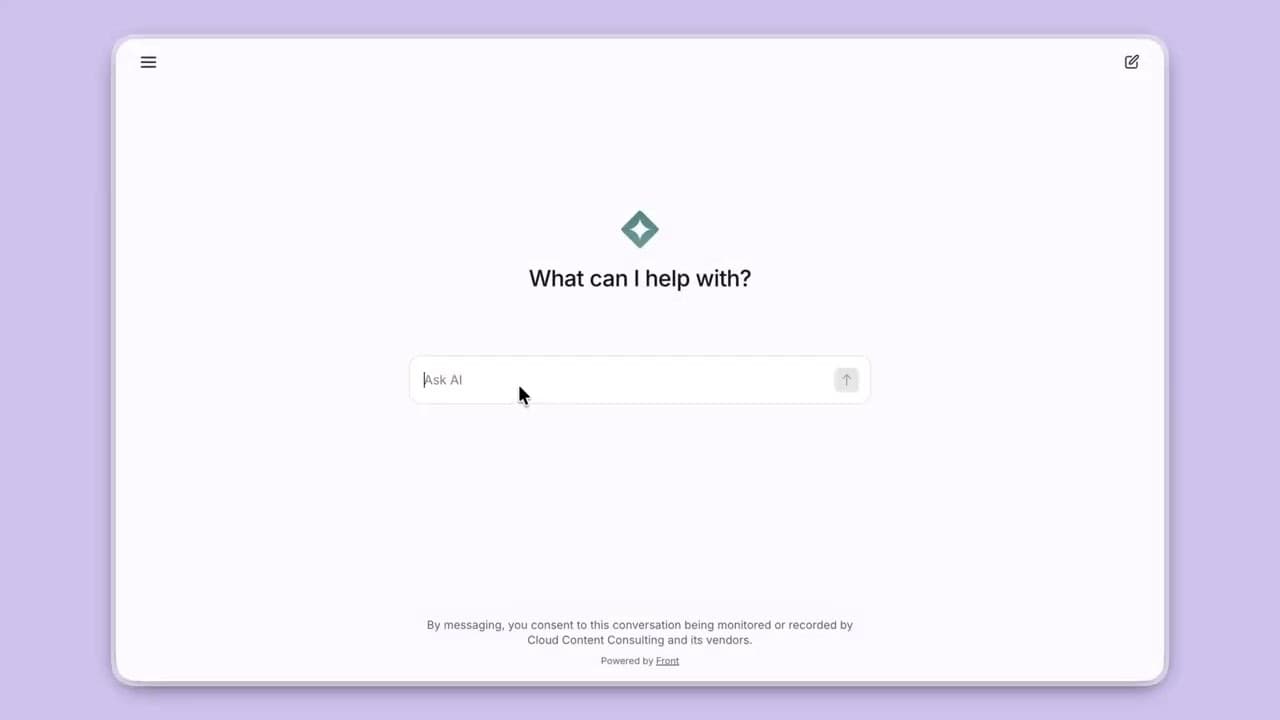
Autopilot handles routine work that follows defined processes. Copilot works as an AI assistant that helps support reps respond faster with suggested replies based on conversation history and the team’s knowledge base. With both, teams maintain control over what they automate and what they handle themselves.
Request a demo to see how you can benefit from the tools that fueled these companies’ success stories.