



Discover how knowledge-centered service (KCS) helps B2B teams improve their operational consistency, service quality, and customer outcomes.
A tricky integration issue nearly stumps your team, but they get to a fix. The customer’s happy, everyone moves on. Then a month later, a near-identical problem lands with a new teammate who has to start from scratch because nobody documented the original conversation or the solution.
Knowledge-centered service (KCS) exists to stop exactly that. It’s the practice of continuously capturing important information and making it available to the whole team through a shared knowledge base. The more you add, the faster your team finds answers, and the more efficient your service gets.
KCS especially matters in B2B, where teams need a consistent reference point as they coordinate work across teams and systems. Front’s Coordination Tax report found that 64% of B2B companies hit at least one customer-facing coordination failure in the past three months, and KCS is one way to tighten collaboration and cut those failures.
Find out what KCS is, its core principles and best practices, and how you can use it to strengthen your customer operations.
What is knowledge-centered service?
A static KCS database of documentation that no one ever uses won’t help much. KCS is a living process, by design. It works by capturing knowledge continuously, so teams can reuse that insight in the next interaction.
It helps to connect your knowledge base with your customer service dashboard so your teams can easily search for answers and update articles without switching apps. Done right, KCS becomes a feedback loop: The knowledge base keeps improving, teams deliver faster service, and every interaction feeds more insight back in.
Say a commercial client of a financial services firm submits incomplete documentation during a loan review. Support has to gather the right documents, coordinate approvals with underwriting and compliance, and keep the customer posted — and, along the way, add clearer documentation guidance to the self-service tools so the next client doesn’t hit the same wall.
Why knowledge-centered service becomes essential as organizations scale
When companies grow and take on more customers, they have more policies, product details, and other knowledge to document. Here’s why KCS matters more as you scale.
Retains customer knowledge
If a customer issue goes undocumented, your team won’t know how to solve it the next time a similar one shows up. As volume climbs, your service quality can slip because it takes longer to find things like a customer’s interaction history.
KCS principles fix this by capturing knowledge right in the flow of customer work. Keep your knowledge sources current, and you give your team what it needs to solve the next problem faster.
Enables consistent customer experiences
When a scaling company rolls out new software, multiple clients may hit the same integration issue. Several teams get pulled into the fix: support handles client communication, development works the code, and product checks whether the change affects other features.
To work together and give customers consistent answers, all those teams need access to the same documentation with the latest details on the integration issue. A shared, up-to-date knowledge base fits the bill.
Reduces duplicate work
When issue volume rises but knowledge management is weak, teams keep solving the same problems twice. Someone fixes it one week, and someone else fixes the identical problem the next, because they never saw the original context.
KCS cuts that out by giving teams a shared view of the latest customer context, product details, bug fixes, and policy updates. They spend their time on new problems instead of re-solving old ones.
Strengthens organizational knowledge
As companies grow into higher issue volumes, they need efficient workflows. KCS gathers knowledge from every conversation to make the next one go faster.
U.S. immigration services provider Boundless Immigration uses Front’s AI-powered knowledge base software to document new information from customer conversations and make it available to teams as they work on future issues. Between the knowledge base and Front’s other features, the company now saves more than 10,000 hours a quarter.
How high-performing B2B teams make the KCS methodology work
Front’s Coordination Tax report found that the typical B2B company spends nearly three hours coordinating for every hour spent solving customer problems. Sharper KCS is one way to get some of that time back. These are the approaches that work.
Don’t wait to make updates
It’s tempting to wait until an issue is fully resolved before documenting it, but new work can pull you away and then it never happens. Document new knowledge during the conversation instead.
A knowledge base connected to your customer operations platform can pull content straight from conversations and tickets, so reps can capture the specifics mid-interaction. Tools with AI can automatically draft new knowledge base content and handle editing and translation.
Maintain shared responsibility
Give your teams shared responsibility for maintaining and updating the knowledge they all depend on, so the work doesn’t all fall on one team.
A manufacturer might get multiple reports of the same product defect after a new production run. As support works with quality assurance and operations to resolve each case, it captures the troubleshooting steps and product guidance to speed up future responses, while operations owns adding the details of how the defect was fixed.
Let customer conversations expose knowledge gaps
When customers keep asking the same question, that’s a signal to update your self-service knowledge base. Study your analytics dashboard to spot the popular questions and use them to sharpen your documentation.
Read the qualitative feedback from customer satisfaction (CSAT) surveys, too, paying special attention to the unhappy responses. Complaints expose gaps you can fill with new or updated articles. Some tools use AI to analyze conversations in bulk and suggest knowledge base improvements.
Measure how knowledge improves customer operations
KCS is about capturing knowledge, but the goal isn’t a bigger pile of articles. Measure the customer outcomes you set out to improve.
Track response and resolution times to see how your knowledge process speeds up fixes. Watch for fewer repeat requests, more self-service resolutions, higher CSAT, and lower customer effort scores.
Level up your knowledge-centered service with Front
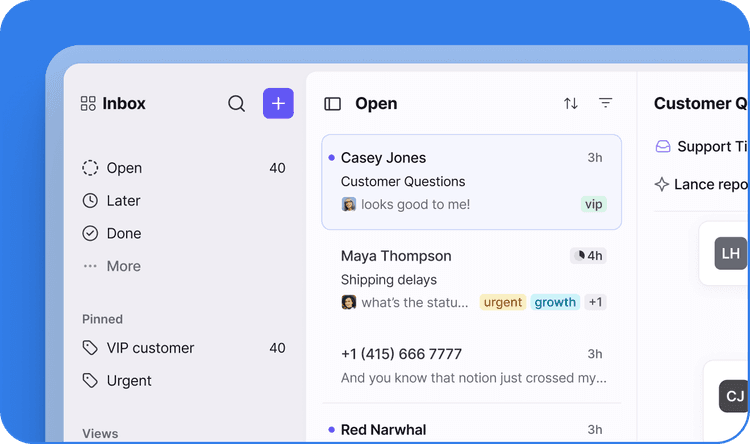
Front embeds knowledge directly into customer operations. Teams can see documentation and knowledge base answers alongside customer conversations, so they can easily update the knowledge base as they work. The result is faster, more consistent customer responses.
The day planning app Structured supports 1.5 million monthly active users spread across the globe with a one-person customer support team. It uses Front’s AI chatbot to answer most queries by pulling from knowledge base articles. The strategy is working well; Structured has thousands of five-star ratings on Apple’s App Store.
Most B2B support teams have more than one person, but the principle holds: Strong KCS cuts repetitive work and keeps support consistent and high-quality at scale. For complex B2B operations spanning multiple teams, a reliable, constantly updated knowledge base isn’t optional.
Request a demo to explore how Front helps organizations turn customer knowledge into an operational advantage.
FAQ
What does KCS stand for?
In customer operations, KCS stands for knowledge-centered service. It’s sometimes also called knowledge-centered support.
How do AI tools support knowledge-centered service?
AI tools make it easier to keep a knowledge base updated by automatically identifying knowledge gaps and drafting articles for teams to review. AI agents, assistants, and chatbots can also pull from knowledge base content to give teams and customers instant answers.
How often should organizations review knowledge articles?
KCS is ideally a continuous process; you add to and update knowledge articles after every interaction. You can also do a regular review every quarter and additional refreshes every time there’s a major change to your products or policies.
How do you measure the success of a knowledge-centered service program?
Measure time to resolution and first contact resolution to see if your KCS knowledge management system is helping teams resolve issues more quickly. Also look for improvements in CSAT.