



Learn what cross-functional collaboration is, why it matters for B2B teams, and how to improve coordination, ownership, and operational visibility.
A logistics customer reports a delay in an important shipment. While the clock ticks, the customer service team needs to coordinate with dispatch, operations, and account management to resolve the issue quickly and give the customer an updated delivery time.
In B2B, this kind of cross-functional collaboration is routine. Front’s Coordination Tax report found that the typical B2B company spends nearly three hours coordinating for every hour solving customer problems. The more teams an issue touches, the harder it gets to keep ownership and customer context intact through the handoffs.
You can win that coordination time back with better collaboration workflows. Here’s what cross-functional collaboration is, the coordination challenges it creates, and the best practices that make it work.
What is cross-functional collaboration?
Cross-functional collaboration is when people from different departments and areas of expertise work together. In B2B customer service, it’s coordinating customer work across teams, and it works best when every issue keeps a clear owner through the whole process.
Take the Central Storage & Warehouse (CSW) team as an example of cross-functional collaboration in action. The company once managed thousands of daily emails across five different warehouses using separate systems. By bringing all five warehouses together into a single customer support platform, the company improved coordination and achieved benefits of cross-functional team collaboration. This reduced scheduling time by 90% and enabled CSW’s customer service team to run 20–30% leaner.
Why scaling makes cross-functional collaboration harder
Plenty of companies struggle with it. In fact, Front’s Coordination Tax report found that 64% of companies experienced at least one customer-facing coordination failure in the past three months. As businesses grow, working together becomes harder.
Customer work typically involves multiple teams
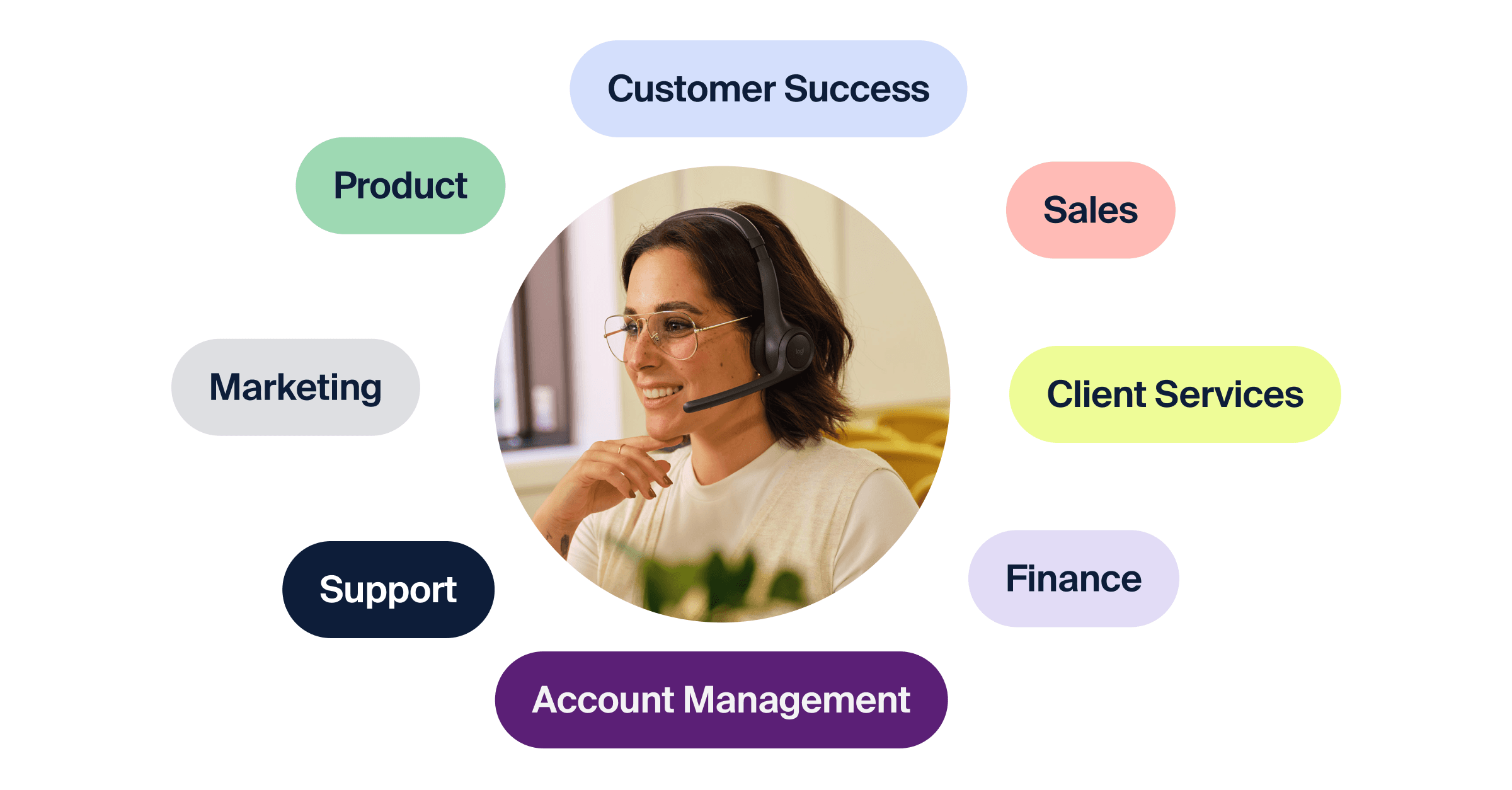
B2B customer inquiries often start with the customer support team, but then involve the engineering, product development, finance, sales, or marketing teams. These teams then need to align on decisions, often under severe time pressure.
A manufacturing customer might report a recurring product defect just before a scheduled delivery. To solve it, quality assurance needs to investigate the defect, while operations adjusts production timelines, customer service updates the customer, and the sales or customer success teams manage the account relationship. All those teams need to share information and work to the same goals, which can be difficult in practice.
Teams lose context during handoffs
Every handoff can lead to lost context, duplicate work, or inconsistent customer experiences. Scaling companies with frequent handoffs are especially at risk.
Say a financial services support team passes a commercial loan application to underwriting without the right documentation. Underwriting asks the customer for documents they’ve already sent, the customer gets frustrated, and the team burns time hunting for paperwork against a regulatory deadline.
Disconnected systems create inconsistencies
As companies grow larger, they might start introducing new tools. If they use multiple communication platforms and other apps without syncing them together, customer context and account information won’t remain up-to-date within every tool. Teams lack access to important information they need to make decisions.
Take a SaaS customer reporting a critical bug after a major update. Product engineering works the fix, but the account manager and customer success team are in a different system, can’t see the progress, and quote the customer an unrealistic wait time.
Coordination work can outpace customer work
As volume climbs, coordinating across teams gets harder. Teams can spend so long assigning tasks and figuring out who owns the next step that there’s little time left to solve the problem.
GLT Logistics, for instance, struggled to manage more than 14,000 emails a month, with no clear way to track ownership. Team members often called out across the room to coordinate customer work. After moving to a single Front workspace with clear ownership on every conversation, GLT eliminated duplicate work and cut email processing time by 83%.
How to improve cross-team collaboration
For effective collaboration in the workplace, you need technology that maintains clear ownership and standard workflows across teams. These approaches help you build collaboration into your customer service operations.
Define ownership early
Document which team owns each stage of the customer journey. When one team passes work to another, the handoff should carry the full context and a clear owner for the next step.
Do this with customer service software that makes ownership visible to every team on the issues, so everyone knows the current status and can update customers accurately.
Standardize workflows across teams
Build a playbook every team follows, so nobody’s guessing mid-collaboration. Create routing rules that specify which types of conversations go to which teams. Define when issues need manager approval or should be escalated to specialists. You can create standard customer service workflows for day-to-day problem resolution or customer relationship management.
Centralize customer information
Moving from a pile of tools to one customer operations platform makes collaboration far easier. Make sure it keeps context visible to every customer-facing team, so anyone can pull up past conversations mid-issue and keep the record current.
Centralized context helps your teams offer a consistent customer experience. An account manager and customer success team can give customers accurate updates if they share the same platform as the engineering team.
Continuously measure and adjust
As you improve how teams collaborate, measure and refine. Watch how work is distributed across people and tools, monitor handoffs and escalations, and treat slow response times as a signal of a bottleneck or recurring friction. As the team grows and processes change, adjust.
Cross-functional collaboration works best when customer operations stay connected
Strong cross-team collaboration depends on connected customer operations: a shared view of every conversation, updated in real time, with clear accountability for who’s resolving the issue.
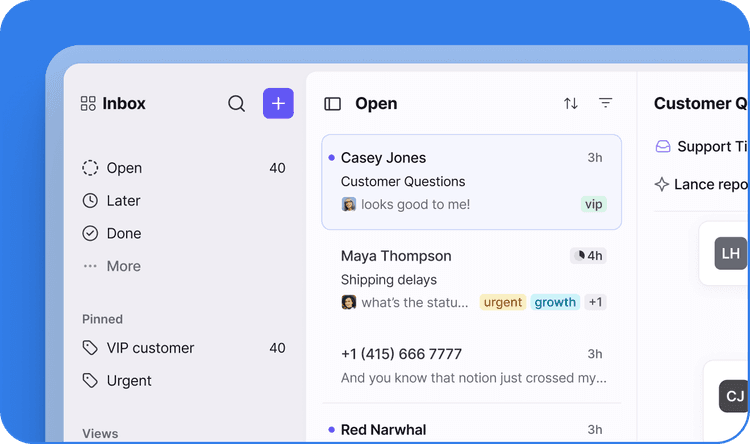
Since Front’s customer operations platform is built for B2B complexity, it helps teams work together more efficiently while dealing with multiple stakeholders across different communication channels. Collaboration tools like internal notes, assignments, and collision detection make it easier to stay accountable and avoid duplicate work, while automated workflows move conversations between teams smoothly.
Gattinoni uses Front to route more than 7,200 daily emails across 166 team members while maintaining operational coordination at scale. The company reported that Front’s intelligent workload distribution model helped it gain 15% faster response times.
Schedule a demo to explore how Front can help your company coordinate customer work across departments and keep every conversation connected.
FAQ
What are the biggest barriers to cross-functional collaboration?
Common barriers to cross-functional collaboration include a lack of shared systems and workflows or the use of tools that don’t maintain clear ownership during handoffs.
What tools support cross-functional collaboration in customer operations?
You can support collaboration with a customer operations platform built for B2B complexity. You can also opt to use a combination of tools, like a customer relationship management system integrated with separate project management software.
How do you measure cross-functional collaboration?
To determine the success of your efforts to boost collaboration, set up a dashboard to track metrics like response times, customer satisfaction, escalation frequency, and handoff times.
What is cross-functional team management?
Cross-functional team management involves leading people from different departments and aligning them around shared goals, responsibilities, and priorities.