



Central Storage & Warehouse (CSW) keeps America’s food supply moving. As a third-party logistics provider specializing in temperature-controlled warehousing, CSW manages over one million square feet across five Wisconsin facilities, storing everything from frozen food to life sciences materials held at -70 degrees Fahrenheit.
Operating 24 hours a day, six days a week, CSW processes thousands of daily emails from manufacturers, carriers, and logistics partners to keep hundreds of trucks moving in and out daily.
“At our core, we are a service company,” explains Hill Hamrick, Co-CEO. “That means being flexible for our customers, reliably hitting performance standards, and remaining highly responsive - quickly communicating issues and delivering actionable solutions.”
Those principles define how CSW competes. But a few years ago, the tools behind CSW were breaking down.
Challenge
Siloed inboxes and zero visibility
Before Front, much of CSW’s communication ran through shared email addresses - one per warehouse. Every customer service representative (CSR), supervisor, and manager received every email that hit the inbox. Half the team used Gmail; the other half used Outlook. Every employee built their own folder structures, tagging systems, and workarounds to manage the flood of inbound emails. Some attempted Inbox Zero. Others had thousands of unread messages every day.
“It was just chaos. We struggled with getting back to customers, we weren’t getting the information we needed to the right people. There was no organization.”
Supervisors splitting time between the dock and the desk struggled to pull actionable insights from the noise. CSRs assigned to specific accounts became single points of failure. “The second a CSR clocked out or went on vacation, that customer wouldn’t get the full service we expect,” Hill says. “As a 24-hour operation, we knew we had to find a better way.”
Five warehouses, zero visibility between them
The problem ran deeper than messy inboxes: each warehouse operated as an island. If a Madison CSR was overwhelmed, a Kenosha CSR couldn’t easily jump in to help. They had few mechanisms to share context or redistribute the workload. “There was limited benefit to being part of a broader company," Hill says.
This isolation was especially challenging for urgent inventory hold requests - when a customer flags that specific goods cannot leave due to safety or quality issues. These often arrive late at night and require zero margin for error; shipping held inventory triggers a product recall. “Those are the emails you cannot miss,” Hill says. “You have to make sure the right person sees it.”
Solution
Building infrastructure for scale
“We knew this problem existed for other logistics companies too,” says Hill. “We just needed to figure out how to collaborate better and stop our teams from operating in silos.”
CSW evaluated Front against several competitors, but the choice came down to the nature of their work. CSW handles thousands of unique, high-stakes communications across five locations daily - each demanding judgment, coordination, and speed. “We receive a high volume of emails and each one is a unique request,” Hill explains. “Our challenge is organizing it internally, routing it to the right person, and executing a swift response.”
Today, Front sits underneath everything CSW does. The team deliberately chose not to adopt Slack or Teams, instead consolidating all communication into Front to maintain a single source of truth.
“Front underlies every single thing we do as a company.”
CSW consolidated into a single Front workspace spanning all five facilities. Shared inboxes are organized by warehouse and by function: appointments, inventory management, and core operations each have dedicated inboxes with automated rules for tagging, assignment, and SLA escalation.
This structure unlocked cross-warehouse collaboration that was previously impossible. Any CSR can now support any facility. A team member in one warehouse can pick up a conversation from another location without missing context. When workload spikes at one site, the broader team absorbs it.
A culture built on better communication
The team runs shift turnover discussions three times daily. Managers post summaries of what happened during their shift, and leadership comments directly in the thread with feedback, flags, or priorities for the next eight hours. These ongoing discussions function like Slack channels but live alongside the customer conversations they reference.
“We’re sharing emails all the time,” Hill says. “It’s very similar to how companies use Slack, and we’re able to accomplish all the email transactions that we do and get the best out of what Slack offers, all in one spot.”
For inventory hold requests, Front’s tooling provides layered protection. Tags and views surface anything resembling a hold request. Three levels of management get pulled in automatically. Timed SLA notifications escalate if action stalls. A knowledge base article inside Front walks the team through exact procedures for every scenario.
“I can tell my customers: here’s how we manage this, here’s how we protect against any miscommunication,” Hill says. “There’s three levels of escalation, these people get notified at these times, here’s our procedure stored within the same software, and here’s how we execute on that.”
The positive response from customers has led Hill to demo Front during account meetings on multiple occasions. “I can think of four or five times when I’ve described our workflows and it leads to a Front demo for them evaluating it for their own internal processes.”
90% less time scheduling
CSW’s warehouses run on appointments. Every inbound and outbound shipment needs a scheduled dock time, and the requests come in the same way: an email from a carrier with a PO number, a requested date, and whether the load is inbound or outbound. Before Autopilot Playbooks, CSW’s scheduler handled every one of those emails manually. She’d read the email, open CSW’s warehouse management system, check dock availability, switch back to Front, type a confirmation using the same email template, copy the appointment code, and go back to the management system to finalize. The same information, copied between the same two systems, throughout the day.
“The scheduler would pull her hair out trying to manage the daily flow of emails,” says Dan Fritsch, Director of Operations. When she went on PTO, coverage scrambled. General managers would try to fill in, but all the knowledge lived in one person’s head.
Autopilot Playbooks changed the workflow at the source. CSW activated Playbooks on their scheduling inboxes across facilities. Now, when a carrier emails requesting a dock appointment, Autopilot reads the message and uses a Playbook to extract the same information the scheduler had to hunt for. That data flows directly into the scheduling workflow.
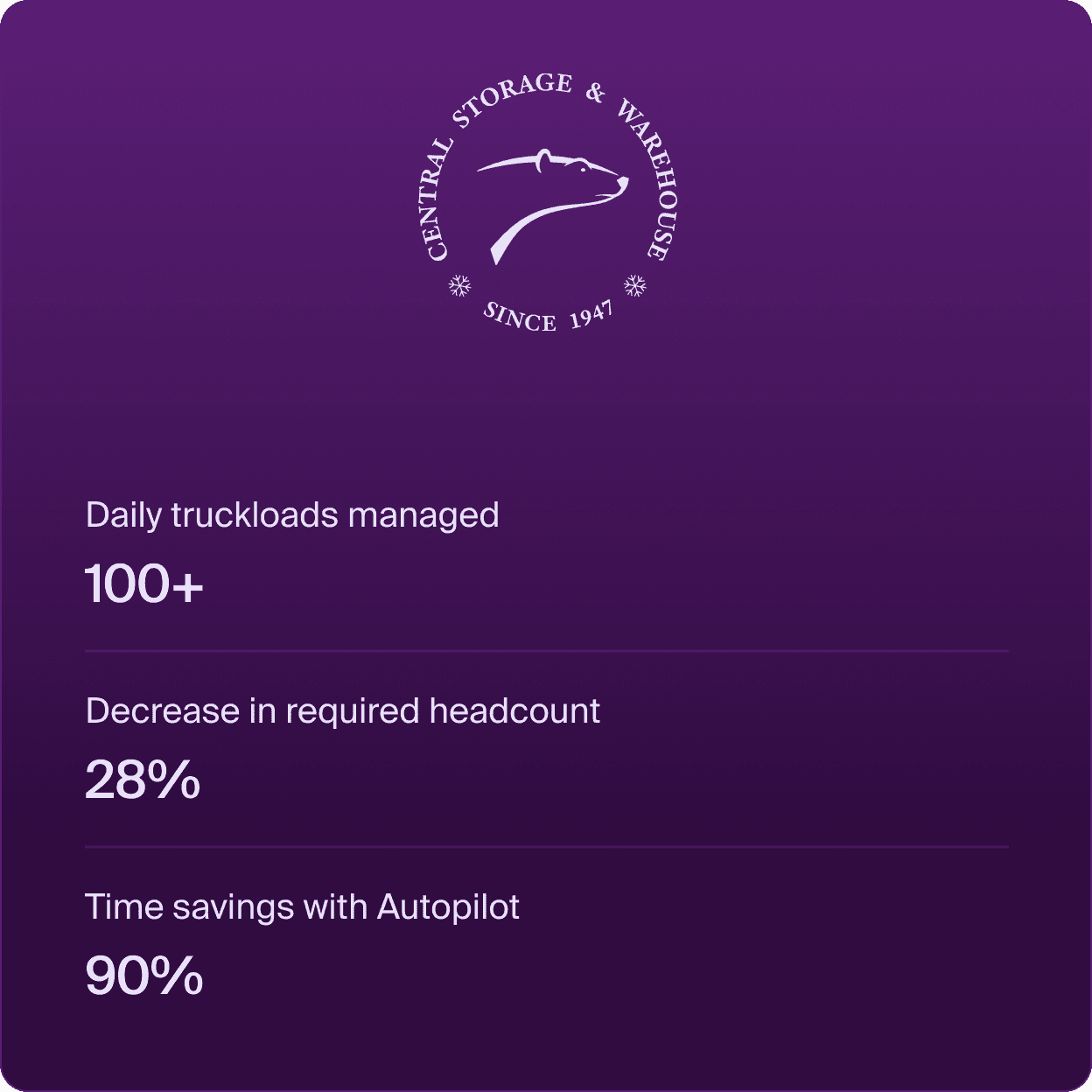
“Before using Autopilot Playbooks, we were constantly bouncing between email and our scheduling system, copying the same details over and over,” Dan says. “Now, Playbooks proactively capture the key information we need from customers, automating much of the time-consuming back-and-forth between systems. Playbooks helped reduce the time spent on scheduling by 90%, freeing up our customer service representatives to focus on solving customers’ problems rather than getting stuck doing data entry.”
The reduction in scheduling time opened a new question: what else can the scheduler take on? She currently handles CSW’s two largest facilities. The plan is to expand her coverage to additional warehouses as the company grows - without adding headcount.
“Autopilot Playbooks help our growing company scale. We can keep adding to our team’s plate as we grow - without adding extra headcount.”
Results
Running leaner without cutting corners
Previously each warehouse needed enough CSRs to handle peak volume independently, with a buffer for sick days, vacations, and the unpredictable nature of a 24-hour logistics operation. With five siloed locations, that meant overstaffing at every site.
Today, CSW runs 20-30 percent leaner from a customer service standpoint. A shared pool of 25 CSRs operating across all five warehouses replaces what would have required 35 in the siloed model.
“Instead of 35 people, we can run at 25 people, because we all collaborate and we can support any warehouse with any CSR through the use of Front.”
But Hill is clear about where the largest win sits. “The real value is the customer service we provide. Back to our three driving principles about being flexible, responsive, and reliable - Front plays a role in every single one of those,” Hill explains.
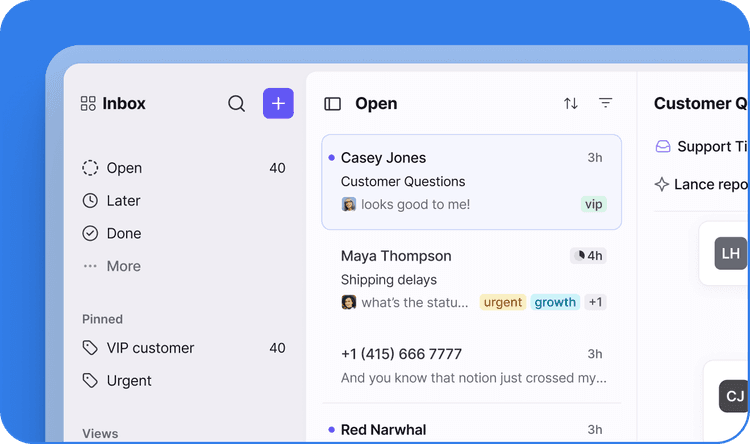
Warehouse inboxes are clean every day. Stages (unassigned, assigned, waiting, resolved) give teams clear visibility into what needs attention and what’s in progress. Responses go out within hours. Critical requests like inventory holds are escalated automatically. And with Autopilot drastically cutting scheduling time, CSW is finding that each layer of Front they adopt builds on the one before it.
A company that operates differently
Three years with Front has changed how CSW works at every level. “Our company culture has improved significantly since we started using Front,” Hill says. “We are far more collaborative. It’s much easier to facilitate two-way communication with our frontline and maintain clear visibility across the entire operation.”
For a family-owned cold storage business that grew from a handful of trucks to a million square feet of temperature-controlled space, there was always concern whether growth would erode the responsiveness that built the business.
“We have better service to our customers because of how we use Front, and our operations run a lot better because we can get information to the right people much faster,” Hill says. “Front has completely changed how we work as a company.”