


Most healthcare staffing agencies assign one recruiter to handle everything for a clinician - sourcing, credentialing, problem-solving post-placement. It’s a simple model that works well when volume is low. But once a marketplace hits scale, it breaks down.
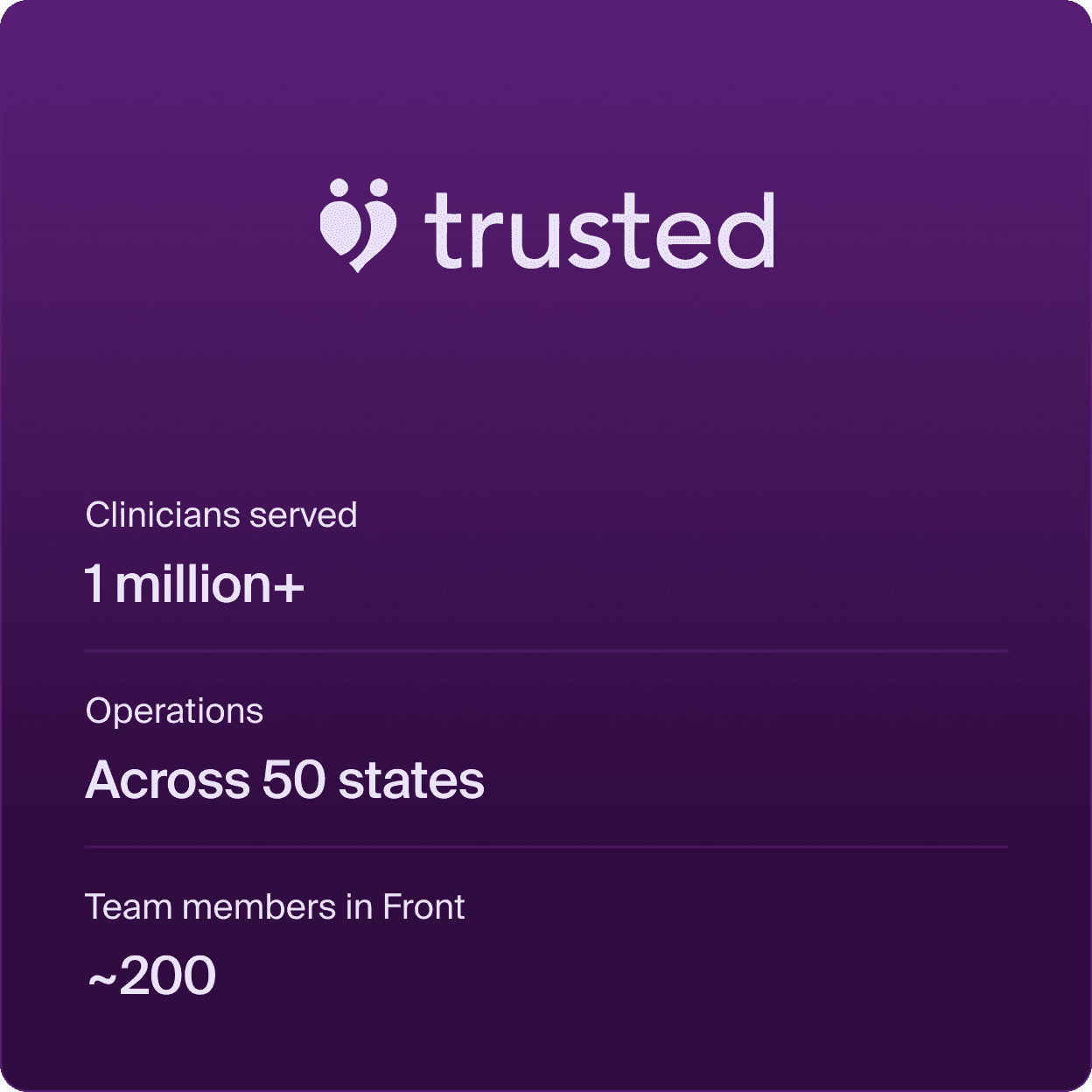
Trusted Health took a different path. Founded in 2017 in San Francisco, Trusted is a two-sided healthcare staffing marketplace connecting more than one million clinicians with thousands of facilities across the country. Travel nurses, surgical technologists, sonographers, and radiologic technologists use the platform to find their next 13-week assignment. Hospitals use it to fill open roles, often fast. Trusted also serves as the employer of record for clinicians across all 50 U.S. states, handling payroll, benefits, onboarding, and compliance on top of the matching itself.
The complexity is significant. Credentialing requirements vary by facility. Compliance rules differ state to state. Shift logistics change last-minute. And on the clinician side, every decision is personal.
“Clinicians are making decisions that affect where they live and who takes care of their patients,” says Amanda Maxedon, President of Marketplace. “We treat them like professionals, not req numbers, and the service experience has to match that.”
Amanda runs the full marketplace organization, from product to engineering to operations. Every metric she cares about - approvals and submissions to placements and retention - lives in her organization. Today, around 200 team members across the marketplace org use Front day-to-day.
Challenge
A model most agencies won’t attempt
Trusted Health’s business model relies on specialized work that lives across different teams. Advocates build relationships with clinicians. Account Managers handle the facility side. Operations handles the credentialing mechanics. Each role focuses on what they do best.
The risk with that structure is that specialization creates handoffs, and handoffs create gaps where context gets lost. A clinician who has to re-explain their situation to three different people doesn’t feel like they’re getting specialized service - they feel like they’re getting passed around. “A clinician isn’t filing a support ticket,” Amanda says. “They’re making a decision about their career and need to feel like someone actually knows them.”
Solution
How Front holds it together
Trusted has been on Front since the early days of the marketplace. Front scaled alongside the business as it grew from a small team to a full operation with advocates and account managers running high-volume inboxes across email, text, and other channels.
“Early on, one advocate could keep a clinician relationship in their head,” Amanda says. “Once we got to real scale, that stopped working. You need shared visibility, handoffs that don’t drop context, and coverage when someone’s out.”
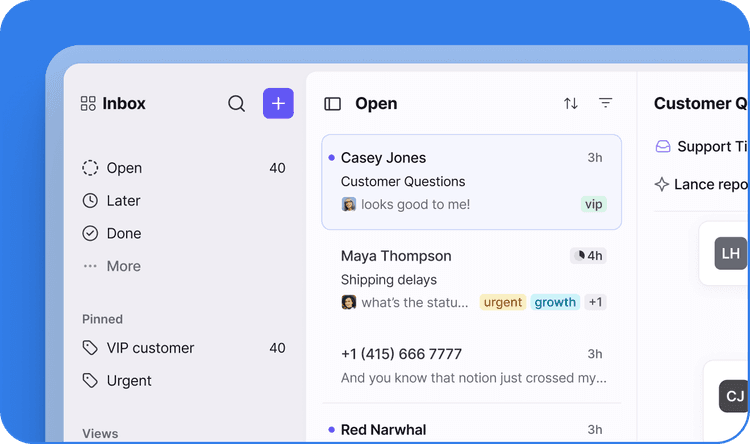
Shared inboxes and assignment workflows are the foundation. Advocates pick up clinician conversations, tag the right teammate when a question needs a specialist, and hand off cleanly when a situation requires it. A clinician question that starts with an advocate and needs facility input can move to an account manager without the clinician ever noticing.
“Nothing sits in a personal inbox where it can die quietly,” Amanda explains.
Rules and automations handle the routing layer. Inbound messages get directed to the right inbox or the right person without manual sorting. Three specialized teams work across a single clinician conversation, and it feels like one seamless interaction. Some of the highest-stakes routing involves payroll. Payroll inquiries get automatically directed to the right team with tight SLAs built in - because with weekly payroll running across all 50 states, a message that sits unread isn’t just a bad experience, it’s a real problem.
Clinicians get answers from whoever is best equipped to help. Amanda says that matters more than speed alone.
“Clinicians feel like they’re talking to Trusted, not to whoever happens to pick up. The continuity is what matters.”
Results
More conversations, same headcount
Trusted is growing - but remains disciplined about not throwing bodies at problems. The metric Amanda keeps coming back to is volume per person. Advocates and account managers handle more conversations per person now than they did a few years ago, without a drop in quality. At Trusted’s scale, that means growing the business without scaling headcount at the same rate.
“Innovation for us means rethinking workflows and using tools like Front to let one advocate cover the ground that used to take two,” Amanda says.
The result is a team that’s working, not firefighting. People operate in shared workspaces where backup is built in. If someone’s out, there’s no scrambling. If a question needs a specialist, the handoff takes seconds. Most importantly, the team likes using Front, which sounds like a minor thing but is huge for Amanda.
“Any ops tool your team resents is a tax on everything. Front doesn’t have that problem here.”
Built to flex
Front has been part of Trusted’s stack since the beginning, and its role keeps expanding. The team is already deep into an AI transformation - both within their own product and inside Front. Early results are promising: AI-generated tags are landing accurately, and the team is working toward a workflow where advocates can review and send AI-drafted replies rather than writing from scratch, reducing review time and freeing them up for the conversations that require a human touch.
Trusted runs a model that would be nearly impossible for other staffing companies because the coordination is hard to pull off. Front makes that coordination invisible to the clinician.
“Front doesn’t force you into one model,” Amanda says. “We’ve built a specialized, high-touch, relationship-driven operation on top of it, and that’s because the product is flexible enough to shape around how we actually work.”