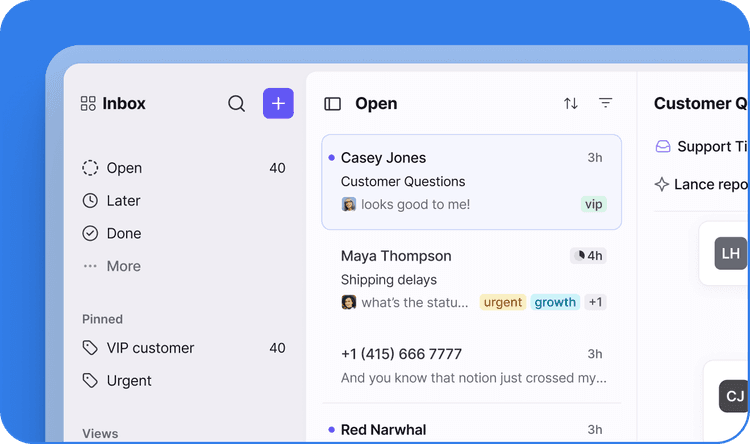




Learn what a support ticket is, how B2B teams manage customer requests at scale, and how workflows improve visibility, coordination, and accountability.
In B2B customer support, conversations rarely involve just one team member. Answering a single request often means coordinating across multiple departments and channels to reach the right stakeholders.
That complexity makes operational consistency hard to maintain, especially as the company scales and ticket volumes climb. A structured support ticket workflow is what keeps service quality intact as that complexity grows.
This guide covers what a support ticket is, how B2B ticket workflows move, and how to manage customer requests at scale, including where AI fits in.
Why B2B customer work falls apart without a structured ticket workflow
A support ticket is an operational record containing details of each customer request. Teams use these tickets to organize, prioritize, and resolve inquiries. In B2B, tickets tend to carry more weight: multiple stakeholders, high-priority escalations, customer history, and SLAs that specify resolution and response time targets.
Because of that complexity, B2B teams can’t just reply directly from an inbox or chat thread. They need tickets to record context, assign ownership, and track progress accurately. Here’s why that support ticketing workflow and structure matter.
Customer requests often span multiple teams
Support issues often move across operations, logistics, and account management teams. Without a good support ticket system, it’s hard to track an issue across people in conversations with full context and clear ownership.
Teams need visibility into customer history and status
Without support tickets, context fragments across apps and channels — some in a Slack thread, some in an email chain, some in a CRM record. Tickets keep that context intact across handoffs.
Support workflows require accountability
Even in a shared inbox, it’s not always clear who owns follow-up, escalation, and resolution. Tickets let you assign each issue to a specific person, so ownership is never a guess.
Operational complexity increases with scale
As companies grow, informal workflows fall apart. More teams and more issues to track means a lack of structure quickly turns into unclear ownership, delays, and lost context.
How support tickets move through operational workflows
Although teams often focus on fast response times, operational quality depends more on coordination than speed. Here’s the lifecycle of a support ticket, from creation to resolution.
Intake and conversation routing
When a customer sends a request on any channel, an omnichannel support platform automatically creates a new ticket to log the details. Then, you or the system can prioritize and route the ticket based on urgency, issue type, and account tier.
Cross-functional collaboration during resolution
As resolution progresses, ownership and next steps often shift. The ticket may move to operations, finance, or customer success as different expertise is needed.
Escalations and SLA management
When a ticket needs special attention, it escalates based on rules and workflows defined in advance — not on an ad hoc judgment call in the moment.
Resolution and continuity
Once the issue is solved, the team communicates with the customer and closes the ticket. Documenting the outcome inside the ticket keeps that context available for every future conversation.
Common support ticket management challenges in B2B operations
Even the best support ticket systems break down when coordination fails. Here’s where that shows up.
Context loss across teams and channels
As Front’s Kenji Hayward observed, support leaders often struggle with the disconnect between support tickets and internal communication platforms. When ideas and solutions are spread across different systems and channels, you lose important context, and customers have to repeat information and waste time.
And this is surprisingly common: Front’s Coordination Tax report found that 64% of companies reported at least one customer-facing coordination failure in the past three months.
Unclear ownership during handoffs
As work moves across teams, it’s often unclear who’s responsible for resolving the issue. That ambiguity slows resolution and shows up to the customer as a poor experience.
Ticket overload without a clear system
As volume rises, it’s easy to lose sight of priority. Some teams end up working through low-priority tickets while urgent issues sit buried in the queue.
Fragmented customer communication
With multiple teams working on a ticket across different channels, customers risk getting inconsistent or even contradictory answers if one team doesn’t know what another already said.
Reporting gaps and limited operational visibility
Many operational failures are coordination failures, not response failures. Front’s Coordination Tax report found that 42% of companies don’t track coordination at all, which means support leaders often can’t see the bottlenecks costing them the most.
How B2B teams design support ticket workflows for operational consistency
1. Maintain continuity
Log every customer interaction and store it in your help desk system, and make sure every team working on an issue has full context — past interactions, handoff notes, account health — as it accumulates over time.
2. Centralize customer visibility across teams
Give your team shared, real-time access to ticket status and customer history. Once that visibility gap closes, reps communicate more consistently because they can see what everyone else is already doing.
3. Standardization for consistency at scale
Define clear rules for repetitive actions — prioritization, routing, escalation — and build workflows that make those rules easy to follow consistently.
4. Maintain accountability across workflows
Build a handoff process that assigns every ticket to a named individual with full context, and use pre-defined escalation paths so high-priority tickets reach the right people automatically. Done well, tickets become an audit trail for long-term accountability.
5. Monitor workflow performance and operational health
Once workflows are in place, track how well they’re actually working. If escalation procedures aren’t being followed consistently, that’s a signal to add training or move that step to automated processes.
Where AI earns its place in B2B ticket management
AI can take real weight off ticket management, but human judgment still needs to lead, especially in complex or high-stakes interactions. Front’s Coordination Tax report found that 71% of companies faced at least one significant AI issue in the past three months, most tied back to coordination failures, not the AI itself.
The best use of AI here isn’t replacing judgment; it’s removing the repetitive operational work that keeps teams from applying that judgment where it matters.
AI-assisted ticket categorization and prioritization
AI is most helpful in the triage stage. It can quickly analyze a large number of new tickets and classify them by urgency, account priority, and support ticket type. Then, it can route them to the right person based on their expertise and workload.
AI-generated response suggestions
AI can summarize complex issues and draft a starting response. Treat it as a first draft. Reps should still review and adjust before sending.
AI-powered self-service support
Self-service isn’t just deflecting easy questions anymore — the better systems stay useful even as a request gets more complex. The real test is whether it hands off cleanly the moment it hits its limit, with full context intact, so the customer never has to re-explain what they’ve already said.
AI-assisted trend and issue identification
AI can spot the patterns you’d expect — recurring product issues, escalation trends, workload spikes — but the more useful signal is often the one customers don’t say out loud. Dissatisfaction shows up in tone, hesitation, and repeat contact long before it shows up in a complaint. Catching that earlier is what turns trend data into something you can act on before a customer feels the impact.
Connect support tickets and customer conversations with Front
Managing support tickets well comes down to visibility, ownership, and continuity across customer service operations. Coordination is the harder problem to solve — and the one worth solving first.
Front’s customer operations platform is built for that complexity. Assignments and collision detection keep teams from duplicating work, while workflow automation and AI tools free reps to focus on the conversations that actually need human judgment. Front’s ticket workflows maintain context and accountability through every escalation, handoff, and ongoing customer relationship across support, operations, and account management.
Book a demo to explore how Front keeps customer conversations, workflows, and ownership connected at scale.