



Looking into outsourced customer support? Learn how B2B teams evaluate providers, coordination needs, and operational fit before scaling.
Scaling a B2B support operation means managing more volume, more complexity, and more stakeholders, often without proportional headcount growth. For many teams, outsourced customer support is one way to extend capacity without building out every function in-house.
But outsourcing introduces its own coordination layer. An external team needs to understand your processes, integrate with your systems, and hand off complex issues cleanly to internal teams. Done well, it expands what your operation can handle. Done poorly, it adds friction on top of friction.
This guide covers what outsourced customer support actually involves for B2B teams, where it helps and where it doesn’t, how to evaluate providers, and five companies worth considering.
What is outsourced customer support?
Outsourced customer support means hiring an external provider to handle some or all of your customer support work. In B2B, that typically includes onboarding support, technical inquiries, and ticket management across channels like email and live chat.
The scope varies significantly by company. Some teams outsource only routine, high-volume inquiries, freeing internal staff to focus on complex issues, account management, and customer success. Others outsource customer support operations more broadly, training the provider to handle escalated issues as well. Either approach can work, but both require the same thing: clear ownership, connected context, and defined handoff points between the external team and your internal operation.
Outsourced customer support for B2B: Operational gains and coordination costs
B2B companies often use outsourced customer support solutions to extend coverage and absorb higher volumes as their operations grow. But that expansion comes with real coordination overhead. The external provider needs to understand your brand, integrate with your systems, and work alongside internal teams, which is harder than it sounds when accounts are complex and context matters.
Why outsource customer service? The operational case
These are the main benefits of outsourcing customer service for B2B companies.
Consistent coverage across regions and markets
Expanding into new markets means supporting customers in different time zones and languages, often without the headcount to match. Outsourcing providers are typically built for 24/7 multi-region coverage, which means customers in new markets get timely responses without your team working overnight shifts or building out a new regional support function from scratch. This allows you to provide a better customer experience (CX) at scale.
Surge capacity when volume spikes
Even well-run support operations get overwhelmed by unpredictable volume spikes: major incidents, product launches, seasonal peaks. When that happens without additional capacity, ticket backlogs grow and response times slip. Outsourcing gives you a buffer — a team that can absorb demand spikes without your internal staff absorbing the pressure. Response times stay predictable; your core team stays focused on the work that requires the most context.
Multilingual support without complex hiring
Offering customer support in different languages is expensive and routing-intensive. Outsourcing providers with multilingual capability let you offer support in multiple languages without adding headcount for each one or building out the routing logic internally. For B2B teams serving global accounts, that’s often a practical advantage over building language coverage in-house.
What doesn’t outsourcing fix
These are some of the customer service challenges that emerge when support work spreads across internal and external teams:
Consistency when two teams own different issues
Most B2B support teams run hybrid models — outsourcing routine volume while keeping complex or high-stakes work in-house. The operational challenge is that customers don’t experience two separate teams; they experience one support operation. If the external team communicates differently, lacks the same context, or applies different standards, the inconsistency shows up at the account level.
Ownership across internal and external handoffs
Clear ownership is already a challenge inside B2B support organizations. Front’s Coordination Tax report found that 64% of companies reported at least one customer-facing coordination failure in the past three months.
Add an external team to that picture, and the risk compounds issues that require escalation between the outsourced team and internal staff — operations, account management, and technical teams — need to find handoff protocols without them. Delays and dropped calls are almost guaranteed.
Quality and CSAT visibility
Quality assurance (QA) is harder when another organization owns day-to-day interactions. Even with strong process alignment, you have less direct control over how your brand sounds on any given call or email. Real-time monitoring of satisfaction signals — catching issues early before they affect account health — requires clear data-sharing agreements and tooling that spans both teams. If that visibility breaks down, you find out about CSAT problems after accounts are already at risk.
How to choose the right outsourced customer support company
Outsourced customer service companies aren’t interchangeable. Evaluate them against the specific operational requirements of your B2B environment.
Coverage across channels, regions, and support volume
Map the channels, languages, and time zones you need to cover. Confirm the provider can handle your typical volume — and your spikes.
Reporting visibility and QA standards
Ask how performance is measured and how operational data gets shared with your team. You need visibility into quality and recurring issues, not just ticket counts.
Escalation handling and response ownership
Understand exactly how the provider manages escalations that require coordination with your internal teams — support, operations, account management, or technical staff. Vague answers here are a sign to pause and reconsider.
Industry expertise and workflow complexity
A general business process outsourcing (BPO) or consumer-focused call center may not be equipped for the context and coordination demands of B2B support. Look for providers with experience in high-context environments, ideally in your industry.
Compatibility with your existing support stack
The external provider needs to work with your systems. Make sure they can integrate with your CRM, omnichannel support platform, and communication apps.
Top 5 outsourced customer support companies in 2026
The best customer service outsourcing provider depends on operational fit and your specific business needs. Some companies are better suited for multilingual support environments, some for technical support workflows, and others for enterprise-scale support operations.
Here are five leading outsourcing companies to consider.
1. SupportNinja
SupportNinja is a good choice for growing SaaS companies that want AI-powered tools and workflow automation. It offers highly scalable customer support, with multilingual teams and support for onboarding and customer success management. Larger companies in different industries should explore further to check if SupportNinja is still a good fit.
2. TaskUs
For large technology and logistics companies, TaskUs is a strong option. Its key strengths are its global scale, automation capabilities, and support for complex workflows. But TaskUs is an enterprise-focused provider, so it may not be a good fit for small or midsize companies.
3. Foundever
As one of the largest outsourcers in the business, Foundever is ideal for global companies. It has 130,000 agents across 45 countries and supports over 60 languages, so it’s perfect for large teams looking for 24/7 support in multiple languages and channels. However, Foundever’s cost and complexity may be too much for smaller teams.
4. Helpware
Helpware is best for startups and smaller firms looking for flexibility and a strong customer focus rather than a standard contact center. The company boasts a strong focus on CX, with a 90% average CSAT and 98% QA score. Keep in mind that it lacks the scale and global reach of more established BPOs.
5. PartnerHero
PartnerHero is a strong choice for tech firms that prioritize CX and brand voice. Its main strength is its focus on matching your company culture and building customer relationships. But because of this specialized, culture-focused approach, it could be harder to scale than some more standardized outsourcing models.
Scale customer support coverage without sacrificing coordination
Outsourcing can give B2B teams meaningful coverage and capacity gains. But it doesn’t solve the underlying coordination problem — and without the right operational foundation, it can make that problem harder.
Front’s Coordination Tax report found that the typical B2B company spends nearly three hours coordinating for every one hour actually solving customer problems. An external support layer doesn’t reduce that ratio on its own. What reduces it is a platform that keeps conversations, context, and ownership connected across internal teams and external partners alike.
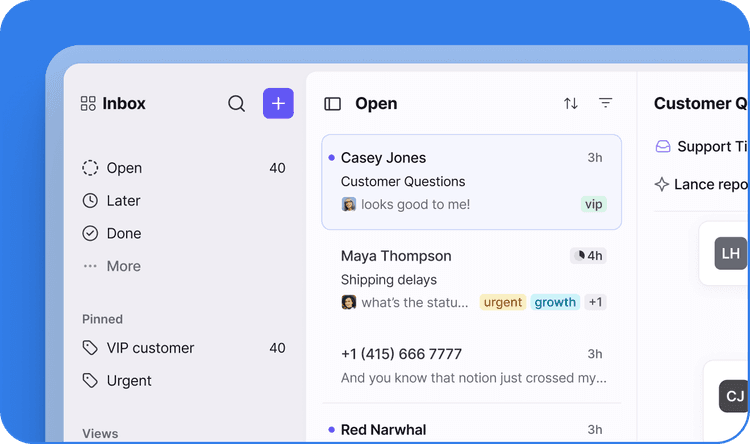
Front is the customer operations platform built for B2B complexity. Whether your support model is in-house, outsourced, or hybrid, Front keeps every team, tool, and customer conversation in sync — so nothing slips between the cracks when ownership changes hands.
Book a demo to explore whether improving operational coordination with Front could complement or simplify your customer support strategy.