



Learn what average handle time is, how to calculate it, industry benchmarks by sector, and how it impacts B2B support operations and performance.
It’s 9:07 a.m., the queue is already stacking up, and a simple customer question is bouncing between three people who each hold part of the answer. One handoff becomes two, and a “quick check” becomes a lengthy Slack thread.
Resolution slows — not because the issue is complex, but because coordination gets in the way. That’s the reality B2B support teams face every day. It’s important to move quickly, but you can’t afford to sacrifice quality.
Average handle time (AHT) sits at the center of that balancing act. It measures how long a customer interaction takes from start to finish, turning that experience into a metric you can actually manage. More importantly, it impacts how you staff your team to deliver high-quality service.
But AHT reveals more than just agent efficiency. It also captures the coordination tax: the time teams spend coordinating when solving customer problems.
To make AHT useful, you need to understand exactly what it measures — and what it doesn’t. Here, we’ll explore what AHT really means, how to calculate it, and what “good” looks like for different support teams.
What is average handle time in customer service?
AHT measures the average time it takes a support team to resolve a customer interaction, from the initial conversation to the moment follow-up is complete. It captures the full lifecycle of a customer request based on:
Talk time: Time spent actively helping the customer
Hold time: Time the customer spends waiting
After-call work (ACW): Time spent wrapping up after the interaction ends
AHT applies across channels, but the way these components show up can vary. A phone call might include literal hold time, while chat and email reflect response gaps or delays between messages. ACW can be a wide range of follow-up tasks, like escalating to another team, filing customer-provided documentation, or sending a follow-up email.
Used well, AHT is an operational signal. When it starts to climb, the culprit is often inefficient routing or unclear ownership. But when AHT drops, that’s not always a win either. Check whether that newfound speed comes at the expense of service quality or customer satisfaction (CSAT).
How to calculate average handle time
The standard formula for calculating average handle time is:
AHT = (Total talk time + total hold time + after-call work) / Total number of interactions
Each part of the formula represents a different slice of the customer experience. Talk time covers the time an agent spends actively engaging with the customer. Hold time captures any period the customer is waiting while the agent looks up information or coordinates internally. And ACW includes everything that happens once the conversation ends, such as updating systems and completing follow-ups.
Imagine a B2B logistics team handling shipment status calls over the course of the morning:
Total talk time: 240 minutes
Total hold time: 60 minutes
Total ACW: 100 minutes
Total calls handled: 50
Plug those numbers into the time formula:
AHT = (240 + 60 + 100) / 50 = 400 / 50 = 8 minutes
In this scenario, AHT is 8 minutes per interaction. If hold times increase or after-call work becomes more complex, that number will rise, even if the talk time stays the same.
With non-voice channels, the calculation is a bit simpler since chat and email don’t involve “wait time” in the traditional sense. For chat, AHT is the total handling time divided by the number of chats. For email, it’s the total time spent per ticket divided by the number of tickets handled. Once you’ve calculated your baseline AHT, the next question is whether it actually reflects operational efficiency.
Why average handle time analysis matters for B2B operations
When AHT is only used to score individual performance, it turns into a vanity metric without fully considering the overall impact to your operations. Here’s where the sum is greater than its parts really comes into play for a more diagnostic approach to finding hiccups in your customer experience.
Here are some things that an AHT analysis can do.
Identify operational bottlenecks
If AHT climbs for specific interactions, take a closer look at your processes. Did a slowdown come from a missed handoff? Did your agents have to dig through too many tools to get the information they needed to respond? These patterns make it easier to pinpoint where time is lost, so teams can improve routing and smooth out handoffs that add to lost time.
Improve workforce planning
AHT helps teams understand how workload translates into capacity needs. If handle times run longer than expected, it could be a staffing issue. Staffing gaps often show up as service-level agreement (SLA) misses or growing backlogs rather than obvious AHT spikes. By tracking handle time alongside volume, managers can make more informed decisions for proper shift coverage.
Measure team performance
On its own, AHT can be misleading. Faster doesn’t always mean better, and slower doesn’t always mean inefficient. That’s why AHT is most meaningful when paired with customer service metrics, such as CSAT and first call resolution.
In that context, AHT shows how work is handled, not just how quickly. It can reveal whether agents rush through interactions, over-escalate cases, or lose time navigating unclear systems. Evaluated alongside quality key performance indicators, AHT is a more accurate reflection of team performance and productivity.
Protect SLA compliance
AHT customer service trends can catch early signs of performance degradation. A single spike might come from a temporary issue, such as a seasonal surge, but a sustained increase often signals a deeper operational problem.
For B2B teams managing tiered queues or channel-based SLAs, those upward trends quietly erode compliance before turning into missed targets. Monitoring AHT over time helps teams step in early and prevent delays from becoming systemic issues.
The teams that get the most value from AHT don’t chase the lowest number. Instead, they use it as a lens to understand where inefficiencies are dragging out the clock and what’s causing it.
AHT improvement plan: Understanding the causes and where to begin
Now you know that high AHT is a symptom rather than a root problem. Before trying to push that metric down, make targeted, intentional improvements to reduce handle time without sacrificing quality.
Fragmented context across tools
Piecing together customer history across multiple systems slows down interactions. Each extra tab, handoff, and verification adds to the coordination tax, forcing agents to dig up context and confirm details before forming a response.
This investigation time adds up fast, and it shows in AHT. Give agents a unified view to clear bottlenecks, so they can resolve issues without unnecessary delays.
Unclear ownership and handoffs
When ownership isn’t clearly defined, conversations break down. Requests bounce between teams, and every handoff increases hold time and creates extra ACW to get the next person up to speed. Over time, those small inefficiencies compound into significantly longer handle times. Clarifying ownership and tightening escalation paths keeps conversations moving toward resolution.
High volume of routine requests
Routine requests at scale can quietly drive up AHT. Even when interactions are quick, they still consume time that could be offloaded. Shifting repetitive requests to automation or self-service support can help more of your customers at scale. This lowers AHT at a system level without forcing agents to rush more complex, high-value interactions.
Knowledge gaps and tool limitations
When teams lack training or the right tools, they’re forced to search for answers during live interactions. Slow systems or hard-to-access knowledge bases directly translate into longer handle times. That overhead compounds across every conversation. Better access to information and stronger customer support tools enable faster, more consistent resolutions.
Now you know what could elongate AHT. But, how do you fix it? Check out Front’s guide on lowering AHT and turn these insights into measurable improvements.
How Front helps teams improve average handle time
AHT metrics often reveal the same issue: misalignment between people, tools, and processes that delay resolution more than any single interaction. Front addresses this at the level where resolution actually breaks down — the handoffs, routing decisions, and context gaps between teams.
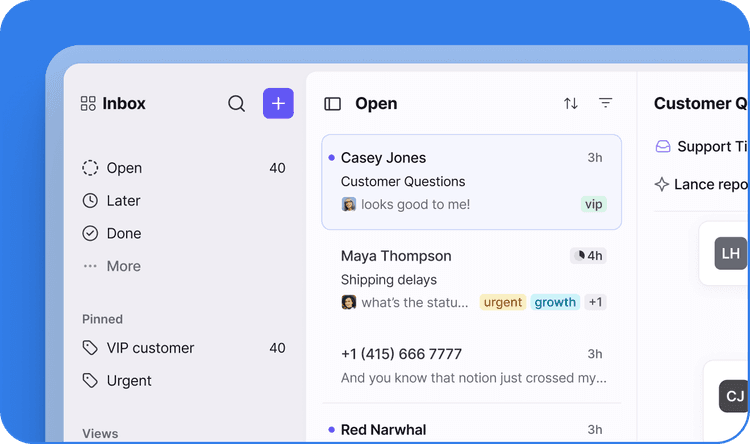
With Front’s unified workspace, teams can coordinate across channels through integrations such as Aircall and Dialpad. Built-in analytics surface AHT at the team, inbox, and individual level, making it easier to see how time is being spent and why.
Front also reduces the coordination tax that drives up AHT in multi-team environments. Clear ownership, real-time assignments, and shared drafts eliminate handoff delays and prevent duplicated work, keeping conversations on the fast track to resolution.
Explore how Front gives operations teams visibility into AHT, so they can improve service quality and CSAT.
FAQs
How do you forecast average handle time?
Teams forecast AHT by analyzing historical handle data and breaking it down by channel and interaction type, including talk time, hold time, and ACW. They then adjust for expected changes in volume or staffing to estimate how long future interactions are likely to take.
What’s the difference between AHT and resolution time?
AHT measures the time an agent spends actively handling the customer interaction. Resolution time, on the other hand, tracks the total time from a customer’s first contact to full closure, including any waiting periods or idle time between interactions.