



Customer service response time reflects more than speed. See how B2B teams use ownership, routing, SLA tracking, and visibility to keep replies on track.
In manufacturing or supply chain operations, a single delayed response halts critical processes. One missed update ripples across teams, derails production schedules, disrupts deliveries, or puts regulatory deadlines at risk.
That’s why customer service response time is more than a speed metric — it’s a window into how well your teams coordinate. It reveals how effectively updates are orchestrated across support teams — reflecting whether ownership is clearly assigned, handoffs are accurate, and workflows are under control.
When slow response times become the norm, they signal gaps in how teams work together and how much visibility leaders have.
That’s why response time deserves executive attention. It shows where workflows stall and operational predictability erodes. And it does so well before those issues manifest as missed service-level agreements (SLAs) or lost revenue.
What response time reveals about your operations
Knowing average response times becomes a useful metric when you look beyond the raw number and, instead, focus on its variability.
Spikes and inconsistencies in times often stem from misrouted conversations, overlapping ownership, missing escalation paths, or delays between teams — making response time a direct reflection of how work actually moves.
Interpret your average response time alongside other signals for the clearest picture of pain points. SLA compliance shows downstream impact, backlog volume reveals accumulation, handoff delays expose coordination gaps, and team capacity highlights structural limits. Together, they paint a clear picture of exactly where things break down.
This is also where patterns become actionable. In logistics, delays often tie back to dispatch coordination or carrier communication gaps, while in manufacturing, they emerge in order management and supply chain dependencies.
Keep in mind that benchmarks can highlight outliers, but the real insight comes from understanding what drives variability inside your own operations.
Why managing response time gets complex as operations scale
Quick response times become harder to maintain as coordination grows more complex. Volume spreads across multiple channels, work crosses team boundaries, and seemingly simple interactions turn into multi-step workflows.
Without a clear owner, replies sit unresolved. Teams may be stalled, waiting for input from others, and deadlines slip because urgency isn’t visible until it’s too late. Gaps in customer history cause repeated follow-ups, errors, and duplicate effort. Conflicting goals leave work misrouted.
The result: Teams lose predictability as they grow. But this complexity also provides useful context. Response time becomes a clear indicator of how well teams coordinate work across the organization.
How high-performing teams improve customer response time
There are no universally accepted rules to improve customer service response times. However, faster responses shouldn’t come at the expense of accuracy, context, or coordination. Speed alone can’t replace human oversight or precision.
Here are five ways to build repeatable patterns and improve customer response time.
1. Centralized communication
Nothing breaks B2B workflows faster than fragmented context. When a renewal risk lingers in email or a billing dispute sits buried in the support inbox, the customer may escalate before a team member can connect the dots.
Centralizing communication brings everything into one place: the conversation itself. It’s not a ticket summary or note in the CRM, but the actual thread with the customer.
When a high-value account flags a delay, that thread becomes the operational focal point. Teams collaborate directly within it, decisions are recorded in near real time, and context stays intact.
No need to sync systems after the fact when everyone’s working from the same thread.
2. Clear ownership and assignments
Ambiguity is the root cause of stalled work. And in B2B, that ambiguity often shows up when multiple teams touch the same account but no one owns the assignment.
Clear ownership means assigning a single accountable person to every conversation at all times, with any changes tracked as part of the workflow. Responsibility is visible, transferable, and time-bound.
When a new onboarding thread is created, it’s assigned immediately. If it sits past a defined threshold, it escalates automatically and visibly.
As a result, there’s no ambiguity to hide behind. Either someone owns it, or it’s clearly unassigned and at risk. That clarity allows leaders to hold teams accountable without digging through systems.
3. Workflow automation and routing
Routing is where your team’s priorities get put into practice.When routing is inconsistent, everything downstream suffers: missed SLAs, delays for priority accounts, and wasted time re-triaging.
Workflow automation lets you define routing rules based on business signals instead of inbox volume. Account tier, issue type, contract value, and risk indicators determine where a conversation goes and how it’s handled.
For example, when an enterprise account escalates, the ticket is routed to the right support team. Meanwhile, a routine request can be handled with an AI-assisted draft and a quick review.
Front makes this possible by keeping routing, assignments, and AI-assisted drafting via Copilot all within the same layer. AI suggests, but humans stay in control — so you get an increase in speed without eliminating human judgment.
4. Real-time visibility and dashboards
Support and operations leaders don’t need more reports — they need earlier signals.
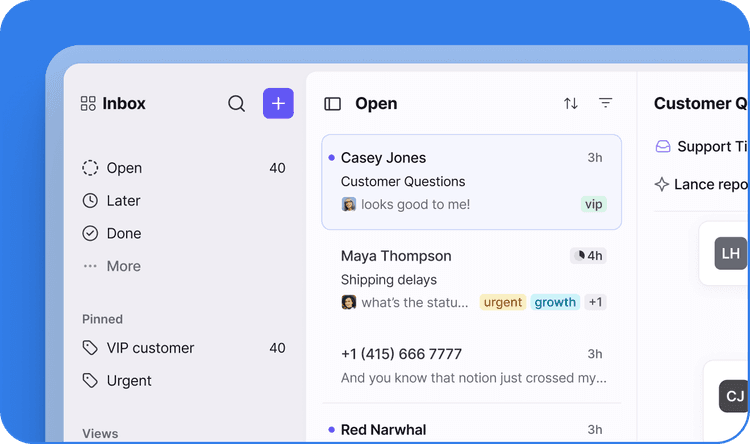
Real-time visibility and dashboards let you observe operations as they happen. You can track which queues are building, which conversations are aging, and where ownership gaps are forming. Insights surface while there’s still time to fix the issue.
For a support team, you can spot SLA risks in a specific segment before they breach. For operations, you can catch structural issues, like misrouted tickets or uneven workloads, without waiting for end-of-week summaries.
5. SLA tracking and reporting
Most teams track SLAs. Few operationalize them.
Effective SLA tracking turns deadlines into real-time guardrails. Each conversation carries a deadline based on customer tier or issue type, and SLA tracking flags risks as those deadlines approach. When thresholds are crossed, escalation triggers immediately — not after the fact.
With SLA tracking and reporting, you manage response times in real time. Leaders can see exactly which commitments are at risk, which teams consistently approach breach, and whether the issue is capacity, routing, or ownership.
This approach makes SLAs enforceable, turning deadlines into real-time accountability that shapes team behavior.
Real-world example: Response time as a competitive advantage
Mixam, a global online and print-on-demand printing business, supports creatives and businesses in designing, producing, shipping, and selling their work efficiently and accurately.
Expanding operations across continents is no small feat, and streamlining order fulfillment while improving customer response times presents constant challenges.
As the company scaled, gaps started to appear: HelpScout lacked the automation the team needed, maintaining the workflow dashboard was time-consuming, and tasks often sat without owners or clear communication between customers and teams.
Mixam needed a customer operations platform that could tag, automate, and route customer inquiries from orders, website forms, email, and chat.
Front became the clear choice. Using Front Chat, Mixam engaged with customers in real time and automated requests for estimated time of arrivals or tracking numbers, freeing the team to focus on complex issues that require human judgment. AI summaries surfaced insights and context faster, which brought up key context faster, leading to better first-response times and a stronger customer experience.
The results followed quickly: Transitioning to Front’s chat interface cut first-response times by 60% and reduced email and call inquiries by 16%, as customers adopted the faster, more efficient interface. With Front, the Mixam team now responds within a minute and maintains an average resolution time of 16-18 minutes.
Diagnose bottlenecks in real time with Front dashboards
Dashboards only matter if they help teams decide what to do next.
When dashboards reflect real workflows (not static reports), they give operations a live view of conversations, ownership, and priorities. They eliminate guesswork, enabling faster, more consistent decision-making.
For B2B customer service teams, this shift happens when coordination improves. Systems that centralize knowledge and keep tools and conversations in sync make it easier to route work, maintain accountability, and respond with context.
What looks complex on the surface becomes a structured, manageable operation underneath, and that’s where you can gain an edge. Success follows quickly: fewer gaps, clearer ownership, and a team that moves with confidence because the system supports how they actually work.
Explore how Front helps leaders maintain visibility across conversations, clarify ownership, and organize workflows. See Front in action.
For a practical way to measure and improve performance, download the customer service QA scorecard.
FAQs
How do peak volumes affect response time, and how can teams plan for them?
Peak volumes bring sharp spikes in inquiries and more complex, multi-step requests. Teams that maintain consistent customer response times rely on automation to deflect repetitive questions, dashboards to monitor real-time load, and clear assignment rules to keep ownership from slipping.
During peak periods, like the holiday season, AI-assisted workflows surged up to 64%, showing that planning for complexity, not just volume, is what keeps response times stable.
How can teams balance urgent vs. high-value customer requests to optimize response time?
Teams looking at how to improve response time to customer requests need more than speed; they need structure. SLAs define urgency, while routing and escalation rules ensure high-value or time-sensitive conversations reach the right owner immediately.
This keeps critical work moving with full context, while lower-priority requests flow through automation or queues, preserving both efficiency and quality across B2B workflows.
How can leaders tell whether slow response times are caused by staffing issues or workflow breakdowns?
Slow response times don’t always point to a lack of capacity. In many B2B operations, delays come from unclear ownership, poor routing, fragmented communication, or bottlenecks between teams.
Leaders can spot the difference by comparing response times with backlog growth, SLA breaches, and handoff delays. If workloads are stable but conversations still stall, the issue is likely workflow coordination rather than capacity.