

AI routing
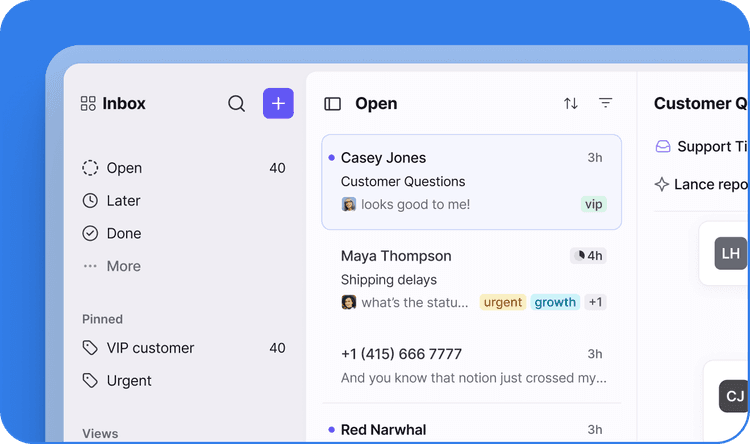
Artificial intelligence (AI) routing is a system that automatically directs customer requests to the right department. It uses keyword triggers, predefined rules, and conversation context to understand intent. It also prioritizes messages so teams address urgent or high-value queries first.
Though AI routing can have different meanings across industries, this glossary covers routing customer conversations in B2B support and customer operations.
How AI routing works in B2B customer service
AI routing uses machine learning and natural language processing to interpret a customer’s message in real time, route or escalate it, and decide the next step when the route is unclear. It may also generate responses or resolve the conversation if the customer asks a simple enough question.
Unlike manual routing, AI routing dynamically adapts to the conversation thread. This matters in B2B customer service where customers might need help from multiple departments at once. If they have questions about upgrading their software package and onboarding new employees, AI routing systems loop in both sales and IT teams.
AI routing use cases in customer service
AI routing is an important part of automating customer support — with it, teams no longer spend valuable time sorting through messages. Instead, they’re able to offer hands-on assistance to more customers.
Here are some examples of AI routing use cases in day-to-day B2B customer service operations:
- Account-tiered routing: AI directs enterprise or high-value customers to dedicated technical managers. At the same time, it resolves standard tier queries without human intervention.
- Intent and sentiment triage: Ticket routing with AI analyzes customer messages for urgency or frustration to instantly escalate a problem to the right person.
- Departmental splitting: AI routing automatically sends billing questions to finance, API or technical bugs to technical support, and onboarding roadblocks to support and product teams.
- Automated data gathering and analysis: Using chatbots and AI assistants, AI routing asks for missing diagnostic details before a ticket reaches a human representative. Once a real team member joins the chat, they have all the context they need to resolve issues accurately.
What makes AI routing effective
Though AI routing isn’t a perfect system, it still makes customer service workflows much more efficient. Here’s how:
- Supports human decision-making: AI routing recommends the best route or next step while allowing human agents to override or adjust decisions when needed.
- Preserves customer context: Conversation history, account details, and intent travel with the customer so they don’t have to repeat themselves.
- Routes based on intent: Effective AI routing considers customer intent, urgency, and sentiment to match cases with the right resource.
- Learns from outcomes: AI routing can continuously improve by analyzing resolution data and customer satisfaction scores.
- Provides transparency into routing decisions: Human agents and leaders can improve routing logic based on past interaction success.
Other resources
- Ticket escalation
Effective ticket escalation means preserving ownership and context through every handoff. Find out how B2B teams create clear escalation paths.
- Chatbot vs. conversational AI
Understand the difference between a chatbot versus conversational AI, and learn when each option works best for support teams managing customer needs.
- Conversational AI
Learn what conversational AI is, how it works, and how businesses use it to automate customer communication and support workflows.
- AI chatbot
Learn what an AI chatbot is, how they function, and how businesses use conversational AI to automate customer support and communication workflows.
- Intent classification
Learn what intent classification is and how it helps B2B support teams route customer conversations, preserve context, and escalate with clarity.
- Intelligent routing
Find out what intelligent routing is and how it speeds up resolution times and simplifies handoffs by directing customer conversations to the right place.
- Skill-based routing
Learn how skill-based routing matches customer conversations with the team members qualified to handle them. Find out the best ways to apply the approach.
- AI guardrails
Find out how AI guardrails constrain AI behavior, where they apply, and how they enhance B2B customer operations with clear ownership and human oversight.