




How to connect with customers in B2B starts with continuity: shared context, clear handoffs, and consistent communication across every interaction.
In B2B, trust is built through consistent communication, clear expectations, and coordinated teams. One thoughtful reply or well-coordinated handoff can deepen the relationship. But when context is scattered or teams are misaligned, even the strongest product can’t make up for a subpar experience.
Your customers are more than a deal to land or a support ticket to close. They’re long-term partners with goals, timelines, and expectations, and every interaction shapes how they see your business. In this guide, we’ll break down how to connect with customers in ways that build real trust.
What connecting with customers truly means
In B2B operations, customer connection isn’t about individual transactions — it’s about maintaining relationship continuity across dozens of interactions and multiple team members. When a logistics client emails about a delayed shipment, they’re not just asking for an update. They’re testing whether your operation has the visibility and coordination to keep them informed without forcing them to chase answers.
That kind of service requires clear communication, shared context across teams, and the systems to follow through — every time. When your operation runs with that level of alignment, your customers don’t just get answers. They get a partner they can trust.
Start by understanding them
To connect with customers, operations teams need shared clarity — not just about what a customer is asking, but why it matters to their business. When a manufacturing client asks about component availability, they’re not making small talk. They’re managing production timelines, customer commitments, and inventory costs. If that context doesn’t flow to everyone who touches the conversation, your team can’t respond with the urgency or precision the situation requires.
You don’t need a full research project to figure this out. Often, the most helpful insights come from everyday moments — a short customer feedback form, a question that keeps coming up, or a pattern you notice in their behavior. When you understand the “why” behind what they do, it becomes easier to anticipate needs and offer support that helps.
Communicate clearly and with empathy
Clarity and empathy go hand in hand. Clear communication keeps customers informed, while empathy shows you understand their perspective. Whether you’re replying to an email, responding in chat, or answering a comment on social media, your message should feel like it came from a real person who cares, not a template.
Be consistent across every touchpoint
Consistency turns good interactions into great experiences. Customers engage across multiple touchpoints, and each one should reflect the same care and attention. By sharing context through tools and repeatable workflows, teams can respond faster and maintain a reliable customer experience.
Practical ways operations teams build stronger customer relationships
Strong customer relationships in B2B operations come from consistent execution across teams. It’s not about grand gestures — it’s about ensuring that when a customer reaches out on Monday to one team member and follows up Thursday with another, both interactions feel informed, coordinated, and responsive to the same underlying need. When your team is aligned and communicates thoughtfully, every interaction becomes an opportunity to build trust and loyalty.
So how do you connect with customers in a meaningful way? Let’s break it down.
Personalize communication where it matters
Generic responses don’t cut it anymore. Customers notice when messages are tailored to them. Use what you know about their preferences, past interactions, and pain points to personalize your messages.
Use your customer support tools or CRM to capture key details like product preferences or special requests. Most platforms let you tag, segment, or pull up a customer’s history in seconds, so support reps can personalize messages at scale without manually tracking every detail.
Respond quickly and set clear expectations
Quick replies matter, but clarity matters more. Even if you can’t solve a problem immediately, acknowledge the message and outline what happens next.
Pro tip: Use a quick acknowledgment template like: “Thanks for reaching out! Here’s what we’re doing next…” — then add a personalized sentence specific to their situation.
Offer proactive help before customers ask
Don’t wait for customers to flag issues. If you spot recurring questions, potential pain points, or upcoming changes, reach out first. Proactive support shows you’re paying attention and thinking ahead.
Pro tip: Track common questions or complaints in your team’s shared workspace. When a pattern emerges, create a short preemptive message or FAQ to send proactively to prevent frustration.
Collaborate internally to give accurate answers
Customers notice when teams aren’t aligned. Make sure everyone has access to the same context and information so responses are accurate and consistent. Share notes, tag teammates in shared tools, and coordinate handoffs carefully.
Pro tip: Have a quick weekly check-in or shared dashboard for tricky cases and recurring issues. When the team stays informed, customers get correct, thoughtful answers every time.
The operational foundation behind consistent customer service
Great customer communication starts internally. When teams share context, coordinate handoffs, and follow repeatable processes, they can respond faster and deliver a consistent, personalized customer experience. Here are four workflows that can help.
1. Centralize context so every team has the full picture
Customers notice when your team isn’t on the same page. Centralizing conversation history, notes, and key details ensures anyone interacting with a customer — whether it’s support, success, or operations — can see what’s already happened and respond accordingly.
Example: A logistics client mentions a preference for email updates during their first interaction. When that detail lives in a shared system, every subsequent team member can honor that preference without the client having to repeat it.
2. Coordinate handoffs to prevent information loss
Handoffs are where most interactions break down — and the data backs it up. Nearly two-thirds of B2B companies experienced at least one customer-facing coordination failure in the past three months, with context lost between handoffs and customers asked to repeat themselves among the most common culprits. A customer shouldn’t have to re-explain a billing dispute because it moved from chat to support to operations. Clear handoff processes and shared visibility keep that context intact — so every team that touches the conversation picks up exactly where the last one left off.
Example: A financial services client reports a billing discrepancy via chat. When the issue gets escalated to the billing team, they see the full chat transcript, the specific invoice number discussed, and the client’s transaction history — allowing them to resolve the issue without asking the client to re-explain everything.
3. Use automation to maintain consistency, not replace judgment
AI automation is a tool, not a replacement for human care. Smart reminders and workflow triggers help teams stay organized and ensure no customer falls through the cracks, while keeping interactions personal.
Example: An automated alert reminds an account manager to follow up two days after a manufacturing client reports a quality issue. The manager sends a personalized message: “Following up on the component quality concern from last week — has the replacement shipment resolved the issue, or is there anything else we should address?”
4. Maintain communication guidelines as a team
Consistency is key. Customers expect the same attention and tone across every channel. When your team follows shared guidelines for messaging and escalation, every email, chat, or social media reply maintains professional standards and brand voice.
Example: A logistics customer emails with an urgent shipment issue that requires immediate attention. Without clear escalation guidelines, three different representatives respond: one acknowledges the email, another asks clarifying questions, and a third starts troubleshooting — but none of them escalate to the operations team who can actually reroute the shipment. The customer’s urgent issue sits unresolved for hours. With documented escalation guidelines, every team member knows when to handle issues themselves versus when to immediately escalate to specialized teams.
Turn scattered conversations into coordinated customer operations with Front
Every delayed response or misaligned handoff erodes trust in high-stakes B2B relationships. When customer conversations are scattered across email, chat, and internal systems, operations teams lose the context and coordination they need to deliver consistent service, leaving customers frustrated and relationships at risk.
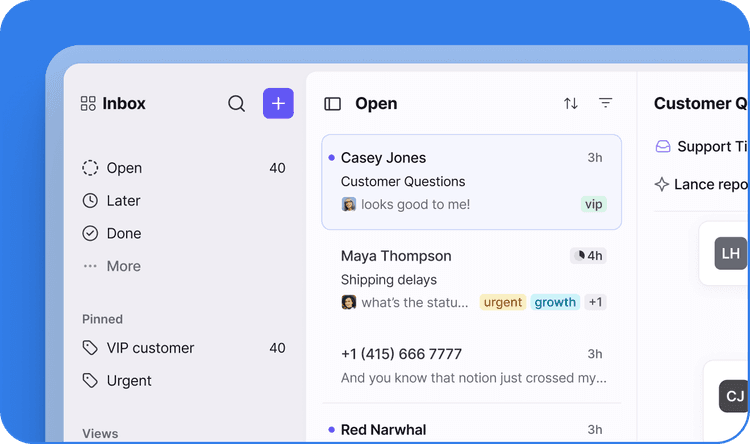
Front fixes that. By bringing every customer conversation into one shared workspace, your team can see the complete history, coordinate across departments, and respond faster — with full context and control over every customer interaction.
Front’s AI Copilot helps teams work faster by suggesting responses and surfacing trends — while keeping full control over every customer interaction. Support teams can handle repetitive tasks efficiently and focus their expertise where it matters most. Every interaction becomes an opportunity to build loyalty that lasts.
Customer connection doesn’t come from scripts or shortcuts. It comes from teams that are aligned and ready to deliver. That’s what Front makes possible. Book a demo to see how.
FAQs
Why do internal workflows matter for external customer experience?
Customers experience the result of your internal coordination. When teams share context, hand off conversations smoothly, and follow consistent processes, customers notice the difference through faster responses, fewer repeated questions, and more accurate answers. Poor internal workflows — scattered information, unclear ownership, manual handoffs — create the friction customers ultimately feel.
How do operations teams maintain consistency across multiple customer touchpoints?
Operations teams maintain consistency by centralizing all customer conversations in one workspace, establishing shared response guidelines, and ensuring every team member has access to full conversation history. When context is visible and workflows are standardized, customers receive the same level of service regardless of which team member responds or which channel they use.
What’s the difference between customer service and customer operations?
Customer service typically focuses on individual support interactions and ticket resolution. Customer operations encompasses the broader system — how teams coordinate across channels, how context flows between departments, and how workflows scale as complexity grows. In B2B environments with multi-team coordination and high-stakes relationships, customer operations ensures the entire system works together to deliver consistent service.