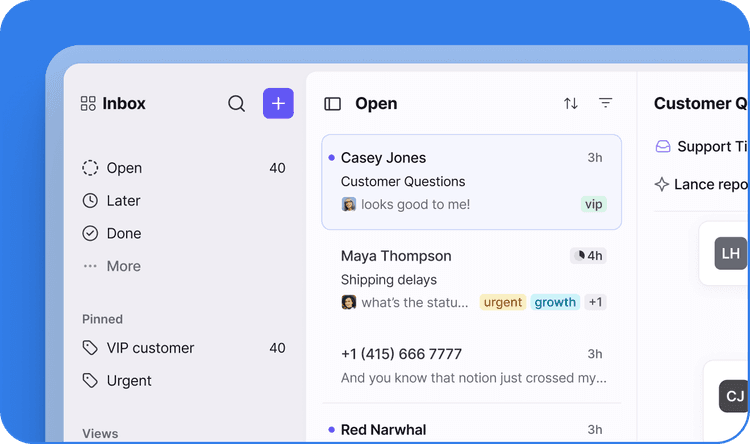





Digital customer experience depends on shared context, clear ownership, and visibility across channels. See what keeps B2B service consistent at scale.
B2B is complicated by nature. Digital interactions only add to it.
Customers read Reddit reviews, watch YouTube videos, and search knowledge bases to find solutions to problems or learn about product features — often long before they talk to anyone on your team. When issues require more hands-on involvement, however, customers reach out on portals, email, chat, and even social media accounts to find answers.
To customers, these interactions feel like one continuous conversation. But in reality, multiple teams are coordinating behind the scenes to keep that experience moving forward. In fact, they spend three hours coordinating for every one hour solving customer problems.
That’s why digital customer experience depends not only on customer-facing touchpoints but also on how well context and ownership stay aligned across teams.
What is online customer experience in B2B?
Online or digital customer experience (also known as digital CX or DCX) refers to how every digital interaction a customer has with your product shapes their impressions of your brand.
Unlike the traditional customer experience, which often relies on face-to-face relationships or direct service interactions, digital CX is shaped through portals, onboarding flows, support conversations, and any online touchpoint customers depend on.
In B2B operations, this might look like a procurement manager tracking an urgent shipment through a customer portal, a distributor waiting on a support update before fulfilling an order, or an enterprise customer moving between sales, onboarding, and account management teams without repeating information.
That’s just how B2B works. But what customers remember isn’t the structure behind the experience — they remember whether interactions feel consistent and ended in a resolution. Internal alignment matters as much as any customer-facing touchpoint.
Why is digital customer experience important for B2B teams
Nothing loses a customer faster than making them chase updates across channels. And that’s more common than B2B companies would admit. As a single request moves between teams in hours, delivering a consistent experience becomes harder than it looks.
Teams need shared context, clear handoffs, and consistent coordination to keep conversations moving efficiently. Otherwise, all customers get is a slow experience with less reliable answers than the last interaction.
4 components for a strong digital customer experience strategy
A fast chatbot response or polished website homepage doesn’t define what good digital customer experience looks like in B2B. What happens behind the scenes when conversations move does.
Let’s say a customer submits a support request Monday morning. By Wednesday, they had repeated the same information to sales, support, and operations. Three different teams, three different conversations, but no clear resolution. Internally, everyone believes someone else is handling it. Externally, the customer sees a company that feels disconnected.
This is what digital customer experience looks like when internal coordination breaks down.
Priorities may shift, but one thing stays the same: Context must be consistent at every touchpoint. That’s why the strongest digital customer experience management systems are built on repeatable processes and clear communication.
1. Shared visibility across digital conversations
One of the biggest challenges in B2B is fragmented customer communication. Customers may start a conversation through email, continue it through a customer portal, and later follow up with support or account management.
If teams cannot see the full interaction history, customers are forced to repeat information, which slows resolution times and creates frustration.
Strong digital CX relies on every team seeing the same picture — so every team involved understands the current status of an account. This becomes especially important when multiple departments support the same customer relationship.
For example, if a procurement issue is already being addressed by operations, the sales team should see that context before contacting the customer again. When internal coordination moves quickly, teams can prioritize efficient responses and identify stalled conversations before they escalate.
2. Clear ownership and structured handoffs
Accountability is the foundation of operational consistency. In B2B, customer issues move across several teams before resolution. Without defined ownership and documented handoff processes, requests sit unresolved while teams assume someone else is responsible.
Clear ownership helps teams maintain service-level agreements (SLAs) and prevents delays during high-volume periods. A customer submits a pricing adjustment request, for example. What happens next should be a documented process that defines who reviews the request, who approves it, and how updates are communicated back to the customer.
This level of coordination also prepares teams to manage customer expectations proactively, monitoring how requests move and resolving bottlenecks before customers notice them.
3. Connected context across systems
Shipment delays, account status, contract terms, inventory availability. All of it shapes how customer conversations go. When teams can access that information in seconds, conversations become more accurate and efficient. A support rep, for example, can immediately explain that an order delay is tied to a compliance review instead of escalating the request unnecessarily.
Bringing customer information into one place makes it easy for teams to access these key details, saving customers from repeating themselves and cutting duplicate work. Over time, continuity replaces repeated explanations and isolated records across the entire customer journey. Customers experience fewer disconnects between departments because the right context is available at every step, not just isolated support cases.
When that context is shared, teams don’t need to manually check multiple systems or wait on internal updates — meaning they can give more consistent answers, faster.
4. Reporting that exposes friction early
Operational problems are often visible well before customers formally complain — the challenge is catching them early enough to act.
That’s where reporting comes in. It plays an important role in surfacing unnecessary friction points that negatively impact digital customer experience performance.
Rather than surface-level activity metrics, operational reporting should focus on measurable outcomes: response times, unresolved conversation volume, escalation frequency, repeated customer follow-ups.
Take a freight distributor, for example. Repeated customer inquiries flood the inbox as shipments face delays or inconsistent updates. When reporting surfaces this friction, the distributor communicates shipment updates consistently across teams and repeat support inquiries drop.
Another report can surface why customers drop off without completing onboarding: long approval handoff times. When sales and implementation teams coordinate and fix this issue, onboarding completion rates jump up again.
Small fixes compound. They directly influence customer confidence and retention. A strong reporting foundation identifies where processes break down, communication slows, and customers have to work harder than they should.
Digital customer experience at scale with Front
Better digital customer experiences don’t happen overnight. But building repeatable processes that map the existing customer journey is a good place to start. Companies that pair that foundation with consistent coordination win in the long run.
Front gives you that coordination layer. Purpose-built for B2B complexity, Front keeps every team, tool, and conversation in sync, so your team can scale fast and provide accurate support without losing connection.
From AI assistance to real-time collaboration, Front supports coordinated, accountable customer communication at scale. See how Front helps teams master communication for better digital CX with our guide.
FAQs
How can B2B companies evaluate their current digital customer experience maturity?
Many B2B companies assume their digital experience is working until customers quietly disengage. A manufacturer, for example, may have strong products but lose leads because its customer portal is difficult to navigate or support responses are inconsistent.
Evaluating digital customer experience maturity starts with understanding the full customer journey, from discovery to renewal. Businesses should analyze engagement data, review onboarding processes, and gather direct customer feedback.
Using digital customer experience analytics can reveal gaps in personalization and show where users abandon interactions. The goal is to create a seamless, data-driven experience that supports long-term customer relationships and scalable growth.
What industries rely most heavily on digital customer experience?
Digital customer experience has become essential in industries where buyers expect fast, personalized, and minimum-friction interactions.
For example, a healthcare provider may depend on intuitive agent portals, while a software as a service (SaaS) company relies on self-service onboarding and real-time support to retain customers.
To stay ahead, many organizations invest in digital customer experience services that strengthen omnichannel coordination and simplify complex buying journeys, such as AI-assisted chat support, personalized customer portals, mobile apps, and automated onboarding workflows.
What are common pitfalls when scaling B2B customer service workflows?
Teams often scale tools before establishing strong processes, which creates fragmented ownership across teams, unclear escalation paths, inconsistent data between systems, and over-automation that fails complex accounts. Strong B2B customer service examples show the opposite: clearly defined SLAs, shared customer context, and structured human escalation points for high-value clients.