


Customer teams are being asked to do more with the same resources: manage larger books of business, spot risk earlier, prepare for every customer conversation, and still build real relationships. AI can help, but only when teams know what to automate, where to keep human judgment, and how to avoid scaling the wrong work.
At Gainsight Pulse, we joined Customer Success leaders for a conversation that kept coming up in different forms: where should AI actually help, and where should humans stay close?
It is the right question to ask, especially as CS teams are under more pressure to be proactive. A CSM may own a large book of business, have renewals coming up, support issues unfolding in the background, product usage changing week to week, and champions moving roles without anyone noticing until it is too late.
The problem usually is not that teams do not care enough. It is that the signals are scattered. The context lives across conversations, CRM notes, product data, support tickets, call recordings, and someone’s memory.
So the team starts the day triaging. Checking what is due, looking for risk, preparing for meetings, and chasing context.
That work matters. But it is not the work only humans can do.
The future of Customer Success is not full automation. It is intentional automation.
The hidden cost of CS work: coordination
A lot of CS work looks productive from the outside: pulling usage data, reviewing open tickets, checking renewal dates, reading through past conversations, and preparing for the next customer meeting.
But much of that work is really coordination. It is the time spent gathering enough context to do the actual work well.
For many teams, that coordination tax is high. The signals are often there: a champion goes quiet, seat utilization drops, a global admin changes jobs, or sentiment shifts across support conversations. But there is no reliable system to catch those signals, connect them, and put them in front of the right person at the right time.
That is why so many teams end up reactive. They focus on the renewal that is already close, the account that already escalated, or the customer that already raised their hand.
AI gives teams a chance to change that pattern, but only if they apply it to the right work.
Start with the customer, not the technology
Most AI advice starts with the tool: What can the model do? What can we automate? What can we generate?
A better question is: what experience are we trying to create for the customer?
For CS teams, that experience is usually about being timely, informed, and useful. Customers want their CSM to understand what is happening in their business, notice risk before it becomes a renewal surprise, and show up prepared when the conversation matters.
That gives us a clearer way to think about automation. The better question is not “How much can AI do?” It is “Where should AI create capacity so humans can spend more time on the relationship?”
Three buckets for CS work
A practical AI strategy starts by sorting work into three buckets: automate, assist, and own.
Automate: research and signal detection
This is the work AI should often own.
It includes reading, monitoring, synthesizing, and updating. The work is important, but it does not always require human judgment at every step.
Think things like:
Renewal risk signals
Seat utilization changes
Champion movement or org changes
Support escalations
CRM updates
Health score inputs
Recurring themes from calls and conversations
This is where AI can reduce the coordination tax most directly.
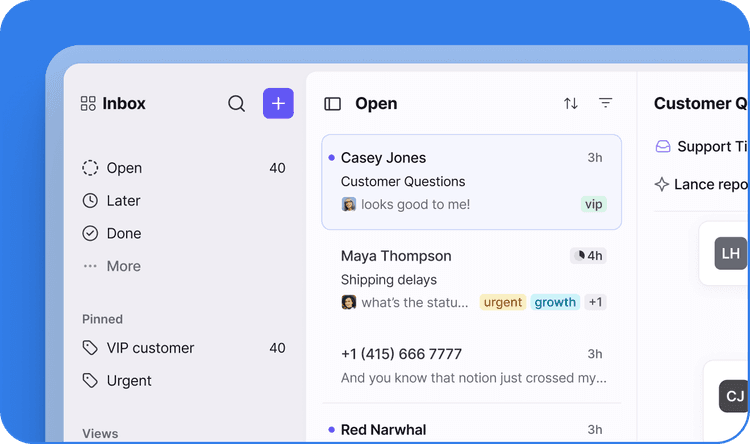
Instead of starting the day with a blank inbox, imagine starting with a prioritized view of your book of business. AI has already looked across product usage, support activity, customer conversations, CRM data, and external signals. It flags the accounts that need attention, explains why, and gives you the context to act.
That does not replace the CSM. It helps them stop spending relationship time on research work.
Assist: triage and prioritization
Some work should not be fully automated, but AI can make it much easier. This is where AI helps direct attention.
Which accounts need outreach this week? What should you prep before a renewal? Where is risk building before it becomes a hard conversation? Who should you contact after a reorg?
AI can surface the recommendation. The human still decides what to do.
That distinction matters. Prioritization has judgment inside it. A model may identify the signal, but the account owner understands the relationship, the business context, and the timing.
In this bucket, AI is not the owner. It is the briefing layer.
Own: the relationship itself
Some moments should stay human.
The QBR. The renewal negotiation. The executive escalation. The conversation where a customer decides whether they trust you enough to stay.
AI can help prepare for these moments by gathering notes, summarizing history, surfacing risks, and drafting talking points. But it should not own the room.
These are the moments where empathy, accountability, nuance, and trust matter most. The point of automation is to protect this work, not replace it.
A useful question: what if research were free?
Here is a simple way to rethink your AI roadmap:
What would your team do differently if research and analysis were nearly free?
If AI could read every conversation, check every signal, scan every support issue, review every call, track every usage change, and prepare every account briefing, where would your team spend its time?
That question changes the conversation.
Instead of looking for random tasks to automate, you start to see the operating model you actually want.
Maybe every account gets the kind of prep only top accounts used to get. Maybe churn risk surfaces 60 days before renewal instead of during the renewal call. Maybe a new account owner can ramp on a book of business without feeling exposed in the first customer conversation.
That is the promise of AI in Customer Success: not less human ownership, but better-timed human ownership.
Three things to try this week
You do not need to transform your entire CS motion overnight. Start with three practical exercises.
1. Map your top workflows into three buckets
Take the 10 things your team does most often. Sort each one into automate, assist, or own.
You may find that your team is spending too much human time on research, prep, updates, and signal detection. That gap is a good place to start.
2. Pick three accounts where you were reactive
Look at three accounts where the team found out too late.
Where was the signal? Was it in product usage? Support conversations? A stakeholder change? A call transcript? A missed renewal pattern?
Then ask why it did not surface sooner. That is your coordination tax, made specific.
3. Ask: if research were free, what would we do differently?
This question can quickly reveal your best AI opportunities. It shows which work should be automated, which decisions still need judgment, and which customer moments your team should protect at all costs.
Automation should create capacity for the human work
The goal is not to build a CS team that does less for customers.
It is to build a CS team that spends more time on the work customers actually feel: more proactive outreach, better-prepared conversations, earlier risk detection, stronger relationships, and more confidence across the whole book of business.
AI should not pull people away from customer relationships. When it is done well, it gives teams more time for the work only humans can do.
If you’re ready to start mapping your workflows this week, you can find the full framework here.