



Learn what customer success software does, which features matter most for different purposes, and how leading B2B tools support retention and workflows.
Customer success software promises healthier accounts, lower churn, and stronger customer relationships. But with dozens of platforms on the market, the right choice comes down to one question: what problem are you actually solving after the sale? Fixing onboarding? Catching churn before it hits enterprise accounts?
For most B2B teams, the real problem is neither; it’s that sales, support, and finance each end up with a different picture of the same customer, built from whatever context happened to reach them.
Recent research found that B2B companies spend three hours coordinating for every hour spent actually solving the actual customer problem.
Here’s what these platforms do, why you should use customer success software, what to look for, and which tools fit which B2B use case.
Here’s a quick glance:
What is customer success software?
Customer success software helps post-sale teams, including customer success, onboarding, technical support, and account management, manage customer relationships by unifying data to predict churn risk or account expansion opportunities. Beyond the relationship itself, it typically tracks:
Onboarding progress
Product usage
Retention trends
These platforms make all of that quantifiable. But customer success isn’t a dashboard. It’s whether context actually moves across support, account management, finance, and operations without someone having to go dig for it.
What to look for in customer success software
Customer success touches nearly every team in the organization, so the right software has to carry some of that coordination weight itself. Here’s what features in customer success software matter and where in the workflow they show up.
Structured account data in one place
Every strong customer interaction starts from the same shared context.
Customer success software pulls customer relationship management (CRM) data, support history, product usage, and billing information into a single account profile — a more extensive version of a customer profile. That single view keeps a CSM from starting each conversation by reconstructing the story from scratch, and it means the customer never has to fill in the gaps the system should already know.
Health scoring and proactive alerts
The strongest tools don’t wait for a customer to raise their hand.
By combining health scores, product usage, and support signals, they surface at-risk accounts before the account manager would have otherwise noticed — which means getting ahead of the risk instead of chasing it.
Onboarding and product usage tracking
A customer’s first experience sets the tone for everything after it. Built-in onboarding journeys help teams manage implementation and assign next steps without guesswork.
Once a customer is live, usage tracking shows what they’ve adopted and what they’re missing, so "are they getting value" stops being a guess.
Real-time communication and handoff visibility
Your account profile tells you where things stand — health score, usage, billing history. It doesn’t tell you what’s happening in this week’s conversations. Customer success software should also centralize live emails, chat, support threads, and internal notes, so sales, support, and success are working from the same conversation history, not just the same customer record. That’s what prevents duplicated outreach and dropped handoffs.
The best customer success software by use case
Customer success software isn’t one category; it’s several, each built around a different part of the job. The customer success software examples in this list support various parts of the work, from management to coordination around customer relationships.
Instead of treating these platforms as interchangeable, here’s what each one does best.
Dedicated customer success platforms
Built specifically for customer success management workflows, such as account health, onboarding, retention, renewals, and customer journey tracking.
Gainsight: Best for enterprise customer success management
As customer portfolios grow, keeping every account on track becomes harder without standardized processes and triggers. Gainsight is built for enterprises where customer success spans multiple teams and renewal cycles.
The platform helps create those repeatable workflows, so relationships and account health stay consistent. It’s best suited for organizations that need structure and visibility into the status of every customer account at scale (rather than manual account management).
ChurnZero: Best for churn prevention and customer health tracking
ChurnZero is ideal for SaaS businesses that want to reduce churn by identifying risks before they turn into cancellations.
Instead of waiting for support tickets, teams can use customer health insights to spot declining engagement and intervene early. This makes it a strong fit for CSMs focused on retention, as it helps prioritize outreach where it can have the greatest impact.
Totango: Best for customer journey orchestration
Totango works best for growing organizations that need a more consistent approach to customer success. As customer bases expand, manually tailoring every interaction becomes difficult.
Totango helps teams design repeatable customer journeys that guide users through onboarding, adoption, renewal, and expansion. The result is a more scalable customer experience without sacrificing relevance, which is particularly valuable for teams managing large volumes of accounts.
Customer success support tools
These aren’t health-scoring or onboarding platforms. They fill the gaps traditional CS software wasn’t built to close.
Front: Best for customer communication and account visibility
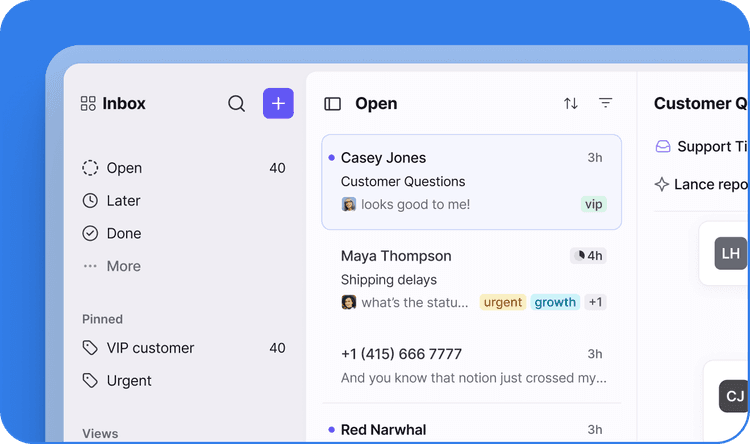
B2B post-sale relationships are high-context and high-touch, with long resolution cycles — exactly the conditions where conversations fragment and ownership gets murky. Front brings email, chat, and other conversations into one shared workspace, so everyone sees the same customer history before they respond. It’s built for cross-functional B2B teams where communication visibility directly shapes the customer experience.
Zendesk: Best for support-led customer success workflows
Zendesk is a legacy, ticket-first customer service platform, best suited for teams where customer success naturally grows from strong support operations.
Every support interaction reveals something about the customer experience, from onboarding friction to recurring product issues. Zendesk helps teams capture those insights and use them to improve customer relationships over time, making it a great choice for organizations that want support and customer success to work together rather than as separate functions.
Fin: Best for AI-powered customer engagement and support
Fin is an AI customer service agent that helps businesses engage customers through fast, conversational support at scale. Instead of relying solely on human agents, Fin resolves routine questions automatically and hands more complex issues off to the right team with full conversation insight.
For customer success teams, this means customers get answers faster while support teams stay focused on high-value conversations. Fin is a strong fit for SaaS companies and fast-growing businesses looking to improve customer responsiveness, reduce support volume, and deliver consistent service as they scale.
Go beyond account health scores with Front
Customer success doesn’t stop at a health score. Someone still has to manage the conversations and handoffs that shape the relationship after the sale, and that’s where most teams struggle. Context fragments between interactions, and follow-through depends on whoever happens to pick it up, not a consistent owner.
Front replaces that fragmented handoff with a single coordinated workspace. Built for high-coordination B2B environments, it keeps customer context connected across every channel, while automation clears repetitive queries and routes the nuanced ones to the right person before anything stalls.
Manage complex B2B customer relationships from a single platform. Try Front today.
FAQ
What metrics should teams use to measure customer success performance?
A mix of quantitative (revenue, churn rate) and qualitative (health score, customer effort score, feature adoption) metrics mapped back to business outcomes, not tracked in isolation.
What are the best practices for implementing customer success software across teams?
Success in implementing customer success software across teams depends on aligning teams around the current customer journey, defining clear ownership, helping teams understand how the software improves their daily work, and integrating feedback loops.
Can customer success software improve retention?
Yes. Customer success software improves retention and customer satisfaction by unifying customer data into a shared view and establishing cross-functional alignment so that teams can have a single source of truth for all risks and opportunities.