



After-sales service goes beyond support tickets. Learn how B2B teams connect onboarding, issue resolution, feedback, and follow-up to improve retention.
The sales team just closed another deal and headed out for a celebratory lunch. For everyone else, the work is just beginning. Once the contract’s signed, the customer needs clean onboarding and reliable support the moment anything goes sideways.
Your after-sales service factors into whether your customers stick around. Weak service puts satisfaction and retention at risk; strong service turns a signature into a lasting relationship.
Here’s what after-sales service means in B2B and how to deliver it consistently across the whole client relationship.
What is after-sales service?
After-sales service is the support and follow-up you give customers after they buy — everything aimed at helping them succeed, resolving issues, and building the relationship over time.
In B2C, that’s technical support, returns, and rewards programs. In B2B, it carries more weight: onboarding, training, customer education, ongoing support, software updates, and regular follow-ups and reviews from an account manager or customer success manager (CSM).
The importance of after-sales service for B2B teams
The point of after-sales service is simple: get customers the most value from what they bought. Answer questions fast, support them before they have to ask, and they’ll keep coming back.
In Front’s State of Service Expectations report, 55% of customers said they feel more loyal to a brand that is attentive. Quick, accurate responses drive retention and satisfaction — one fast fix on a technical issue can drive a client to renew an annual contract.
After-sales service also enhances your reputation and gives you a competitive advantage. Happy customers are more likely to recommend you to others, leading to higher sales from referrals. Consistency is important — delivering it after the sale takes well-coordinated operations running behind the scenes.
How B2B teams make after-sales service consistent across the relationship
B2B after-sales service is a team sport — support, account management, sales support, product, and operations all play a role. These practices keep post-sale work coordinated.
Set clear ownership for post-sale work
Start planning onboarding the moment the deal closes. Build a playbook that names which teams own which onboarding task, so nothing stalls out of the gate. Then carry that through the whole customer lifecycle. B2B issues bounce between teams, so each one needs a named owner. This keeps tasks from slipping through the cracks and leaving customers waiting.
Keep customer context connected across teams
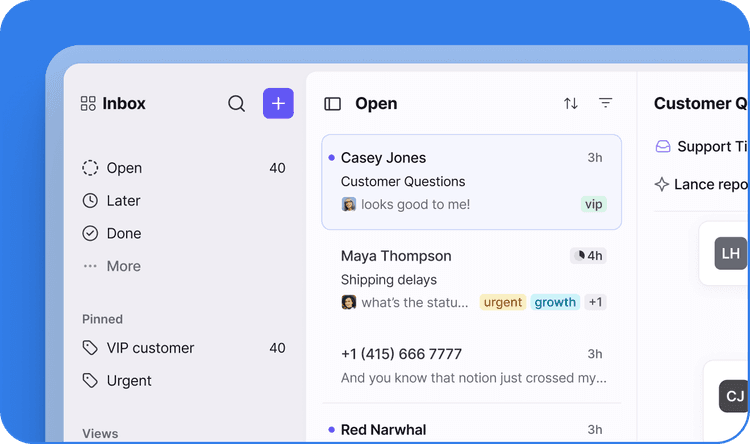
Use a customer service platform that gives teams shared visibility into customer context. When you’re handling customer complaints or other issues, the full picture should travel with the issue through each handoff.
If a customer reports a defective product via live chat, they shouldn’t have to rehash it when the issue is handed off to someone else. Shared context is what lets your team answer consistently by drawing on the full conversation history and account data.
Turn feedback into action
Collect customer feedback regularly via surveys and follow-ups, and act on it to fix product issues. A customer satisfaction (CSAT) survey might reveal that customers want faster status updates as a request moves between departments; The fix is to configure automated updates after each handoff.
The goal is a customer feedback loop: one customer’s complaint becomes the solution for the next customer with the same problem.
The types of after-sales service B2B customers need
These are the core kinds of post-sale support B2B customers rely on.
Onboarding and customer education
Your first job after the sale is helping customers set up and get running. Aim for proactive onboarding that teaches them how to use the product and adopt the workflows that matter.
Then keep that education current as your product evolves, and your customer hires new people who need to learn it. Back it with self-serve guidance — a knowledge base, help center, AI agent, or video tutorials.
Say a logistics company rolls out a new dashboard for tracking shipments. The smart move: add how-to tutorials to the knowledge base and put extra support staff on hand for the go-live, when the questions spike.
Technical support, repairs, and maintenance
In B2B, fixing an operational problem usually requires teams to work together. A financial services company receives a complaint that reports aren’t reconciling — support can’t resolve it on its own, so it escalates to engineering. Whether that handoff is clean or messy is the difference between a quick fix and a frustrated customer.
Feedback, follow-up, and relationship signals
The best customer care builds long-term relationships, and that takes regular follow-up — actually checking in to see whether customers are getting what they need.
Watch the relationship signals: CSAT and Net Promoter Scores, plus operational metrics like response and resolution times. Together, they predict the strength of a customer relationship and the customer’s likelihood of renewal and expansion. Catch a problem early, and you can fix it before it costs you the account.
Say a manufacturer tracking its metrics spots a CSAT dip on a high-value account. The customer success team follows up and books a review. It turns out responses have been slow lately, and self-service isn’t answering the customer’s questions. The company uses that feedback to speed up responses and upgrade its knowledge base.
How Front helps B2B teams run after-sales service as one connected operation
Onboarding, technical support, feedback, follow-up — after-sales service isn’t a string of separate tasks. It’s one continuous operation, and coordinating it across departments is what lifts CSAT and retention.
Seso is an example of well-executed after-sales service. Its post-sale work involves CSMs, operations, logistics, and payroll teams, and Front keeps everyone connected with shared customer context.
After-sales service breaks down when different teams lose context between handoffs or lack clear ownership. Front closes those gaps, so customers receive consistent support throughout the relationship. Start a free trial to see how Front can help you coordinate after-sales service and build stronger customer relationships.