



Discover customer service follow-up best practices and examples to help teams keep every conversation, owner, and next step in sync.
In B2B customer service, the stakes are high: 80% of customers say customer service shapes their overall brand perception, which means every interaction either reinforces trust or exposes operational risk.
B2B issues move across conversations, teams, accounts, and systems — so it’s not enough to send a first reply or close a ticket. You need to check in after each interaction to confirm the customer got what they actually needed: a fast response, accurate information, a real resolution, and communication that got ahead of the problem instead of just reacting to it. Customer service follow-up is the step that confirms all of this held up.
This guide defines customer service follow-up, explains why it matters, outlines the best ways to follow up with customers, and shows how Front keeps every interaction connected to customer outcomes.
What counts as a real customer service follow-up
Customer service follow-up is proactive communication that closes the loop after any customer interaction. It confirms the issue is truly resolved, answers any remaining questions, and gives the customer a clear next step instead of leaving them to guess.
For B2B teams, follow-ups happen constantly — after support fixes, ticket closures, onboarding steps, implementation milestones, and any inquiry that didn’t get a clean answer. They can happen over email, Slack, phone, or whatever channel the customer prefers. The job is the same either way: Check in, confirm the customer is actually satisfied, and leave the door open for anything still unresolved.
The importance of follow-ups
B2B support teams often aim for speed: fast replies, fast resolutions. But speed only matters if the customer’s problem is actually solved.
Front’s State of Service Expectations research found that 59% of customers will leave or advocate leaving after three or fewer bad service experiences. With stakes that high, closing a ticket right after a quick reply is a real risk — you have no way of knowing whether the customer is satisfied or quietly on their way toward churn.
Follow-up closes that gap. It catches unresolved issues before they escalate into retention risks, reinforces a positive experience, and surfaces exactly where your process is falling short.
5 best practices to follow up with customers
Following up well means staying proactive without turning into noise. These five best practices show how to follow up with a customer effectively, covering the elements that move the needle: clarity, timing, context, tone, and next steps.
1. Confirm resolution from the customer’s side
The purpose of a customer service follow-up email is to confirm resolution. A logistics company may think a delayed shipment is handled and close the ticket, only to find out later the customer is still unhappy with the new delivery time.
A short follow-up email with a subject like “Do you still need help?” surfaces that gap fast. The customer responds, the team reopens the ticket, and expedites the shipment to meet the customer’s deadline. That single check-in prevents a small frustration from becoming a churn risk.
2. Tie the follow-up to the original conversation
Every follow-up you send should connect to the original issue in your support platform. That connection gives teammates the full context: who sent the follow-up, what the customer saw last, and what action is needed if they respond.
Take a manufacturing customer who replies to a follow-up saying the recent update didn’t fix the quality issue. Because the message is tied to the original conversation, the support team can immediately see which update the customer is referring to and what the underlying issue was. Without that link, they’d waste time digging for context instead of solving the problem.
3. Make the ask simple and specific
A strong follow-up needs a clear subject line, a quick greeting, and one direct question that tells the customer exactly what you need from them.
A follow-up after a ticket closure might read:
“Hi [Name],
Thanks for contacting us about [product name]. We’ve resolved the issue, but please let me know if you still need help. Just reply to this email and I’ll get back to you promptly.
Best regards,
[Name]”
4. Time the follow-up to the customer’s situation
Time your messages to match the urgency of the issue and the customer’s expectations. After a critical software outage is resolved, check in immediately to confirm recovery and catch any lingering issues.
Not every interaction needs urgent attention. For example, after an onboarding milestone, give the customer a few days to explore the product before asking for feedback. Broader account check-ins can happen every few weeks or months.
5. Turn the reply into a clear next step
A recap isn’t enough — every follow-up should answer what happens next. When a financial services company gets a complaint about a loan application, an apology alone doesn’t close the loop. The follow-up needs to spell out the plan: what happens next, who owns it, and when the customer can expect an update.
Follow-up examples for high-context B2B moments
Follow-ups need to reflect the customer’s situation, the severity of the issue, and the history of the conversation. Here’s how that plays out across common scenarios in B2B customer support operations.
After resolving a support issue
The priority here is confirming the fix worked and catching anything that still needs attention.
Email example:
“Hi [Name],
We’ve fixed the issue with your analytics dashboard, and your data should be syncing correctly now. Take a look when you get a chance and let me know how it’s looking.
Thanks,
[Name]”
Loop in the relevant teams ahead of time so they can move fast if the customer reports that something’s still off.
After closing a ticket
A closed ticket shouldn’t feel like a closed door. This follow-up confirms the closure while making it easy for the customer to re-engage if anything still needs attention.
Email example:
“Hi [Name],
Glad to hear everything’s syncing correctly now! We’ve closed out the ticket, but if anything else pops up, just reply here and I’ll jump back in.
Best regards,
[Name]”
Keep the message tied to the original ticket, even after it’s closed, so the team has full context and can act fast if the customer reaches out again.
After receiving no response
Silence isn’t resolution. Give a clear reason for checking back in so you can reopen the conversation without it feeling like a nudge, and keep the ask small enough that responding takes 10 seconds.
Email example:
“Hi [Name],
I wanted to check in about the data syncing issue you reported — want to make sure everything’s working well on your end. Let me know if it’s resolved, or if you’re still running into anything.
Best regards,
[Name]”
After onboarding or implementation
An onboarding follow-up has one job: Confirm the customer is set up, understands the next step, and knows exactly where to go if something breaks.
Email example:
“Hi [Name],
Glad to hear you’re all set! Take a look at our onboarding guide [link] for the full rundown on what’s next. If anything comes up or you hit any access issues, reach out — happy to help.
Thanks,
[Name]”
Internal coordination matters just as much here — teams need to be ready to move the moment the customer replies with a question or a problem.
Front keeps follow-up connected to the work behind the conversation
A follow-up doesn’t happen in isolation. It needs a customer operations platform that connects the message to the full conversation history and makes clear who owns the next step.
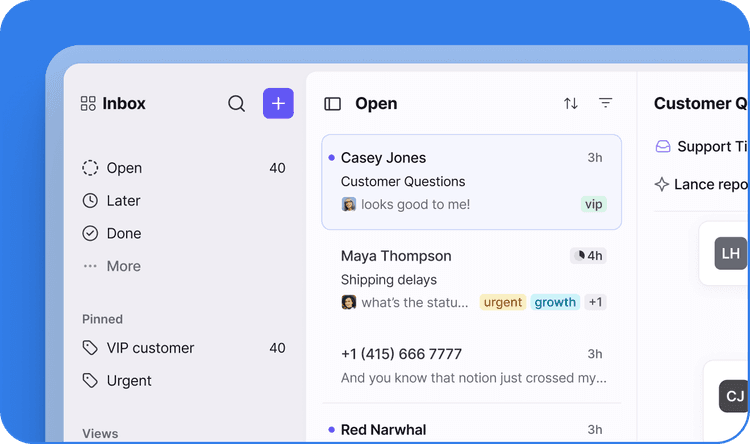
Front is built for B2B complexity, keeping teams, tools, and customer conversations in sync. It gives your teams shared real-time access to customer context and helps them coordinate responses quickly with assignments, internal comments, workflow automation, and analytics.
Logistic Dynamics, one of the fastest-growing logistics providers in the U.S., used Front to consolidate hundreds of individual inboxes into a single shared communication platform. Now the team can assign follow-ups, track conversation status, and collaborate on responses, all in the same place.
Schedule a demo to see how Front keeps every follow-up tied to the right conversation, owner, and next step.
FAQ
What metrics should customer service teams track for follow-up?
Start with customer satisfaction scores and follow-up contact rate, then layer in other support KPIs like response times, resolution times, and reopen rates to see how follow-ups affect the broader workflow.
Should customer service follow-up be automated?
Automate predictable follow-ups, like satisfaction surveys, reminders, or confirmations. For anything nuanced or sensitive, a personalized email from a team member is more effective.
What is the difference between customer service follow-up and escalation?
A follow-up keeps the conversation going with the customer. An escalation moves the issue internally to someone with more expertise or higher authority.