

Ticket triage
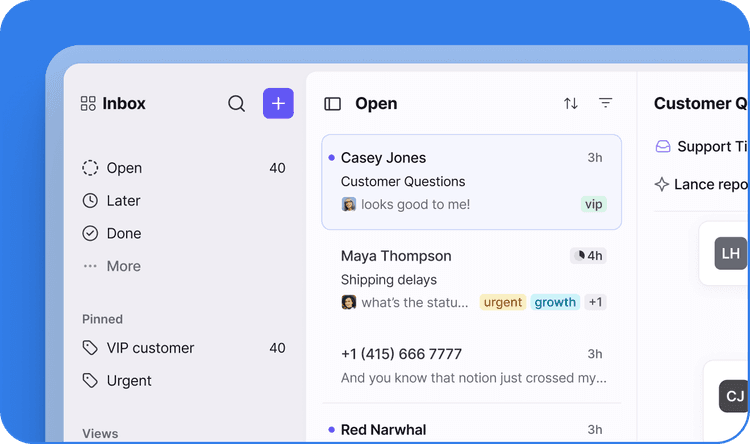
Ticket triage in B2B customer support is the process of categorizing and prioritizing support requests as they roll in, then routing them to the right person.
It’s the first decision after a request arrives: defining what the issue is, how urgent it is, who should own it, and what needs to happen next. Effective triage acts as a command center, helping support teams route tickets faster and resolve issues more accurately.
How ticket triage works in B2B
Sorting tickets into a queue is part of customer support triage, but it’s not the entire process. In B2B, ticket triage is what turns an incoming customer request into a clear path for resolution.
Once you identify the issue type, urgency, and priority, the ticket triage process assigns the right owner, determines whether escalation is needed, and ensures all relevant context moves with the ticket. This prevents duplicate work and repeated explanations by customers. In simple terms, triage is the bridge between speed and quality in B2B customer support.
What teams evaluate during ticket triage
While many teams focus on the order in which tickets arrive, effective triaging depends more on customer and operational signals, such as:
- Priority and urgency scoring: Teams manually (or using software) rank support tickets based on business impact, time sensitivity, and customer value, so critical issues get immediate attention.
- Service-level agreement (SLA) deadlines: Once priority is set, SLA targets decide response and resolution timelines. Both agents and leaders use these deadlines to standardize workflows and maintain consistent outcomes.
- Likelihood of escalation: Teams flag tickets likely to escalate by scanning for severe or technically complex language — such as “leaks” or “compromise” — and route them for higher-level handling.
- Support channel: B2B teams work across multiple channels, and each one carries different expectations for speed and response. Triage uses the channel type to route each request to the right team’s inbox and the representative responsible for that channel.
- Context and internal notes: Taking the right next step is nearly impossible without context. Teams consider account details and past interactions to understand the issue and move forward quickly.
Manual vs. automated support ticket triage
Manual and automated triage aren’t competing approaches. Rather, they complement each other, serving different operational needs.
The bottom line: Automated triage is most effective when you have clear priorities, escalation paths, and context. Otherwise, automation becomes just another tool that increases workload rather than reducing it.
Other resources
- AI triage
Learn how AI triage helps B2B customer service teams assess customer queries, set priorities, and route work to the right team or next action.
- Customer service automation
See how customer service automation helps teams route work, reduce repetitive tasks, and keep ownership clear across customer conversations.
- AI routing
Learn what AI routing means for support teams. Find out how it improves routing accuracy, context transfer, and ownership across conversations.
- Customer support ticket
Learn what a customer support ticket is, how they work and the most common types, and why they matter for B2B teams when managing customer issues.
- Conditional logic
Understand conditional logic and how B2B customer operations teams use if/then rules to keep routing, ownership, escalations, and follow-up clear.
- Email inbox management
Explore email inbox management and how customer-facing teams use techniques like standardized triage and clear ownership to keep conversations moving.
- Task automation
Learn what task automation is, how it works, and best practices for reducing admin work and achieving consistently high-quality B2B support.
- Proactive customer support
Discover how proactive customer support helps B2B teams keep customer conversations moving and catch issues early for a satisfying customer experience.