

Related terms
Workflow automation
Understanding what workflow automation is starts with its core purpose: connecting different software tools and teams to automate repetitive tasks and simplify data flows. It uses rule-based logic to trigger actions — such as automatically routing tickets and sending onboarding emails — without requiring manual intervention.
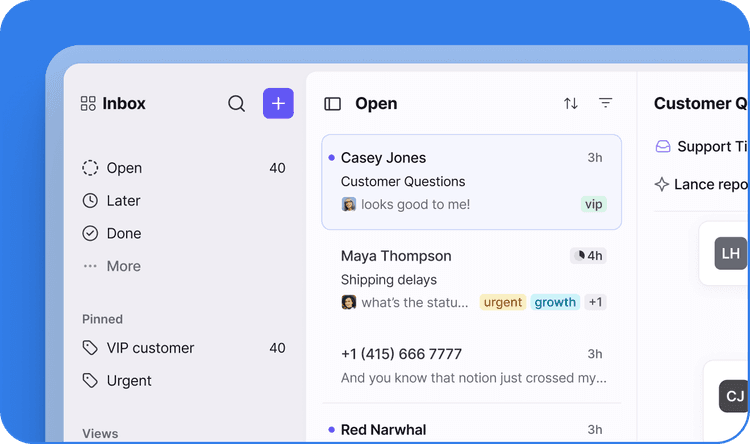
Workflow process automation can reduce the risk of dropped tasks or lost context because it’s directly tied to service-level agreement (SLA) timers. It can also acknowledge new customer requests and parse the issue by severity and urgency using platforms like Front.
Although often mentioned together, task automation and workflow automation serve different purposes. While the former focuses on individual actions, the latter coordinates entire processes involving multiple steps and stakeholders. This broader approach makes workflow automation especially valuable for maintaining consistency and helping teams manage increasingly complex operations.
How workflow automation works
Workflow automation coordinates connected tasks so work moves through a process without constant manual oversight. Instead of automating a single action, it links multiple steps across teams and systems, so progress is continuous from one stage to the next.
Most automated workflows include a combination of triggers, routing logic, assignments, approvals, notifications, and escalations.
For example, a customer request can automatically be assigned to the right team, routed based on priority, approved when required, and escalated if it risks missing a deadline. Ownership rules ensure every task has a clear next step and minimize uncertainty.
By standardizing how work flows, teams spend less time coordinating handoffs or tracking problems manually. Faster responses and focus on higher-value work quickly follow.
Common B2B applications of automated workflow solutions
Common B2B automated workflow applications often center on improving coordination and making work more predictable across teams. Rather than simply replacing manual tasks, these examples address the increased complexity that comes with scaling operations.
- Coordinating cross-functional customer requests: Customer inquiries or service issues often require input from multiple departments. Workflow automation ensures each request is routed to the right team and assigned a clear owner responsible for the process from the first contact to the last handoff.
- Maintaining visibility across complex operations: As work moves between teams, timely updates and status updates keep both teams and customers informed. Everyone understands what has been completed and what happens next, thanks to clear customer communication.
- Standardizing service delivery at scale: Workflow automation applies the same business rules to every request with almost no exceptions — for a good reason. Consistency comes from standardizing service delivery, so customers get the high-quality experience they expect.
- Keeping work moving before issues escalate: Automated workflows identify stalled work and missed deadlines. Then, they trigger escalations before they affect customers. For example, overdue service requests can be reassigned automatically to the next best person on the team, so customers don’t experience any disruption to their schedules.
Workflow automation tools help teams identify opportunities to improve efficiency and service quality while complementing, rather than replacing, the human judgment and personalized support customers need for complex issues.
Other resources
- AI workflow automation
Learn what AI workflow automation is, how it works, and how B2B teams can use workflow automation tools to effectively improve their processes.
- Workflow orchestration
Learn how workflow orchestration makes complex B2B work more efficient and connected. Find out how to apply it and how workflow automation comes into play.
- Task automation
Learn what task automation is, how it works, and best practices for reducing admin work and achieving consistently high-quality B2B support.
- Customer service automation
See how customer service automation helps teams route work, reduce repetitive tasks, and keep ownership clear across customer conversations.
- Round robin assignment
Learn what a round robin assignment is, how it works, and the best practices B2B teams use to balance workloads, improve response times, and smooth customer operations.
- Customer self-service
Learn what customer self-service is, why it matters for B2B companies, and common types of self-service that boost operational efficiency.
- Operational customer relationship management
Learn what operational CRM is, how it differs from other CRM types, and how businesses use it to support day-to-day customer work.
- Inbox zero
Learn what inbox zero means for collaborative B2B teams, how to achieve empty inboxes, and the operational tips required to maintain visibility.