

Related terms
Customer service automation
Customer service automation uses technology to handle repetitive support tasks, like routing tickets, with minimal human intervention. Teams can automate AI chatbots or self-service functions to deliver faster resolutions or eliminate the need to open an inquiry in the first place.
What is customer service automation useful for?
One of the most effective applications of customer service automation is self-service. Resources like knowledge bases enable customers to find answers and resolve common issues on their own. Self-service portals add another layer by letting customers complete routine tasks independently, like resetting passwords and scheduling appointments.
AI customer service automation is a more advanced solution for complex tasks. AI agents and chatbots can manage entire customer conversations, but human reps can take over when escalation is necessary.
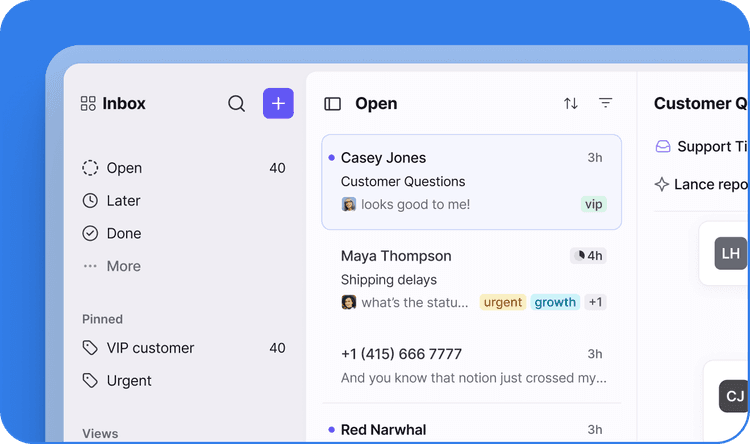
A middle ground between these options is rule-based task automation. With this model, a new incoming ticket or customer reply triggers customer service software to execute actions based on preset rules you defined. For example, you might have a rule like, “If an incoming ticket comes from a VIP customer, assign it to the head of support,” to partially automate triage.
Support teams commonly use customer service automation to do the following:
- Gather customer feedback by distributing questionnaires like customer satisfaction and Net Promoter Score surveys.
- Send automatic notifications to update customer support representatives about ticket status changes or new replies.
- Route and assign tickets automatically.
Benefits of customer service automation
Automation tools reduce administrative work so support specialists can focus on the high-value tasks that require their expertise. Ticketing systems with automation capabilities, for example, can route, assign, and follow up on a high volume of queries even as support operations scale. Auto-responses enable fast response times, so customers generally leave the interaction feeling satisfied.
In Front’s Coordination Tax report, 64% of companies reported experiencing one or more customer-facing coordination failures, like giving inconsistent answers or losing context, in the past three months. Companies could potentially reduce those failures by using automation tools that keep task ownership visible and answers consistent.
Common customer service automation examples
Teams can put automated systems to use in numerous ways, including:
- SLA breach alerts: Support reps can get notifications when they’re close to breaching a service-level agreement (SLA) commitment, like a ticket about to hit its response-time deadline.
- Auto-tagging: Customer service automation tools can label inquiries by topic or urgency for more efficient ticket management.
- AI-assisted escalation: AI systems can identify complex or high-priority support requests and automatically route them to the right agent with full context, including customer history, system logs, and previous resolution attempts.
Other resources
- Ticket triage
See how ticket triage helps support teams classify requests, prioritize urgent issues, assign ownership, and keep customer work moving with clear context.
- Task automation
Learn what task automation is, how it works, and best practices for reducing admin work and achieving consistently high-quality B2B support.
- Omnichannel communication
Learn how omnichannel communication helps B2B teams keep customer conversations connected as work moves across channels, teams, and systems.
- Email inbox management
Explore email inbox management and how customer-facing teams use techniques like standardized triage and clear ownership to keep conversations moving.
- AI triage
Learn how AI triage helps B2B customer service teams assess customer queries, set priorities, and route work to the right team or next action.
- Workflow automation
Learn what workflow automation is, how it works, and how B2B organizations use it to improve coordination, visibility, and operational efficiency.
- Proactive customer support
Discover how proactive customer support helps B2B teams keep customer conversations moving and catch issues early for a satisfying customer experience.
- Service-level agreement
Learn what an SLA is and how it helps B2B support teams set measurable expectations for key metrics, like response, resolution, and service quality.