

Related terms
Email inbox management
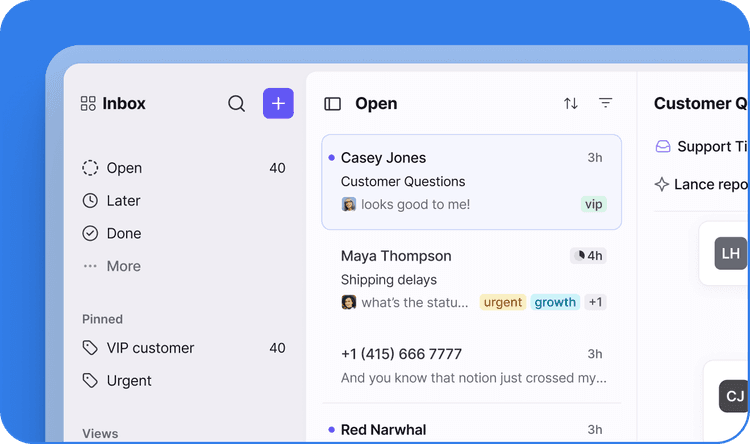
Email inbox management refers to the systems teams use to organize, prioritize, and respond to emails. In customer service operations, it’s less about the way individual team members manage their inboxes and more about team-level daily habits. When done right, email inbox management allows for quicker response times without sacrificing quality.
What is inbox management useful for?
Many businesses face coordination issues. In Front’s Coordination Tax Report, 64% of B2B companies said they experienced at least one customer-facing coordination failure in the past three months. In many cases, the culprit is a messy inbox packed with disorganized, unlabeled folders that make it challenging to find information.
Without the clear visibility, ownership, and prioritization a tidy inbox provides, teams are more likely to miss follow-ups and send duplicate replies. This makes support representatives’ jobs unnecessarily difficult and can leave customers waiting for responses. Effective inbox management aims to prevent these issues.
Email management tips and tricks
Here’s how to organize an email inbox with time-tested email management techniques.
Standardize triage workflows, labels, and folders
Instead of improvising, devise a consistent process for checking emails and keeping them organized. This might include auto-tagging and bulk sorting routine messages with predefined labels or subfolders. Then you don’t end up with a system where one support representative uses one set of labels while another uses a completely different one. Customer context doesn’t disappear during handoffs.
Make ownership crystal-clear
Shared inboxes create visibility, but it’s important that team members also know who owns what. Assign a clear owner to every ticket or use email management software with AI tools that label ownership automatically.
Define priority signals
Fixed criteria puts everyone on the same page about what counts as an urgent ticket and what’s less of a priority. Establish clear, tailored signals based on factors such as sender status (e.g., VIP accounts), request type, and tone. This way, triaging incoming tickets is faster and more consistent.
Develop a follow-up workflow
Follow-ups can fall by the wayside when teams rely on memory instead of well-defined processes. Set specific times to review the shared inbox for overdue tasks. Or, enable notifications to alert the right person when it’s time to reply to a neglected sender or escalate a thread that’s about to overshoot its target response time.
Other resources
- Team inbox
Learn how a team inbox keeps customer conversations moving with shared visibility, clear ownership, and reliable follow-through.
- Outbound email
Outbound email isn’t just for cold outreach. Learn how B2B teams use it to proactively start purposeful conversations and keep them clear and actionable.
- Email etiquette
Learn the core rules of email etiquette, why they matter, and how they help teams keep customer conversations clear, consistent, and easy to act on.
- Ticket triage
See how ticket triage helps support teams classify requests, prioritize urgent issues, assign ownership, and keep customer work moving with clear context.
- Contact data management
Learn about contact data management and how B2B teams use software to create customer records, preserve account context, and keep conversations moving.
- Proactive customer support
Discover how proactive customer support helps B2B teams keep customer conversations moving and catch issues early for a satisfying customer experience.
- Inbox zero
Learn what inbox zero means for collaborative B2B teams, how to achieve empty inboxes, and the operational tips required to maintain visibility.
- Help desk software
Explore help desk software features, benefits, and buying criteria for teams that need clearer support, defined ownership, and better visibility.