

Related terms
Contact data management
Contact data management is the system or strategy a business uses to keep customer and business contact information organized and current.
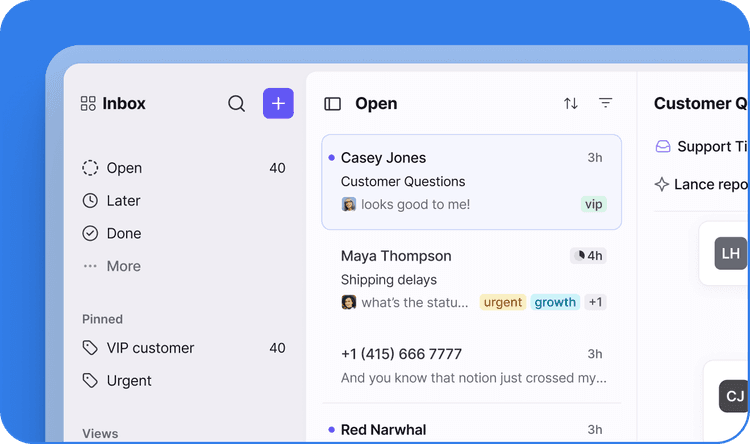
When customer support representatives can easily pull the customer profile they need or a handoff automatically comes with context and communication history, that’s contact data management in action. The ultimate goal is to support relationships throughout the customer lifecycle by keeping contact details easy to find and connected to conversations.
CRM vs. contact management
Customer relationship management (CRM) refers to the tools that businesses use to organize and manage customer relationships and coordinate interactions across the full customer journey.
Contact data management (sometimes simply called contact management) focuses specifically on storing and organizing customer contact details and interaction history. These tools often place call notes, email threads, and account history right next to each contact record, making it easier for team members to find the context they need when interacting with a customer.
Today, contact management software is typically included as a key function within a broader CRM platform, which may also offer capabilities such as interaction analytics, sales tracking, and insights based on customer activity and purchase history.
How contact data management supports B2B operations
Here’s a look at a few key contact management applications for B2B customer service operations.
Keeps context up-to-date at all times
Contact management software keeps records and interactions centralized, so details and communication history stay current, no matter who touched them last. Any new information — a status update, a new reply to an open conversation, a resolution — is visible to everyone. All stakeholders, from customer service to the sales team, know what’s going on.
This becomes especially valuable as businesses grow. With a centralized source of information, teams can scale without losing context or letting a growing contact list and increasing support volume create unnecessary chaos.
Preserves context between handoffs
Keeping the data synced means support ticket escalations and reassignments don’t amount to duplicated work. When context travels together with each contact and conversation, support reps know exactly where the last team member left off. No one has to ask the customer to repeat themselves or retry resolution attempts that have already proven ineffective.
Clarifies ownership and next steps
Contact management that allows for extra data fields keeps responsibility and next steps clear by attaching an owner to each client and conversation. That clarity helps keep commitments from falling by the wayside; team members know when to send a follow-up email or take the next step in a drawn-out sales process with a high-value client.
Other resources
- Contact management
Learn the definition of contact management, what software features to look for, and how it differs from a traditional CRM platform.
- Customer profile
Learn what a B2B customer profile is and how this account context gives teams the clarity they need to support customers throughout the relationship.
- Email inbox management
Explore email inbox management and how customer-facing teams use techniques like standardized triage and clear ownership to keep conversations moving.
- API integration
An API integration connects software platforms to enable two-way data sharing. Learn how API integrations work and how teams use them in B2B operations.
- Operational customer relationship management
Learn what operational CRM is, how it differs from other CRM types, and how businesses use it to support day-to-day customer work.
- Point of contact
Understand what a point of contact is, why it matters in B2B, and how clear ownership helps teams manage customer inquiries and follow-ups.
- Customer event tracking
Learn what customer event tracking is and how B2B teams use customer behavior and operational signals to improve conversations and decision-making.
- Omnichannel communication
Learn how omnichannel communication helps B2B teams keep customer conversations connected as work moves across channels, teams, and systems.