

Operational customer relationship management
Without a cohesive system to manage customer information and interactions, simple requests quickly turn into a maze of disconnected conversations. Operational customer relationship management (CRM) solves this problem by organizing customer data, supporting consistent follow-through, and giving teams a central platform for everything they need.
What is operational CRM?
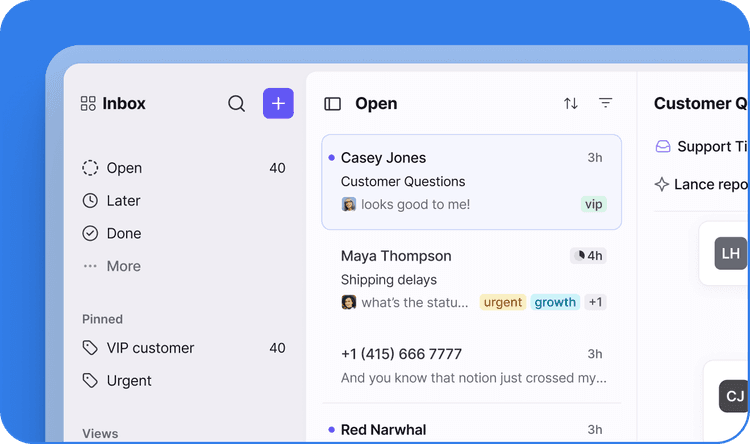
Operational CRM refers to software tools that make customer-focused work easier. It gives teams a shared system where they can collaborate cohesively to manage customer activity and track ownership of tasks.
There are three types of this software: operational CRM, analytical CRM, and collaborative CRM. In practice, most companies use all three because they serve slightly different purposes:
- Operational CRM is about doing the work.
- Analytical CRM is about learning from the work.
- Collaborative CRM is about connecting the work.
Operational CRM software is for day-to-day tasks. It updates and tracks customer information, manages handoffs, and follows up on active issues. Analytical CRM software helps leaders understand patterns in customer data through reporting, market segmentation, and performance analysis tools. Collaborative CRM software is about communication, coordinating messages and unifying organizations on customer touchpoints.
How operational CRM works
By definition, operational CRM helps customer-facing systems operate effectively. Teams use this to automate simple, repetitive tasks and organize customer data, giving them visibility into what’s happening within each account. The goal is to reduce friction for customers so teams can focus on the interactions in front of them — instead of getting tied up in the internal mechanics behind them.
Most operational CRMs support a few different workflows:
- Sales automation assigns ownership, tracks outreach, and sends follow-ups on time so existing customers and prospects aren’t left waiting.
- Marketing automation coordinates customer-facing messages and handoffs, helping teams provide timely information without manual scheduling.
- Service automation routes customer inquiries and centralizes context across interactions so customers get consistent responses between agents or departments.
In each workflow, the ultimate objective is to make every customer experience more predictable and smooth, especially when multiple teams are working on the same account.
Why operational CRM matters in B2B customer operations
Inefficient internal communication is the silent killer of good customer support. Front’s Coordination Tax study revealed that B2B teams spend almost three hours coordinating internally for every one hour they spend actively solving customer issues. Customers may not see the chaos unfolding behind the scenes, but they feel its effects.
The right customer service software lifts this operational load off the shoulders of B2B teams by giving them a shared source of reliable information. They can clearly see what’s happening, who’s responsible, and what needs to happen next.
The following examples of operational CRM features shows how transformative it can be for B2B teams:
- Document account activity, like emails, calls, and meeting notes, so teams can all see the same customer history.
- Route inbound requests to the right owner without manual triage.
- Manage cross-team follow-ups so next steps flow cleanly from sales to implementation to support.
- Track account-level commitments to keep SLAs, renewal dates, onboarding milestones, and customer expectations visible to all involved teams.
- Centralize customer context, including account details and history, in a single location so teams don’t have to engage in side conversations to get up to speed.
Other resources
- Contact management
Learn the definition of contact management, what software features to look for, and how it differs from a traditional CRM platform.
- Customer profile
Learn what a B2B customer profile is and how this account context gives teams the clarity they need to support customers throughout the relationship.
- Contact data management
Learn about contact data management and how B2B teams use software to create customer records, preserve account context, and keep conversations moving.
- Customer event tracking
Learn what customer event tracking is and how B2B teams use customer behavior and operational signals to improve conversations and decision-making.
- Customer support ticket
Learn what a customer support ticket is, how they work and the most common types, and why they matter for B2B teams when managing customer issues.
- Workflow automation
Learn what workflow automation is, how it works, and how B2B organizations use it to improve coordination, visibility, and operational efficiency.
- Customer self-service
Learn what customer self-service is, why it matters for B2B companies, and common types of self-service that boost operational efficiency.
- API integration
An API integration connects software platforms to enable two-way data sharing. Learn how API integrations work and how teams use them in B2B operations.