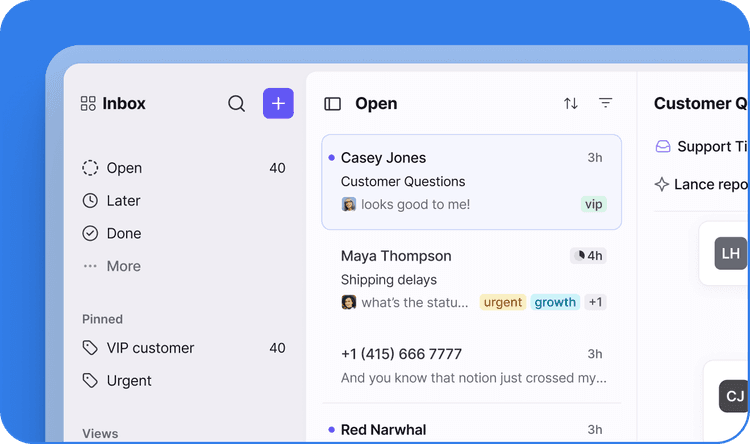



Team inbox
A team inbox is a shared workspace and collaboration tool that allows multiple people to view, route, assign, and respond to customer inquiries from a shared address. It’s particularly valuable in B2B customer operations, where different people or functions may need to access the same conversation while maintaining clear ownership and context.
The core difference between a team inbox and a personal inbox is shared access: Multiple people can access and manage a team inbox, while one individual typically manages a personal inbox. A team inbox also differs from a basic distribution list, which is a group address that simply forwards an email to a predefined collection of personal emails.
What are the benefits of a team inbox for B2B customer work?
The primary benefit of a unified inbox for team collaboration is making customer conversations visible to everyone who needs to be in the loop. Without a shared mailbox, customer communication can quickly become fragmented, with no clear sense of what needs to happen next or who’s responsible for it.
Team inboxes make this coordinated approach possible by addressing several key operational needs, including:
- Clear ownership and accountability: Assigning new conversations to the most appropriate person — whether by a teammate or an automated process — is a standard part of most customer-facing workflows. With team inboxes, everyone sees that assignment, which means there’s no ambiguity about who’s responsible for each inquiry.
- Coordinated responses: Team inboxes let multiple customer-facing teammates work together to resolve an issue without time-consuming back-and-forth messages or having to sit at the same desk. People can jump in and out of a conversation as needed, simply scrolling up if they need a refresher on where the situation stands.
- Smooth handoffs with context: Instead of each support rep forwarding email threads manually, a team inbox centralizes customer communication and context in one place. This keeps staff from having to start fresh when they take over a ticket, avoiding duplicate work and repeated questions.
Best practices to manage a team inbox effectively
A few best practices can keep team inbox management reliable as the volume of incoming inquiries and number of stakeholders grow.
- Define clear ownership standards: Assign an owner to each incoming request as soon as possible. This might be through manual intervention, a defined rotation, or automation. Establishing who owns what early on minimizes confusion and prevents conversations from languishing unresolved in the queue.
- Keep context intact: Moving inter-team discussions out of the inbox and into Slack or personal email accounts defeats the purpose of a shared workspace. Stick to the team inbox platform itself, and take advantage of tags and internal notes to make it even easier for other reps to quickly understand the full history of a conversation.
- Use status labels: Marking each conversation with a status label like “open,” “archived,” or “snoozed” makes it easier for colleagues to see what needs attention and pick up where someone else left off. It also simplifies tracking key analytics and service-level agreement targets, like resolution and response times, because the underlying data is already organized.
These breakdowns aren’t rare in B2B customer operations. Front’s Coordination Tax report revealed that almost two-thirds of companies (64%) experienced at least one customer-facing coordination failure in the previous three months, including lost context, repeated customer questions, or missed messages. Following these established best practices helps prevent these breakdowns and keeps customer conversations moving.
Other resources
- Conversation inbox
Learn what a conversation inbox is, how it works, and how B2B teams use it to coordinate customer communication and maintain shared context.
- Email inbox management
Explore email inbox management and how customer-facing teams use techniques like standardized triage and clear ownership to keep conversations moving.
- Inbox zero
Learn what inbox zero means for collaborative B2B teams, how to achieve empty inboxes, and the operational tips required to maintain visibility.
- Point of contact
Understand what a point of contact is, why it matters in B2B, and how clear ownership helps teams manage customer inquiries and follow-ups.
- Conditional logic
Understand conditional logic and how B2B customer operations teams use if/then rules to keep routing, ownership, escalations, and follow-up clear.
- Customer messaging platform
Learn what a customer messaging platform is, how it works, and the core capabilities to look for to support visibility and cross-team collaboration.
- Customer buying signals
Understand customer buying signals and how B2B teams identify purchase intent through connected customer conversations and shared account context.
- Internal knowledge base
Learn what an internal knowledge base is, how it supports B2B customer work, and what keeps shared knowledge accurate, findable, and reliable over time.