

Related terms
Omnichannel communication
Omnichannel communication describes a connected system for managing customer conversations across every touchpoint. The goal is to give internal teams shared context so they can approach every interaction with continuity and accountability.
In B2B customer operations, teams use omnichannel communication platforms to keep messages and customer history in sync and accessible to all customer-facing team members. Find out how omnichannel communication supports B2B teams, with actionable tips you can apply to maximize the benefits.
What is omnichannel communication useful for?
When organizations expand, maintaining customer relationships gets increasingly complex. Companies often adopt new customer channels, specialized teams, and more advanced systems in the process. This can create parallel streams of information that lead to disjointed conversations and lost continuity.
Front’s Coordination Tax report highlights just how widespread coordination issues are: 64%of B2B companies said they’d experienced at least one customer-facing coordination failure within the previous three months. These failures often arise when customer context is scattered across email, chat, ticketing pools, and internal systems, forcing customer support teams to piece together the full story before they can resolve the issue.
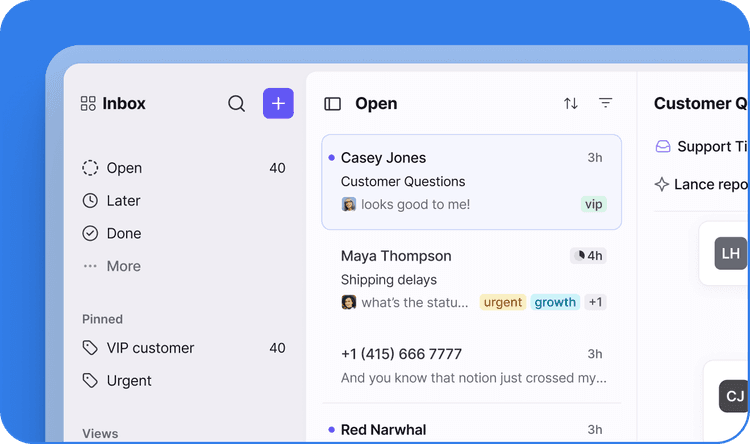
An omnichannel communication strategy reduces coordination issues by ensuring every conversation has shared information and clear ownership, supporting better collaboration and follow-through. Instead of using separate systems, teams manage touchpoints collectively in a unified conversation, so customers get a simplified experience across channels.
Best practices for omnichannel communication
As organizations scale, they can rely on a few guiding principles of omnichannel communication to keep conversations aligned.
In B2B environments, a single inquiry can touch logistics coordinators, account managers, compliance teams, and technical specialists. How well they coordinate with one another determines whether communication feels smooth or disjointed for the customer. An omnichannel approach makes that coordination easier.
The following strategies outline how organizations can sustain alignment as they grow:
- Unified conversation ownership: Assign responsibility at the conversation level rather than the channel level. This keeps teams aligned on who’s responsible for driving the next immediate action, even when the next messages arrive through different touchpoints.
- Shared operational context: Make sure customer history and internal notes are visible whenever teams communicate. When every team member can see the full picture, they avoid redundant outreach and conflicting updates.
- Coordinated workflows: Build processes that move with the conversation instead of forcing customers into rigid channels. This allows teams to escalate issues quickly and maintain continuity without switching tools or losing context.
By grounding every conversation in a shared context that’s easily accessible across teams, organizations can scale communication without confusion. Every customer interaction is anchored to a structured customer history and a clear path forward.
Other resources
- Customer service automation
See how customer service automation helps teams route work, reduce repetitive tasks, and keep ownership clear across customer conversations.
- Omnichannel customer service
Learn what omnichannel customer service means and how connecting context, ownership, and handoffs between channels helps teams deliver consistent support.
- Live chat
Learn what live chat is, explore professional B2B examples, and understand the core operational rules teams use to manage customer experiences.
- In-app messaging
Learn how in-app messaging gives B2B teams a direct way to share updates, support customers in real time, and coordinate communication across channels.
- Messaging strategy
Learn what a messaging strategy is and how it gives customer-facing teams a common foundation, keeping communication consistent across every interaction.
- Proactive customer support
Discover how proactive customer support helps B2B teams keep customer conversations moving and catch issues early for a satisfying customer experience.
- Internal knowledge base
Learn what an internal knowledge base is, how it supports B2B customer work, and what keeps shared knowledge accurate, findable, and reliable over time.
- Real-time messaging
See how real-time messaging works, how it differs from instant messaging, and why live chat features that maintain context are best for B2B communication.