

Related terms
Conversation inbox
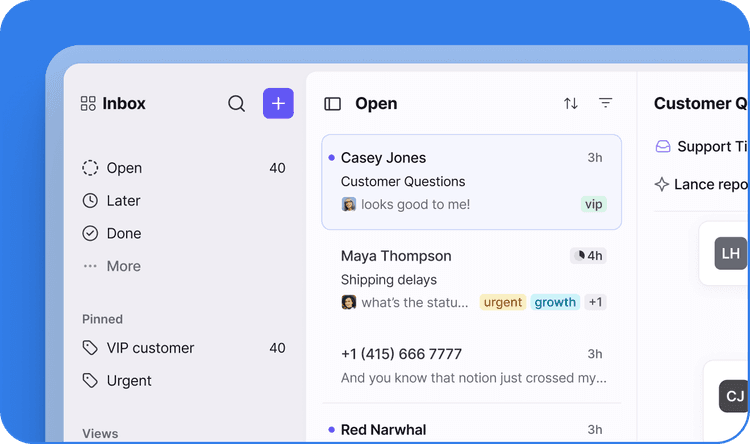
A conversation inbox is a specific type of shared inbox designed to help customer-facing teams manage customer conversations. Unlike a personal inbox or a traditional shared inbox that simply gives multiple people access to the same email address, a conversation inbox supports close collaboration across B2B teams by clarifying ownership, preserving context, and coordinating replies when multiple people need to resolve an issue.
How do conversation inboxes work in B2B customer operations?
Conversation inboxes play a role in virtually every part of the customer communication lifecycle.
- Organizing incoming conversations: Each email sent by a customer arrives in the same place. Some customer communication platforms also accept messages from other channels, such as forms and live chat conversations, creating a shared omnichannel inbox that makes it easier to offer omnichannel customer support.
- Assigning ownership: Teams have a high-level overview of the current queue and access to every new request that comes in. This makes it easier to assign each conversation to whoever’s best suited to resolve it. Everyone knows exactly who’s responsible for the next reply, and messages are less likely to fall through the cracks.
- Collaborating internally: Given that everyone’s using the same workspace, team collaboration is smoother and faster. Team members can comment, ask questions, or loop in a specialist directly inside the software instead of starting a separate internal discussion. Plus, everything happens behind the scenes — so reps can collaborate without interrupting or complicating the customer conversation.
- Preserving context: Thanks to shared access, anyone can quickly view a conversation’s complete history and context. If someone needs to make a handoff or work with a rep who has specialized knowledge, they can just share the conversation link or ID. All the relevant details are there, so there’s no need for a long back-and-forth to get the new collaborator up to speed.
- Tracking progress: Reps can verify the status of a conversation at a glance, without having to check multiple apps or ask around. Stalled conversations are easier to catch, and closed conversations are less likely to be reopened unnecessarily. This shared view also helps teams monitor key metrics, such as first-contact resolution and average response time.
Why do B2B organizations use conversation inboxes?
The case for using a unified conversation inbox comes down to several key operational benefits.
- Less busywork: Piecing together the context of an inbox chat from scattered tools is inefficient and wasteful. Using a shared conversation inbox keeps that context intact so teams can focus on solving customer problems instead of tracking down disconnected information.
- Smarter triage: Because managers and supervisors can see everything that’s going on, it’s easier to spot and prioritize urgent issues before they get lost at the bottom of the queue.
- Cleaner cross-functional handoffs: Bringing in other collaborators is quick and easy because nothing gets lost in translation. If the support team sends a prospect to the sales team or the marketing team, for example, the prospect doesn’t have to explain what they’re looking for all over again.
- Consistent communication: Having a shared record of each conversation means teams don’t have to ask customers to repeat themselves, keeping conversations focused and concise. It also keeps tone and messaging aligned, so customers don’t get warm and friendly replies from one rep only to get overly formal replies when another rep chimes in.
Other resources
- Team inbox
Learn how a team inbox keeps customer conversations moving with shared visibility, clear ownership, and reliable follow-through.
- Real-time messaging
See how real-time messaging works, how it differs from instant messaging, and why live chat features that maintain context are best for B2B communication.
- Canned response
Learn what a canned response is, when to use one, and how they help support reply faster without sacrificing customer context.
- Inbox zero
Learn what inbox zero means for collaborative B2B teams, how to achieve empty inboxes, and the operational tips required to maintain visibility.
- Talk track
Find out what a talk track is, what makes one effective, and how talk tracks foster structured, consistent customer conversations in B2B support.
- In-app messaging
Learn how in-app messaging gives B2B teams a direct way to share updates, support customers in real time, and coordinate communication across channels.
- Omnichannel communication
Learn how omnichannel communication helps B2B teams keep customer conversations connected as work moves across channels, teams, and systems.
- Internal knowledge base
Learn what an internal knowledge base is, how it supports B2B customer work, and what keeps shared knowledge accurate, findable, and reliable over time.