

Live chat
In B2B customer service, fast, precise communication isn’t a nice-to-have; it’s what keeps operations moving and customers feeling reassured. As digital touchpoints multiply, live chat remains a critical channel that customers rely on for quick answers, workflow guidance, and human support when needed.
Live chat complements both human-led and automated support systems, giving operational teams a responsive, context-rich way to engage customers during key moments.
What is live chat?
Live chat is an agent-led communication channel typically embedded within a product, dashboard, or service portal. It enables real-time conversation between a customer and a trained support or customer success professional, acting as a crucial layer of B2B customer operations.
It’s important to define live chat clearly and distinguish it from other customer support channels.
Unlike asynchronous messaging systems or AI chatbots, live chat is a synchronous, text-based channel that relies on human expertise. Agents actively interpret context, make decisions, and guide customers through complex workflows in the moment. Real-time live chat enables thoughtful support tailored to nuanced business needs.
While chatbots are useful for routing inquiries, collecting basic information, and handling routine requests, they operate based on predefined logic and struggle with exceptions or issues that need cross-functional coordination. That’s where human-led live chat becomes essential.
Live chat examples in B2B customer operations
Here are three examples of what live chat looks like in B2B environments with layered, time-sensitive workflows.
Logistics exception management
A customer notices a delay in a high-value shipment. They use live chat in their logistics platform to connect with an operations specialist who can access internal systems, reroute freight, and coordinate with carriers in real time. This isn’t a simple status update request — human judgment is necessary across multiple touchpoints to resolve the issue.
SaaS onboarding and implementation support
During onboarding, a customer’s technical team encounters an API integration issue. Through live chat embedded in the admin dashboard, they reach a solutions engineer who reviews logs and identifies configuration gaps before walking them through the fix in minutes. This prevents delays in product adoption and avoids long email threads or phone calls.
Financial services account operations
An enterprise client needs to update permissions across multiple sub-accounts after an internal restructure. A live chat agent works alongside compliance and account management teams to validate requests and execute changes securely. The workflow is sensitive and requires layered authorization that automation alone can’t handle.
Live chat best practices for professional teams
Implementing live chat effectively means designing a controlled, high-context customer experience. The most successful teams treat live chat as an extension of their internal workflows, where every conversation has clear ownership and moves efficiently toward resolution.
Here are some live chat tips that support strong operational performance:
- Collect context before the conversation begins: Use pre-chat forms and system integrations to capture account details, intent, and relevant metadata before an agent joins. This allows teams to enter conversations already informed and ready to assist.
- Establish clear ownership of conversations: Assign each chat to a specific team or agent to ensure accountability throughout the interaction. Avoid situations where multiple agents respond without coordination.
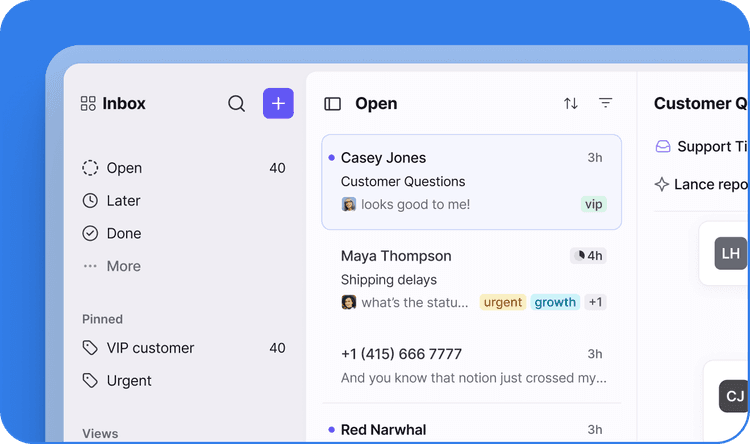
- Centralize communication across channels: Integrate live chat into a shared workspace alongside email and internal messaging. When agents can easily access past interactions, they can maintain continuity and respond with helpful context.
- Enable controlled escalation paths: Build workflows that allow agents to involve specialists or escalate issues without losing context. This keeps conversations cohesive and moving confidently toward resolution.
Other resources
- Chatbot vs. conversational AI
Understand the difference between a chatbot versus conversational AI, and learn when each option works best for support teams managing customer needs.
- Conversational AI
Learn what conversational AI is, how it works, and how businesses use it to automate customer communication and support workflows.
- AI chatbot
Learn what an AI chatbot is, how they function, and how businesses use conversational AI to automate customer support and communication workflows.
- AI knowledge base
Learn what an AI knowledge base is and how organizations use it to organize information for easy access by customers, internal teams, and chatbots.
- B2B customer experience
Understand B2B customer experiences, what makes them different from B2C experiences, and how teams balance digital convenience with human judgment.
- Intent classification
Learn what intent classification is and how it helps B2B support teams route customer conversations, preserve context, and escalate with clarity.
- Human-in-the-loop AI
Learn what human-in-the-loop AI is, the technology behind it, its main use cases, and the benefits of human-led AI in customer service.
- Email etiquette
Learn the core rules of email etiquette, why they matter, and how they help teams keep customer conversations clear, consistent, and easy to act on.