

Related terms
Omnichannel customer service
Omnichannel customer service is a customer-centric approach that unifies context, conversation history, and ownership across all available support channels. It’s not just about giving customers more places to reach you, but also building continuity.
With an omnichannel strategy, a conversation might begin in live chat, shift to SMS, and end on a phone call — yet all the details carry forward so customers never have to repeat themselves when switching channels.
An example of an omnichannel customer service use case is a financial services provider verifying a client’s identity in one channel before continuing a sensitive conversation over a secure messaging platform.
Omnichannel vs. multichannel customer service
These approaches may look similar on the surface, but they function very differently. Here’s how they compare across key characteristics:
Why omnichannel customer service matters
The clearest benefit of omnichannel customer service is the continuous, contextual throughline it creates for every support request — no matter how many communication channels a conversation moves through.
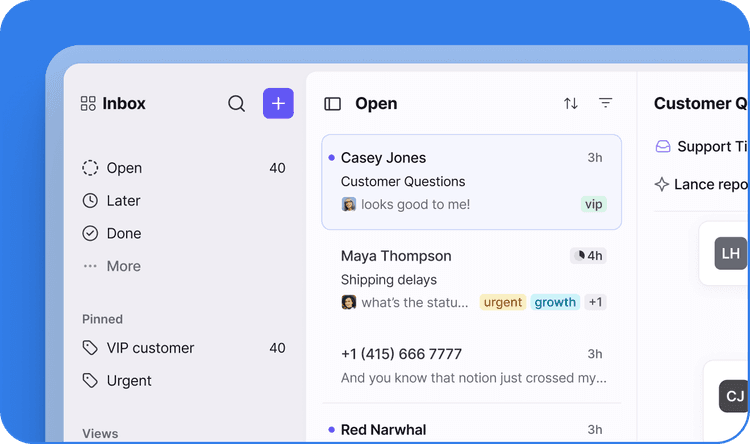
When emails, social media chats, self-service interactions, and chatbot conversations live in a single system rather than isolated silos, the experience feels consistent, personalized, and effortless. Support teams benefit, too: With a shared view of interactions, agents can continue the conversation without backtracking, even after switching channels.
This continuity leads to higher customer satisfaction by enabling faster, more accurate responses. That’s because agents don’t have to patch together a fragmented conversation history to understand the context before addressing a request.
Omnichannel customer support becomes even more valuable when paired with omnichannel analytics. Teams can see the entire customer journey, not just isolated touchpoints, making it easier to spot where conversations stall and address the friction that slows customers down.
How to achieve omnichannel customer service
A successful omnichannel strategy takes more than channel coverage. Follow these best practices:
- Use technology wisely: Look for omnichannel solutions that combine automation with strong analytics capabilities. Centralized data lets teams personalize interactions to create a consistent, tailored customer experience. AI chatbots keep conversations going after business hours, ready to be picked up again by human agents in the morning.
- Preserve ownership across handoffs: Ownership should transfer alongside context and conversation history. When every handoff is logged and visible, accountability stays intact and agents don’t have to scramble to figure out who owns what as conversations move between channels.
- Be data-driven: Track cross-channel analytics — response time, resolution time, customer effort, and channel usage — to identify friction points and improve both overall support quality and operational efficiency.
Other resources
- Omnichannel communication
Learn how omnichannel communication helps B2B teams keep customer conversations connected as work moves across channels, teams, and systems.
- Customer service operations
Learn how customer service operations align B2B teams, workflows, and customer conversations so service stays consistent and reliable.
- Customer effort score
Learn how to measure customer effort score (CES) and how B2B support teams can reduce effort through clearer context, routing, and ownership.
- AI routing
Learn what AI routing means for support teams. Find out how it improves routing accuracy, context transfer, and ownership across conversations.
- Team inbox
Learn how a team inbox keeps customer conversations moving with shared visibility, clear ownership, and reliable follow-through.
- Canned response
Learn what a canned response is, when to use one, and how they help support reply faster without sacrificing customer context.
- Customer support ticketing system
Learn what customer support ticketing systems are, how they fit into B2B customer service, and what sets them apart from customer operations platforms.
- Service-level agreement
Learn what an SLA is and how it helps B2B support teams set measurable expectations for key metrics, like response, resolution, and service quality.