

Related terms
Customer support
For B2B companies, customer support quality directly affects critical business objectives like retention, revenue stability, and growth. When customers receive consistently valuable, proactive support, they tend to stick around and recommend you to their peers. Understanding the basic definition of customer support — and how to do it well — is a good place to start.
What is customer support?
Customer support is the collection of tools and teams organizations use to manage customer inquiries and address their needs. Everyday customer support examples include troubleshooting technical issues, answering questions about billing, and fielding complaints.
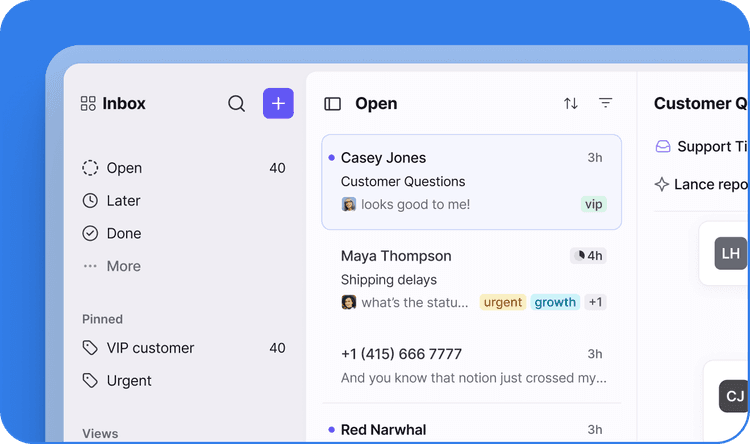
In B2B contexts, customer support often means coordinating across teams and systems to resolve issues quickly and maintain service quality. Without shared visibility into open tickets and clear ownership, even a well-staffed support crew can have trouble giving advice consistently at scale.
So, what’s the difference between customer support versus customer service? While these terms are closely related and often used interchangeably, they have different scopes. Customer support covers a single (very important) aspect of the overall customer experience: solving problems so everyone can get back to work.
Customer service has a wider, more operational reach, focusing not just on troubleshooting but on keeping the customer experience smooth across teams and stages. That means defining escalation paths and ownership rules more so than following those paths and rules to solve day-to-day product issues.
Why customer support matters in B2B organizations
Customer support directly affects satisfaction by making sure people get reliable help when they need it. In turn, strong satisfaction leads to improved customer retention through higher loyalty. This supports stable, long-term revenue as customer relationships cement and mature.
Prioritizing support also has benefits that aren’t directly related to your finances. For one, support interactions are a gold mine of customer feedback you can use to spot and address usability issues and unmet needs. Plus, a reputation for great support can help your company stand out when prospective customers are weighing their options.
Unlike retail stores, B2B support inquiries often require multiple support team members and customer conversations for full resolution. For example, taking care of a complicated billing discrepancy might involve not just support, but also finance and sales, each with their own piece of the puzzle. For a smooth and complete resolution, teams need visibility into the full conversation history, clear ownership of who does what, and tight coordination to support efficiency and reduce rework.
Customer support best practices
Best practices help support teams resolve issues efficiently in line with customer needs and expectations. Here are some customer support best practices:
- Invest in AI: AI support chatbots can’t handle every issue — especially in complex B2B environments — but they can significantly lighten the load for human support specialists. While AI and automation take care of routine inquiries, your team can spend more time on more complex tasks.
- Have empathy: Support interactions often happen when something has gone wrong. Keeping the customer’s situation and potential anxiety top of mind helps support specialists respond with the patience and care that keeps a stressful moment from snowballing into a costly and time-consuming escalation (or even a lost customer).
- Offer a variety of support channels: Customers like to know they can get in touch through their preferred channels. Someone who wants a lot of hand-holding might prefer a real-time text conversation, while someone else who’s more hands-on might have a better experience with a self-service knowledge base or even a simple FAQ doc.
Other resources
- First contact resolution
Learn what first contact resolution is, how to calculate it, why it matters, and best practices for improving customer service performance.
- Proactive customer support
Discover how proactive customer support helps B2B teams keep customer conversations moving and catch issues early for a satisfying customer experience.
- Customer self-service
Learn what customer self-service is, why it matters for B2B companies, and common types of self-service that boost operational efficiency.
- Customer feedback
Understand what customer feedback is, why it matters, and how to use it to identify recurring issues and improve the customer experience.
- Escalation matrix
See how an escalation matrix helps B2B teams navigate complex issues by defining when to escalate and who owns the next step, keeping handoffs on track.
- Customer support ticket
Learn what a customer support ticket is, how they work and the most common types, and why they matter for B2B teams when managing customer issues.
- Email cadence
Learn the meaning of email cadence, why it matters, and best practices that help B2B teams communicate consistently and nurture customer relationships.
- SLA breach
Learn what an SLA breach is, why it happens, and how B2B teams can catch potential issues before they escalate into full violations.