


Related terms
Customer feedback
Customer feedback encompasses any input customers provide to a company about their experience with its products and services. In B2B relationships, this feedback often comes from ongoing conversations — such as support tickets and renewal discussions, where customers reveal frustrations and expectations — in addition to formal surveys.
Why is collecting customer feedback important in B2B?
Customer feedback is what anchors B2B decision-making in reality. The importance of customer feedback shows up in three primary areas:
- Understanding needs and expectations: Listening to feedback either validates your assumptions about what customers want or reveals gaps in your understanding. With real customer insights to analyze, you shift from guesswork to evidence-based decision-making. And when teams are aligned internally around what customers actually need, it leads to more coordinated customer relationship management.
- Spotting recurring issues: Customer feedback helps teams identify and prioritize issues that come up repeatedly, from ongoing service gaps to handoff or process friction that slows resolution. It also surfaces account risks that rarely show up in formal surveys, like an upcoming budget cut. These frustrations become opportunities to fix problems proactively and show customers you’re paying attention.
- Enhancing the experience over time: Acting on feedback to improve systems and offerings promotes customer loyalty and reduces churn. Happy customers tend to stick around, especially when they see improvements based on their input.
Common sources of customer feedback
There are many ways to collect customer feedback besides formal surveys. It often shows up naturally in everyday interactions and channels that capture the voice of the customer, including:
- Social media: Testimonials and success stories shared on social media provide proof that there are real customers standing behind your offerings.
- Reviews: Product or service reviews on third-party websites capture unguarded, unprompted feedback that’s often more honest than directly solicited feedback.
- Support interactions: Tickets and conversations give teams an organic way to root out recurring issues and gather qualitative insights on the customer experience.
- Account check-ins and renewals: Discussions with account teams might uncover actionable insights that don’t appear in formal channels.
How to collect and use customer feedback
Here’s how to use customer feedback and turn insights into action:
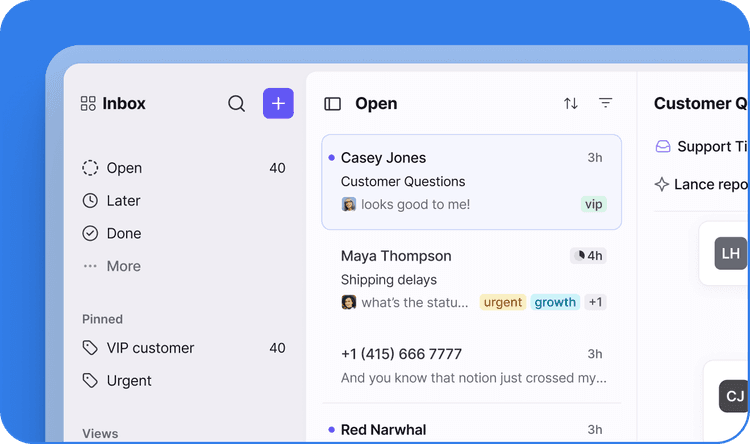
- Centralize feedback: When customer feedback is scattered across individual inboxes and support tickets, it’s easy to lose and difficult to integrate. Collecting everything in one place helps teams catch valuable ideas and see each comment in its full context.
- Close the loop: If you don’t respond to feedback in a timely manner, customers may end up feeling ignored. Acknowledge every piece of feedback and let customers know how you’re acting on it. Even a brief follow-up shows you’re listening.
- Conduct customer feedback surveys: Surveys like customer effort score, customer satisfaction score, and Net Promoter Score aren’t the only way to gather feedback, but they’re still practical for gauging sentiment and identifying areas for improvement. Quantitative ratings and benchmarks show how customers feel and how that sentiment shifts over time, while open-ended, qualitative questions reveal why they feel that way. Use a combination of these surveys to get a complete picture of the customer experience.
Other resources
- Voice of the customer
Learn what voice of the customer means, where VoC data comes from, and how teams use feedback to improve service quality and customer operations.
- Customer satisfaction survey
Learn what a customer satisfaction survey is, the core survey types teams use to track account health, and how feedback drives retention in B2B.
- What is NPS?
Learn why Net Promoter Score is a key customer experience metric. Explore what NPS is, how it works, and why B2B teams use it to improve retention.
- Customer satisfaction score
Learn what CSAT is, how organizations measure customer satisfaction through post-interaction surveys, and how to use the insights to improve.
- Customer health score
Learn what a customer health score is and how B2B teams use operational signals to identify customer risk and prioritize proactive engagement.
- Customer effort score
Learn how to measure customer effort score (CES) and how B2B support teams can reduce effort through clearer context, routing, and ownership.
- Sentiment analysis
Learn what sentiment analysis is, how it works, and how organizations use it to calibrate support operations and improve the customer experience.
- Customer journey map
Learn what a customer journey map is and the stages it includes. Create your own to uncover pain points and improve customer experience.