

Related terms
Help desk software
Effective help desk software gives support teams the tools and visibility they need to respond to customers quickly and efficiently.
What is help desk software?
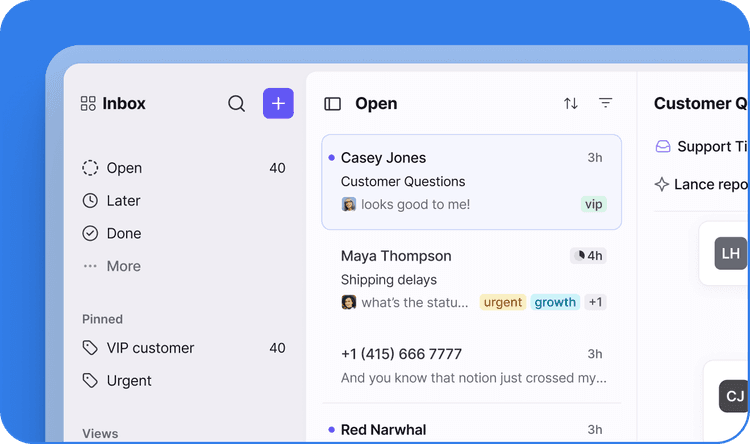
Help desk software is a platform that simplifies support ticket management by centralizing requests from every channel and facilitating the steps toward resolution.
Today’s help desk systems aren’t limited to ticket management. Beyond that, they help B2B teams maintain full visibility into conversations, ownership, context, and workflows for maximum oversight, ensuring nothing gets lost during handoffs.
Core features and benefits of help desk software
Customer support can be difficult. According to Front’s Coordination Tax Report, the average B2B company spends nearly three hours coordinating for every hour spent actually working on customer issues.
Help desk systems exist to rein in that inefficiency by linking context with clear ownership and visible workflows, allowing support teams to focus on customer satisfaction instead of internal back-and-forth communication.
These platforms support a variety of use cases. They organize incoming requests, keep tickets moving toward resolution, and make sure the right context is always visible. The result: Teams spend less time hunting down information and more time helping customers.
Here are some of the most valuable features of high-quality help desk systems:
- Conversation and queue management: A cluttered inbox multiplies your team’s coordination burden. Queue management unifies customer inquiries from every channel — live chat, email, web forms, and in-app messaging — in a single feed so support staff always know who they’re talking to and what the problem is.
- Internal collaboration and ownership: Help desk software assigns clear responsibility for each request, ensuring tickets never get lost. Features like status tracking and internal notes enable teams to loop in colleagues without losing context or creating parallel conversations.
- Workflow automation and AI-powered assistance: Modern help desk systems go beyond auto-replies and canned responses. Using rule-based automation and AI, teams can route tickets, triage issues, and surface the right context. AI also suggests appropriate responses, helping human agents reply quickly and accurately.
Which is the best help desk software for customer support?
The best help desk software is the one that best matches your organization’s operational needs.
Pricing and features matter, but if your chosen help desk application doesn’t support your communication channels, workflows, and customer relationship management (CRM) integrations, it quickly becomes a source of frustration. Verify that the software offers the level of automation you need and can handle the complexity of long-term support.
Here are examples of the top help desk software on the market today:
- Front: Front is built specifically for B2B customer operations. By connecting teams and customer communication while anchoring every interaction in deep context, it provides expansive visibility across the customer lifecycle. Customizable, AI-powered workflows improve as context grows, and because everything is centralized, data and conversations stay in sync by default.
- Zendesk: Larger teams with broad ticketing needs find Zendesk to be a strong choice. It consolidates email, chat, phone, and social channels into one ticketing system, providing a high-level view of support operations. Zendesk is also known for its knowledge base tools, which enable self-service portals that help reduce ticket volume. The tradeoff is complexity: Setup can take several months and require a dedicated IT team.
- Freshdesk: Freshdesk is popular with teams that need heavy automation capabilities. Its intuitive interface allows users to automate workflows (like assigning tickets to the most appropriate support staff and sending follow-up emails), but it can feel limited for teams that depend on deeper internal collaboration.
If none of these options fit, you might look into other popular solutions like Intercom, Zoho Desk, HubSpot, ServiceDesk Plus, Freshservice, and Salesforce Service Cloud.
Other resources
- Email ticketing system
Learn what an email ticketing system is, how it works, and the features organizations should look for to manage customer communication more efficiently.
- Customer messaging platform
Learn what a customer messaging platform is, how it works, and the core capabilities to look for to support visibility and cross-team collaboration.
- Contact management
Learn the definition of contact management, what software features to look for, and how it differs from a traditional CRM platform.
- Customer support ticketing system
Learn what customer support ticketing systems are, how they fit into B2B customer service, and what sets them apart from customer operations platforms.
- Real-time messaging
See how real-time messaging works, how it differs from instant messaging, and why live chat features that maintain context are best for B2B communication.
- Team inbox
Learn how a team inbox keeps customer conversations moving with shared visibility, clear ownership, and reliable follow-through.
- Email inbox management
Explore email inbox management and how customer-facing teams use techniques like standardized triage and clear ownership to keep conversations moving.
- Omnichannel customer service
Learn what omnichannel customer service means and how connecting context, ownership, and handoffs between channels helps teams deliver consistent support.