

Related terms
Customer support ticket
Without a ticketing system in place, teams handling a high volume of customer inquiries can get overwhelmed fast. By documenting queries, tickets give representatives a way to track and resolve customer needs efficiently without getting lost.
What is a customer support ticket?
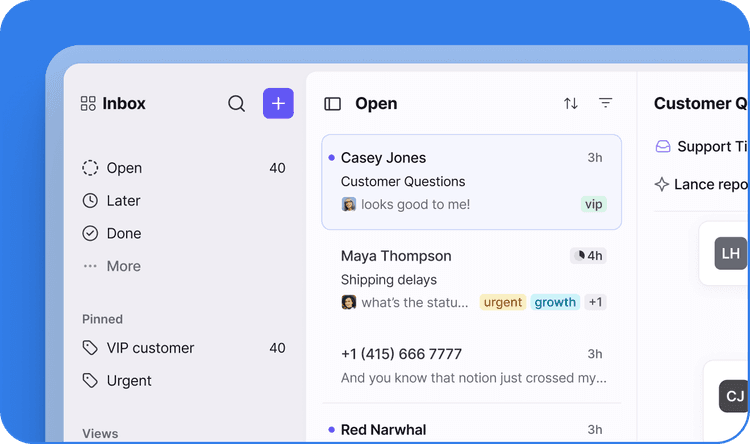
A customer support ticket is a record created when a customer submits a request for support or help through omnichannel inputs, like web forms, email threads, or phone calls.
Ticketing systems document every query and promote visibility across support teams. When everyone has access to the same tickets and knows who owns them, collaborative workflows are easier to coordinate, handoffs are smoother, and issues are less likely to languish in the queue.
In a B2B context, support tickets carry extra weight because they create a paper trail of customer interactions and relationships. Companies can draw on that history to uncover patterns, improve processes, and strengthen partnerships.
How does a customer support ticket work?
The customer support ticket lifecycle has six core stages:
- Query submission: A customer sends in a query through a supported channel.
- Ticket creation: A support team member or a software ticketing system for customer service creates a ticket with a unique ID and problem description.
- Categorization and triage: The ticket gets categorized and prioritized by urgency, either by hand or via help desk software automation based on preset rules.
- Assignment: A support rep or ticket management solution assigns the ticket to the appropriate team member or department.
- Status tracking: The ticket management system or support team tracks the status of the resolution, as well as any interactions with the customer.
- Resolution: Once the relevant team resolves the issue, the system closes the ticket. At this stage, asking the customer for feedback is a best practice for continuously improving the customer experience.
Common customer support ticket types
Support tickets fall into a variety of categories based on the nature and urgency of the request. These are the most common:
- Service requests: These tickets cover simple everyday requests, such as resetting forgotten passwords or updating user permissions.
- Incidents: When an incident ticket shows up in the log, it indicates an urgent, unplanned disruption to a system or regular service. Acceptable resolution times are often covered in a service-level agreement.
- Change requests: These document requests for modifications to systems or services, such as hardware updates or software deployments. They help teams coordinate and track risk assessments and approvals before going live.
- Bug reports: Bug reports point out software issues affecting a customer’s ability to use a product or service effectively. The ticket may include screenshots or other attachments to illustrate the problem.
- Account inquiries: Issues related to billing, subscriptions, or account details like contracts or invoices usually fall under account inquiries.
Beyond day-to-day support, ticket data provides valuable insights into customer needs and recurring challenges. And this ultimately enables organizations to improve service quality and build stronger customer relationships over time.
Other resources
- Ticket triage
See how ticket triage helps support teams classify requests, prioritize urgent issues, assign ownership, and keep customer work moving with clear context.
- Customer support
Learn what customer support is, why it matters, and the best practices B2B teams use to deliver consistent service and resolve customer issues.
- Customer support ticketing system
Learn what customer support ticketing systems are, how they fit into B2B customer service, and what sets them apart from customer operations platforms.
- Ticket escalation
Effective ticket escalation means preserving ownership and context through every handoff. Find out how B2B teams create clear escalation paths.
- Customer self-service
Learn what customer self-service is, why it matters for B2B companies, and common types of self-service that boost operational efficiency.
- Operational customer relationship management
Learn what operational CRM is, how it differs from other CRM types, and how businesses use it to support day-to-day customer work.
- Automated response
Learn what automated responses are and how they work. Find out when B2B teams should rely on auto-responses and when human expertise should take the lead.
- Proactive customer support
Discover how proactive customer support helps B2B teams keep customer conversations moving and catch issues early for a satisfying customer experience.