



Build customer service workflows that hold up under B2B volume, automate repeatable tasks, and keep work connected to every conversation.
Customer service workflows can look simple on paper: A request comes in, someone resolves it, and the customer gets an answer.
But as volume grows, that simple path turns into a web of handoffs across sales, product, and customer operations teams. Responses get lost in the shuffle between systems, and no one’s left holding ownership of the follow-up.
Unclear workflows carry a real cost. On average, companies spend three hours hunting down the right team to handle a fix that’ll only take one hour. Issues could get solved four times faster if teams weren’t burning that time finding owners, chasing context, and routing work to the right place.
Strong workflows slash that coordination time. Ownership is clear from the first message, teams spend their time solving instead of searching, and customers stop waiting on answers that should’ve taken minutes.
This guide breaks down how to design and build strong workflows that keep your team connected.
Customer service workflows behind the scenes
A customer service workflow is a structured, repeatable sequence of steps that a support team follows to resolve customer requests. Each task, including data routing, ticket assignment, and escalation, gets teams closer to solving customer problems.
Users experience this workflow as the customer journey. Their broader impressions across touchpoints determine whether or not this process feels like a success.
Building blocks that keep work moving at B2B scale
A reliable customer service workflow runs on clear rules that tell teams exactly what happens next. Front’s support approach centers on three fundamentals: clear ownership, defined priority, and service-level agreements (SLAs). That’s what makes each rule in the workflow straightforward and repeatable, not case-by-case guesswork.
Here’s what every customer service process is built on.
What starts the workflow?
First, decide what events trigger the support sequence, like a ticket from a high-value enterprise customer or zero user logins over a 30-day window.
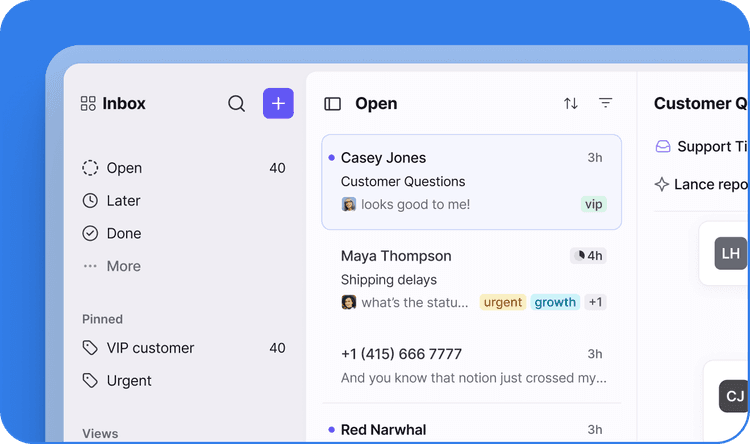
Then, build the tags and categories that route work onto the right path from the moment it arrives. Tag the enterprise customer as VIP so they skip the general queue entirely. Flag the inactive customer internally, so an automated risk review kicks off without anyone having to notice the gap manually.
Who owns the next step?
Ownership and routing determine who’s responsible for moving the request forward. But more importantly, they clarify the next step for both reps and customers.
That’s why your first response matters the most. It should answer the immediate question, anticipate likely follow-up needs, and preserve context another teammate would need if the conversation is reassigned.
When does the workflow need escalation or SLA handling?
One of the most common customer service workflow bottlenecks is escalating too early or too late. Escalate too early, and you waste time on a simple problem that could have been solved without help. Too late, and you risk longer delays while waiting for higher-level attention. Both issues leave customers frustrated since they’re stuck waiting for a response.
The fix: Set expectations before anyone’s staring down an actual ticket. Who gets priority, and on what kind of request? What happens the moment your team misses an SLA deadline?
Creating a clear roadmap for handling escalations and SLAs eliminates friction down the road, even when requests are complex.
How does the team know the workflow was a success?
Front’s Coordination Tax Report revealed that only 5% of companies have total insight into how work moves, from handoffs to resolution.
Tracking resolution signals and clear measurement points tells you whether your team is resolving requests quickly or wasting time on coordination. Once you can see where the slowdown lives, fixing it is the easy part.
3 customer service workflow examples
Coordination eats time that should go to actually solving the problem. Here’s what it looks like when the workflow is built intentionally instead of assembled ad hoc.
1. Email support workflow
Email support workflows start when a support request lands in your inbox. The system determines whether it needs to be a ticket. A simple question, for example, doesn’t have to be a ticket since teams can resolve it with a template.
If the issue requires a closer look, teams or platforms send a reply with a ticket number and expected response window based on account tier. Meanwhile, they also scan the email for keywords, such as billing, order update, or contract type. Reps assign priority and routing rules based on these categories.
Once the ticket has proper metadata, a specific owner, like a Tier-1 Support Lead or Billing Specialist, takes over. They review historical account data against the current ticket context to understand what support the customer needs.
If it calls for input from another team, that coordination happens internally, so the customer-facing thread stays clean instead of turning into a back-and-forth. The owner drafts a context-aware solution, or asks for whatever’s missing.
Once the customer confirms the fix actually solved it, the owner closes the ticket and asks for feedback.
2. Ticket escalation workflow
Sometimes, the frontline rep genuinely can’t solve it.
When that happens, the ticket has to move from initial intake (Tier-1) to a specialized tier or management. This action triggers the ticket escalation workflow so high-touch issues still get fast resolution without losing context.
The workflow determines whether the escalation is hierarchical (a manager) or functional (engineering, billing, etc.). Either way, the customer sees one continuous owner because full context and account notes travel with the case instead of getting left behind.
Meanwhile, the new owner sends status checkpoints, applies the fix, and confirms the solution works with the customer. After the ticket closes, the owner reviews to see why it escalated in the first place.
3. Customer feedback workflow
Feedback workflows start after resolutions or follow-ups. Customers receive automated surveys that capture the raw text, metadata, and sentiment.
Support leads or automated rules analyze the feedback against urgency and category. Next, the responsible department investigates the root cause and plans a solution. When the fix is in place, the account manager or support lead contacts the customer to explain what changed to close the feedback loop.
Where customer service workflow automation helps most
When customer service automation works alongside human judgment, service quality thrives. But that’s only when it’s applied to the right tasks; get that wrong, and customers feel unheard, especially on critical concerns.
Tasks where AI for customer service workflow automation provide the most value are:
Handling repetitive tasks: Repeatable decisions like order status updates often make up the highest number in ticket queues. Automating them with AI-assisted replies is a win-win situation. Customers instantly get answers, and reps have more time to focus on problems that actually need their expertise.
Assigning ownership: AI reviews customer data like account tier and contract value to route incoming tickets to the right team. This removes manual triage delays while ensuring continuous, context-aware support.
Sending follow-up reminders: Automation sends time-based or behavioral follow-up reminders to owners. It also emails customers when tickets stall, minimizing missed communication and SLA breaches.
Cisco Meraki, an enterprise IT company specializing in security and communications solutions, is a great example of deploying human-led automation. Their 16-person Sales Support team serves more than 600 reps, and the old workflow couldn’t handle all the emails siloed in personal inboxes. Missing one message slowed down the sales cycle, so they needed a solution to give the right people more visibility. The team used Front to flag unanswered messages as “urgent” after 15 minutes and apply tags to track request trends. This automation saves the team hours and gives leaders more visibility into which questions are most common.
How Front automates customer service workflow management
Without clear steps, teams spend hours manually deciding who handles every request. Instead of solving urgent tickets, they’re parsing through emails and chat logs.
Every step in a strong customer service workflow should be obvious, to reps and customers alike. That’s what Front is built to be: the customer operations platform that keeps B2B teams connected across every tool and conversation.
Front Workflow Automation keeps processes moving without extra work, whether you need to stick to your SLAs better or route messages to the right person on the first try. Reps resolve issues faster, and customers spend less time tracking down answers.
Explore Front Workflow Automation to keep every conversation and workflow connected.